



Tetrapeptide-6: properties, uses, pros, cons, safety
Tetrapeptide-6 – a synthetic 3–amino acid peptide (oligopeptide) used as a “skin conditioning” cosmetic active
Synonyms: tetrapeptide 6 (spelling variant), tetrapeptidic peptide (descriptive usage)
INCI / Functions: skin conditioning
Definition
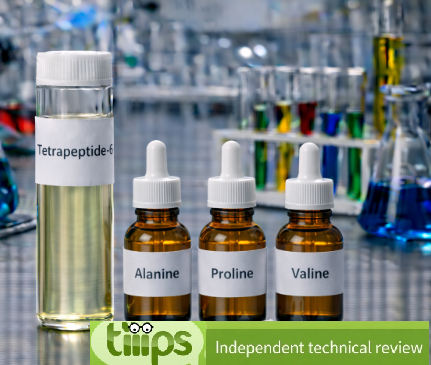
Tetrapeptide-6 is an oligopeptide (short amino-acid chain), a synthetic protein composed of amino acids joined together including alanine, proline and valine, classified in cosmetics as an ingredient with a skin conditioning function. In practice, it belongs to the family of “cosmetic peptides” used to support the perceived quality of the skin (appearance, comfort feel, and overall “good skin condition”), often within active complexes where the peptide is combined with other functional components.
Peptides, natural and synthetic, have the ability to activate an immunomodulatory action by interacting with the cells of the immune system. (Werner GH. Natural and synthetic peptides (other than neuropeptides) endowed with immunomodulating activities. Immunol Lett. 1987 Dec;16(3-4):363-70. doi: 10.1016/0165-2478(87)90170-2.)
From a formulation standpoint, the rationale for using tetrapeptides is typically linked to:
good compatibility with aqueous systems (depending on commercial form and carrier);
use at low percentages, where performance is more connected to correct delivery and stability than to the “mass” of active;
the need to control the formulation context (pH, preservatives, electrolytes, interactions with polymers) to avoid loss of efficacy or instability.
Main uses
Food.
It is not a typical ingredient for food use. Use is mainly technical/cosmetic.
Cosmetics.
It is used primarily in skincare products (serums, creams, lotions, targeted treatments) positioned around improving the appearance of the skin and supporting overall “good skin condition.” In practical terms, it is commonly found in:
multi-active anti-age/anti-wrinkle formulas (in synergy with humectants, antioxidants, film formers, and delivery systems);
products for stressed or dehydrated skin, where the objective is a more uniform and comfortable feel;
cosmetic routines where gradual improvement of the overall look is targeted (sensory and instrumental testing remains decisive for claim strategy).
INCI Functions
Skin conditioning agent. It is the mainstay of topical skin treatment as it has the function of restoring, increasing or improving skin tolerance to external factors, including melanocyte tolerance. The most important function of the conditioning agent is to prevent skin dehydration, but the subject is rather complex and involves emollients and humectants that can be added in the formulation.
Identification data and specifications
| Characteristic | Value |
|---|---|
| INCI name | Tetrapeptide-6 |
| INCI function | skin conditioning |
| Origin (classification) | synthetic (as reported in cosmetic databases) |
| Molecular formula (indicative) | C16H29N5O4 |
| Molar mass (indicative) | 355.43 g/mol |
| CAS number | not always uniquely declared in public databases for this entry; verify on the supplier’s SDS/CoA |
| EC/EINECS number | not always reported/uniquely mapped; verify on the supplier’s SDS/CoA |
| Useful alternative identifier | UNII (GSRS): C70D7B74QF |
| Typical commercial form | powder or solution in a carrier (glycerin/propanediol/water or similar), grade-dependent |
Chemical-physical properties (indicative)
| Characteristic | Value | Note |
|---|---|---|
| Chemical nature | peptide (oligopeptide) | more “formulation-sensitive” than reactive |
| Solubility | variable (grade/carrier) | often supplied already in solution for easier dosing |
| pH sensitivity | moderate | avoid pH extremes unless supported by supplier data |
| Stability in formula | system-dependent | preservatives, metals, electrolytes, and packaging can have an impact |
Functional role and practical mechanism
| Characteristic | What it does in formula | Technical note |
|---|---|---|
| Skin conditioning | contributes to keeping skin in “good condition” | regulatory/descriptive function; performance is formula-dependent |
| Sensory/aesthetic support | may improve comfort feel and perceived uniformity | often within complexes with other actives and delivery systems |
Formulation compatibility
Tetrapeptide-6, like many cosmetic peptides, requires attention to three operational areas:
pH and chemical environment.
In general, it is prudent to work within common cosmetic pH intervals compatible with the preservative system, avoiding overly acidic or overly basic conditions unless validated. Some peptides can show reduced performance or instability in the presence of certain preservatives/solvents or under prolonged thermal stress.
Interactions with polymers and salts.
The presence of electrolytes or strongly ionic polymers can change the micro-distribution of the active (adsorption, “sequestration” within a gel network, changes in cosmetic bioavailability). For “sensitive” or highly structured formulas, targeted stability control is recommended (viscosity, haze, separations).
Commercial form and order of addition.
Many peptides are supplied in solution (for example in glycerin/propanediol). Adding them typically in the cool-down phase or, in any case, below moderate temperatures with adequate mixing reduces degradation risk and supports lot-to-lot repeatability.
Use guidelines (indicative)
| Application | Typical range | Technical note |
|---|---|---|
| Face serums and creams (leave-on) | 0.01–0.50% | actual range depends on the commercial solution assay and claim target |
| Eye contour/targeted treatments | 0.01–0.30% | verify tolerability and compatibility with fragrance/solvents |
| Lightweight lotions/fluid emulsions | 0.01–0.20% | watch stability in highly electrolytic systems |
| Rinse-off | possible but less common | perceived efficacy often lower than leave-on |
Quality, grades, and specifications
| Characteristic | What to check |
|---|---|
| Identity | INCI alignment, documentation (SDS/CoA), possible UNII, and traceability |
| Assay/active level | true peptide concentration (especially if supplied in solution) |
| Impurities | synthesis residues, solvents, salts; declared limits |
| Microbiology | especially for aqueous solutions or multi-use carriers |
| Stability | compatibility with preservatives, fragrance, pH, and thermal stress |
| Packaging | evaluate adsorption/loss in systems where actives may interact with surfaces |
Safety, regulatory, and environment
In cosmetics, Tetrapeptide-6 is framed as skin conditioning. Safety assessment is always performed on the finished product (use scenario, applied dose, frequency, application area, sensitive populations). For peptides, risk management is often centered on grade quality, impurities, stability, and lot-to-lot consistency, plus compatibility with the preservative system.
At quality-system level, application of GMP and coherent process controls (a HACCP approach where relevant as a control methodology) support repeatability and manufacturing robustness.
Formulation troubleshooting
| Problem | Possible cause | Recommended intervention |
|---|---|---|
| Drop in perceived performance | effective dose not centered, active “sequestered” by gel network | retune dose, evaluate carrier/delivery, review polymers/electrolytes |
| Instability (haze/precipitates) | incompatibility with ionic polymers, salts, or preservatives | compatibility screening, reduce electrolytes, change preservative or addition order |
| Viscosity changes | interactions with polymer network or salinity | optimize rheology, confirm cool-down addition and mixing |
| Lot-to-lot inconsistency | differences in solution assay or raw materials | control assay, standardize process and QC checks |
Conclusion
Tetrapeptide-6 is a cosmetic peptide with an INCI function of skin conditioning, used mainly in leave-on products to support the appearance and “good condition” feel of the skin. In-formula outcome depends decisively on grade quality, true assay, compatibility with pH/preservatives/polymers, and an appropriate addition strategy. With formulation validation (stability + performance on the finished product), it is coherent for skincare lines targeting gradual improvement of overall look.
Mini-glossary
INCI: standard nomenclature for cosmetic ingredient labeling.
Oligopeptide: short peptide composed of a few amino acids.
Skin conditioning: cosmetic function indicating a contribution to maintaining skin in good condition.
GMP: Good manufacturing practice; benefit: reduces variability and contamination.
HACCP: Hazard analysis and critical control points; benefit: strengthens prevention and control of critical process points.
UNII: Unique Ingredient Identifier, a unique substance identifier used in regulatory databases (e.g., GSRS).

