



Hexapeptide-93: properties, uses, pros, cons, safety
Hexapeptide-93 is a synthetic peptide (a hexapeptide) used in cosmetics as a skin conditioning ingredient, often included in facial formulas and sometimes haircare products where a functional contribution to skin (and, in some concepts, hair) condition and sensorial performance is sought.
Synonyms: Hexapeptide-93 (EN); hexapeptide-93 (descriptive).
Definition
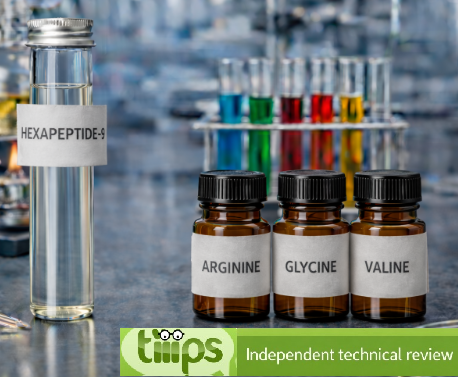
Hexapeptide-93 is defined as a synthetic peptide composed of amino acids (some databases describe it as consisting of arginine, glycine, and valine). As with many named cosmetic peptides under INCI, it may be marketed in solution (e.g., in water/glycols) or within delivery systems, and in-formula performance depends materially on the supplier’s grade and delivery system.
From a practical standpoint, technical management typically focuses on: aqueous stability, compatibility with preservatives/chelants, sensitivity to pH and temperature, and batch-to-batch repeatability of active assay (ppm or % of peptide in the commercial blend).
Synthetic peptides can be generated as copies of protein fragments by incorporating non-proteinogenic amino acids and modifications to enhance the proteolytic stability of the molecules. Peptides are used in the development of therapeutic drugs for their antimicrobial activity, and for their bioactive interest.
(Bin Hafeez A, Jiang X, Bergen PJ, Zhu Y. Antimicrobial Peptides: An Update on Classifications and Databases. Int J Mol Sci. 2021 Oct 28;22(21):11691. doi: 10.3390/ijms222111691.
Yuan Y. Mechanisms Inspired Targeting Peptides. Adv Exp Med Biol. 2020;1248:531-546. doi: 10.1007/978-981-15-3266-5_21.)
What it is used for and where
Cosmetics - INCI Functions
Skin conditioning agent - Occlusive. This ingredient has the task of modifying the condition of the skin when it is damaged or dry by reducing flaking and restoring elasticity. It has a strong lipophilic character and is identified as an occlusive ingredient; it is generally composed of oily and fatty materials that remain on the skin surface and reduce trans epidermal water loss.
Identification data and specifications
| Characteristic | Value |
|---|---|
| INCI name | Hexapeptide-93 |
| INCI functions | skin conditioning (in some databases: skin conditioning – occlusive) |
| Origin (common classification) | synthetic |
| CAS number | not unique / often not disclosed in consumer databases; verify supplier SDS and documentation |
| EC/EINECS number | not unique / often not listed; verify supplier SDS and documentation |
| Molecular formula | not available as a unique value (depends on sequence/modifications and possible salt form; commercial products are often blends) |
| Molecular weight | not available as a unique value (depends on sequence/modifications and possible salt form; often given in supplier specs if the sequence is disclosed) |
| Typical commercial form | solution or blend (ppm/% active declared by supplier) |
| Practical quality note | controls on active assay, purity/impurities, solvents/carrier, and microbiological profile of the blend |
Physico-chemical properties (indicative)
| Characteristic | Value | Note |
|---|---|---|
| Chemical nature | oligopeptide (hexapeptide) | cosmetic functional material |
| Solubility | typically handled in the aqueous phase (if supplied in solution) | depends on vehicle and commercial form |
| pH stability | typically better in moderate ranges | extremes may promote degradation/hydrolysis over time |
| Thermal stability | sensitive to prolonged stress | avoid excessive heat in processing and storage |
| Oxidation sensitivity | variable | depends on sequence and presence of antioxidants/carrier |
| Critical parameters | assay (ppm/%), purity, preservative compatibility, microbiology | drive performance and repeatability |
Functional role and practical mechanism of action
Practically, Hexapeptide-93 is used as a conditioning ingredient: the expected benefit is associated with the formula’s overall perceived quality (comfort, feel, support to a more even-looking skin), rather than a single measurable physical parameter such as viscosity or emulsification. Real-world performance depends primarily on: active concentration, vehicle, contact time (leave-on vs rinse-off), and co-ingredients.
Formulation compatibility
Key technical points typically include:
formula pH: preferably kept within a moderate range and confirmed via accelerated stability
preservatives: verify compatibility (some systems may interact with peptides or the carrier)
electrolytes and chelants: generally manageable, but dependent on the commercial blend
process: addition during cool-down or at controlled temperatures to reduce thermal stress
Use guidelines (indicative)
Use levels are strongly dependent on the commercial grade (assay) and formulator objective. Operationally, it is useful to work in terms of “ppm/% of active peptide” rather than % of the as-supplied raw material, and to validate via:
accelerated stability (hot/cold; light where relevant)
packaging compatibility
sensorial checks and batch-to-batch repeatability
Quality, grades, and specifications
The most common variability arises from differences between:
“neat” peptide versus peptide in solution/blend
synthesis/purification approaches and allowable residues
declared assay and the associated analytical method
For robust control, supplier documentation should clearly state: assay, critical impurities, solvents/carrier, microbiological requirements, and storage conditions.
Safety, regulatory, and environment
In cosmetics, safety management is centered on the finished product: concentration, application area, target population, and impurities/carrier profile. As a class, cosmetic peptides are generally manageable, but the following remain relevant:
potential for irritation in heavily loaded leave-on formulas or on reactive skin
compatibility with preservatives/solvents, which can be the primary tolerability drivers
A GMP framework (good manufacturing practice; benefit: reduces variability and contamination) across the supply chain helps keep assay and impurity profiles under control.
Formulation troubleshooting (reduced)
Loss of perceived efficacy or instability over time.
Action: check pH and process thermal stress, confirm true active assay in the blend, and repeat accelerated stability in final packaging.
Compatibility issues with preservatives/solvents in the blend.
Action: evaluate preservative alternatives or switch grade/supplier to a more compatible carrier, while keeping the target ppm of active peptide constant.
Conclusion
Hexapeptide-93 is a synthetic peptide used in cosmetics as a skin conditioning ingredient, where performance depends on active assay, vehicle, and formulation compatibility. For reliable use, key points are: specification control (ppm/% active), pH and temperature management, and finished-product safety assessment, supported by a GMP-oriented supply chain.
Mini-glossary
Oligopeptide: a peptide composed of a small number of amino-acid units (e.g., 6 for a hexapeptide).
Carrier/vehicle: a mixture (water, glycols, etc.) in which the active is dissolved or dispersed to facilitate formulation use.
GMP: good manufacturing practice; benefit: improves quality control and reduces contamination/variability.

