



Oligopeptide-1: properties, uses, pros, cons, safety
Definition
Oligopeptide-1, with declared composition “Glycine, oligomer with histidine and lysine,” is a peptide oligomer built from repeating glycine units and co-units of histidine and lysine. Practically, it is a peptide material with low molecular weight compared to larger proteins/complex peptides, with a cationic component (lysine) and an amphoteric/buffering component (histidine). These features can influence interaction with the skin surface, skin feel, and compatibility with polymers and surfactants.
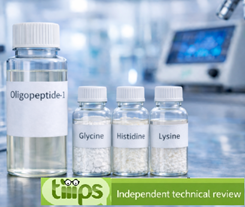
Synthetic peptides can be generated as copies of protein fragments by incorporating non-proteinogenic amino acids and modifications to enhance the proteolytic stability of the molecules. Peptides are used in the development of therapeutic drugs for their antimicrobial activity, and for their bioactive interest.
Production process
For a “glycine–histidine–lysine” oligomer, production is typically via peptide synthesis (or controlled oligomerization processes), followed by purification and standardization (assay, oligomer profile, residual salts). Key points remain: purity, oligomer distribution, presence of salts or process residues, and stability as a function of pH and preservatives.
Key constituents
The functional component is the peptide oligomer based on:
glycine (main structural/repeating unit),
histidine (supports amphoteric behavior and potential local buffering),
lysine (supports positive charge and potential interaction with surfaces/biopolymers).
Trace components (within specification) may include salts (counter-ions), water, and minor process-related impurities. Real performance depends strongly on average degree of polymerization, charge profile, and formula compatibility.
Identification data and specifications
| Characteristic | Value | Note |
|---|---|---|
| INCI name | Oligopeptide-1 | cosmetic denomination |
| Declared composition | Glycine, oligomer with histidine and lysine | defines peptide nature |
| Typical cosmetic function | Skin conditioning | primary function |
| Nature | peptide oligomer | low MW vs proteins |
| CAS number | depends on the exact substance/supplier standard | verify supplier SDS/COA |
| Molecular formula / molecular weight | not unique (mixture of oligomers) | distribution of chain lengths |
Physicochemical properties (indicative)
| Characteristic | Indicative value | Note |
|---|---|---|
| Physical state (raw material) | aqueous solution or powder | depends on grade |
| Solubility | typically good in water | often supplied in solution |
| Stability | sensitive to extreme pH and oxidants | depends on matrix/preservatives |
| Charge/interactions | cationic/amphoteric tendency | lysine/histidine affect compatibility |
| Practical formulation pH range | close to physiological pH | for comfort and stability |
| Heat sensitivity | moderate | avoid thermal stress |
| Sensory impact | generally neutral | low-use levels |
Functional role and mechanism of action
With this composition, the rationale is more consistent with skin conditioning driven by:
possible light film effect and improved skin feel (slip/soft feel) at low levels,
electrostatic interactions with formula components and the skin surface (role of lysine),
a contribution to a smoother skin perception when used in hydrating, barrier-friendly systems.
It is less appropriate to expect “growth factor–like” mechanisms (EGF) if the substance is truly this glycine–histidine–lysine oligomer.
Main uses
Cosmetics
Typically used in serums, gels, and light creams aimed at:
skin conditioning and improved perceived skin quality,
hydration-focused formulas with comfort claims,
systems where a cationic/amphoteric peptide can contribute to sensorial performance or surface deposition.
INCI functions
Skin conditioning agent. It is the mainstay of topical skin treatment as it has the function of restoring, increasing or improving skin tolerance to external factors, including melanocyte tolerance. The most important function of the conditioning agent is to prevent skin dehydration, but the subject is rather complex and involves emollients and humectants that can be added in the formulation.
Pros and cons
Pros
May support sensoriality and perceived smoother skin in well-designed formulas.
Used at low concentrations, with minimal impact on odor/color.
Peptide-based composition can fit technical/premium skincare positioning.
Cons
Market ambiguity: “Oligopeptide-1” can refer to different materials; without SDS/COA there is a risk of mismatched expectations and claims.
Possible interactions with anionic polymers/surfactants: the cationic character may affect viscosity or stability in some bases.
Stability depends on pH and preservatives: some systems may reduce peptide integrity.
Safety, regulatory, and practical aspects
Safety profile (practical)
For a peptide oligomer like the one described, safety is generally tied to purity, contaminant control, and tolerability of the finished product. The cationic charge may increase the likelihood of irritation if the formula is already “active” or harsh (e.g., high alcohol, strong surfactants), so formulation balance is central.
Allergen
Not a fragrance allergen. When reactions occur, they are more often irritative or related to the overall formula.
Contraindications and cautions
Use caution on very reactive skin if the formula also includes other potential irritants. During development: verify stability, compatibility (especially with anionic polymers), and finished-product tolerability.
Conclusion
With the composition “Glycine, oligomer with histidine and lysine,” Oligopeptide-1 should be interpreted as a peptide oligomer aimed at skin conditioning and surface/sensorial performance, not as an EGF-like ingredient. The key to defensible use is traceability (SDS/COA) and designing the formula with charge, stability, and compatibility in mind.
Mini-glossary
Oligopeptide: a short peptide with few amino-acid units (or a distribution of lengths).
Cationic/amphoteric: charge behavior influenced by basic amino acids (lysine) and amphoteric ones (histidine).

