



Congo Red is a synthetic azo dye known for its distinctive red color and historical significance in dyeing and staining. It is widely used in various industrial, biological, and diagnostic applications due to its vibrant color.
Chemical Composition and Structure
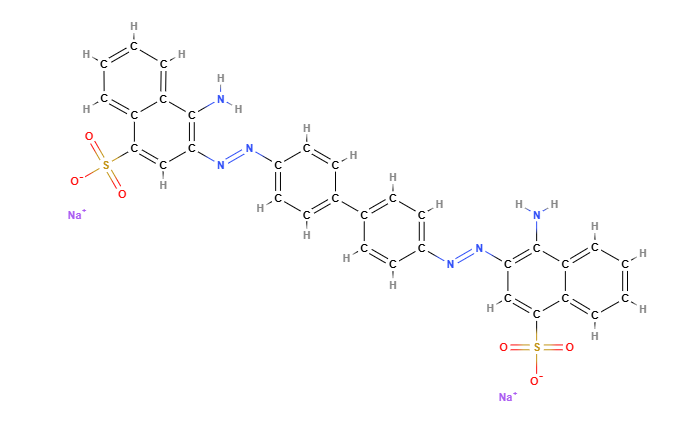
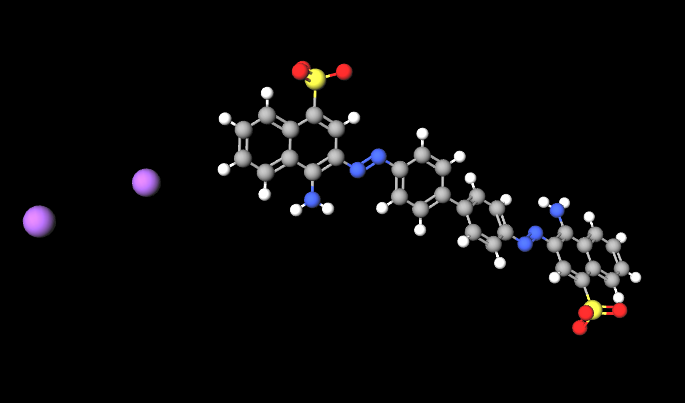
Congo Red is an azo dye, meaning it contains one or more azo groups (-N=N-) in its molecular structure. The chemical formula for Congo Red is C32H22N6Na2O6S2. Its structure includes two azo groups linked to aromatic rings and sulfonate groups, contributing to its water solubility and bright red hue.
Physical Properties
Congo Red typically appears as a dark red to brown powder. It is highly soluble in water, producing a red solution when dissolved. The dye is known for its ability to bind to amyloid fibrils, a property that makes it useful in various diagnostic applications. Congo Red exhibits good stability under various conditions, including resistance to light and moderate heat.
Chemical Industrial Synthesis Process
- Preparation of reagents. The main raw materials include benzidine, sulfuric acid (H₂SO₄), sodium nitrite (NaNO₂), a base such as sodium hydroxide (NaOH), and 1-naphthylamine-4-sulfonic acid.
- Diazotization. Benzidine is treated with sulfuric acid and sodium nitrite to form a diazonium intermediate. This reaction produces a diazonium salt.
- Coupling. The diazonium salt is then coupled with 1-naphthylamine-4-sulfonic acid in the presence of a base, such as sodium hydroxide, to form the azo compound intermediate.
- Formation of Congo Red dye. The azo compound intermediate is further processed and stabilized to form the Congo Red dye.
- Filtration. The resulting suspension is filtered to separate the solid precipitate from the aqueous solution.
- Washing. The precipitate is washed with deionized water to remove any soluble impurities.
- Drying. The washed precipitate is dried at controlled temperatures to remove residual moisture and obtain a dry powder.
- Grinding. The dried product is ground to obtain a fine and uniform powder.
- Classification. The dried powder is classified to ensure a uniform particle size. This step may involve sieving or the use of air classifiers.
- Stabilization. The Congo Red powder is stabilized to ensure its stability during transportation and storage, preventing aggregation and degradation.
- Quality control. The Congo Red undergoes rigorous quality testing to ensure it meets standards for purity, color intensity, and safety. These tests include chemical analysis, spectroscopy, and physical tests to determine particle size and rheological properties.
What it is used for and where
Medical
Biological Staining. Congo Red is widely used as a histological dye in biological and medical research. It is particularly valuable for staining amyloid fibrils in tissue samples, helping in the diagnosis of amyloidosis and other conditions associated with amyloid deposits.
Congo Red is a histological dye commonly used for the detection of amyloid for the visualization and the quantification ante che in vivo of cerebral amyloids (1).
Cosmetics
Restricted cosmetic ingredient as II/986 a Relevant Item in the Annexes of the European Cosmetics Regulation 1223/2009. Substance or ingredient reported:
- Disodium 3,3'-[[1,1'-biphenyl]-4,4'-diylbis(azo)] bis(4-aminonaphthalene-1- sulphonate). Prohibited substance in cosmetic products
Industrial Applications
Textile Dyeing: Historically, Congo Red has been used as a direct dye for cotton and other cellulosic fibers. Its vibrant color and ease of application made it popular in the textile industry, although its use has declined due to the availability of more stable dyes.
Indicator and pH Testing: Congo Red acts as a pH indicator, changing color from red at pH levels above 5.0 to blue at pH levels below 3.0. This property makes it useful in various laboratory settings for monitoring pH changes.
Paper and Inks: Congo Red is used in the paper industry to dye paper products and in the production of certain types of inks. Its bright red color and water solubility make it suitable for these applications.
Safety
The problem associated with azo dyes (monoazo or diazo) is photocatalytic degradation leading to eventual oxidation and subsequent formation of impurities such as aromatic amines some of which have carcinogenic activity (2).
 |  |
Molecular Formula C32H22N6Na2O6S2
Molecular Weight 696.7 g/mol
CAS 573-58-0
UNII 3U05FHG59S
EC Number 209-358-4
Synonyms:
Direct Red 28
C.I. Direct Red 28
NSC-56651
NSC-7232

