



Amaranth is a chemical compound, an azo synthetic red dye also known by the name Food Red 9 or CI 16185 or Food Red 9
Chemical name:
trisodium;3-hydroxy-4-[(4-sulfonatonaphthalen-1-yl)diazenyl]naphthalene-2,7-disulfonate
Amaranth is a synthetic monoazo dye known for its bright red color. It is widely used in various industries, including food, cosmetics, and pharmaceuticals, due to its vibrant color and excellent stability.
Chemical Composition and Structure
Amaranth is a monoazo dye, meaning it contains a single azo group (-N=N-) in its molecular structure. The chemical formula for Amaranth is C20H11N2Na3O10S3. Its structure includes an azo group linked to aromatic rings, contributing to its distinctive red hue. It is also known as E123 in the food industry.
Physical Properties
Amaranth typically appears as a reddish-brown powder. It is water-soluble, producing a bright red solution when dissolved. The dye exhibits excellent stability under various conditions, including resistance to light and heat, making it suitable for a wide range of applications.
Chemical Industrial Synthesis Process
- Preparation of reagents. The main raw materials include naphthalene-1,4,5,8-tetrasulfonic acid sodium salt, sulfuric acid (H₂SO₄), sodium nitrite (NaNO₂), a base such as sodium hydroxide (NaOH), and 2-naphthol-3,6-disulfonic acid (J acid).
- Diazotization. The naphthalene-1,4,5,8-tetrasulfonic acid sodium salt is treated with sulfuric acid and sodium nitrite to form a diazonium intermediate. This reaction produces a diazonium salt.
- Coupling. The diazonium salt is then coupled with 2-naphthol-3,6-disulfonic acid (J acid) in the presence of a base, such as sodium hydroxide, to form the azo compound intermediate.
- Formation of Amaranth Dye. The azo compound intermediate is further processed to stabilize the Amaranth dye.
- Filtration. The resulting suspension is filtered to separate the solid precipitate from the aqueous solution.
- Washing. The precipitate is washed with deionized water to remove any soluble impurities.
- Drying. The washed precipitate is dried at controlled temperatures to remove residual moisture and obtain a dry powder.
- Grinding. The dried product is ground to obtain a fine and uniform powder.
- Classification. The dried powder is classified to ensure a uniform particle size. This step may involve sieving or the use of air classifiers.
- Stabilization. The Amaranth powder is stabilized to ensure its stability during transportation and storage, preventing aggregation and degradation.
- Quality control. The Amaranth undergoes rigorous quality testing to ensure it meets standards for purity, color intensity, and safety. These tests include chemical analysis, spectroscopy, and physical tests to determine particle size and rheological properties.
Safety
The problem associated with azo dyes (monoazo or diazo) is photocatalytic degradation leading to eventual oxidation and subsequent formation of impurities such as aromatic amines some of which have carcinogenic activity (1).
Use in hair colouring products is prohibited.
What it is used for and where
Amaranth is a synthetic dye commonly used in a variety of cosmetic and food products. Also known as Acid Red 27 or Erythrosine B, this substance is valued for its intense red hue and is employed to impart color to products such as beverages, sweets, cosmetics, and personal care products.
Cosmetics
It is a restricted ingredient as IV/33 (CI 16185) II/1350 (Acid Red 27; CI 16185: when used as a substance in hair dye products) a Relevant Item in the Annexes of the European Cosmetics Regulation 1223/2009. Substance or ingredient reported: Trisodium 3-hydroxy-4-(4'-sulphonatonaphthylazo)naphthalene-2,7-disulphonate.
Purity criteria as set out in Commission Directive 95/45/EC (E 123)
Colorant. It is an ingredient that makes the final product more attractive from an aesthetic point of view, but can pose a potential health risk with undesirable side effects especially when used continuously as it can be absorbed through the skin or mucous membranes.
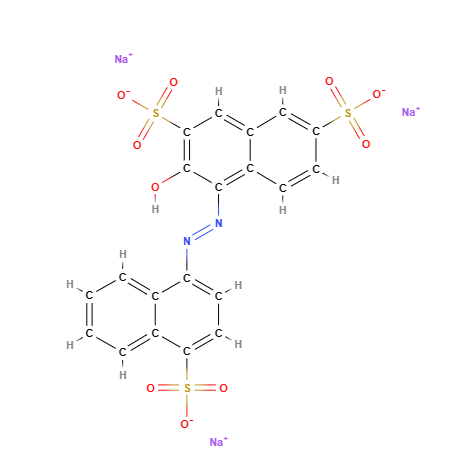 | 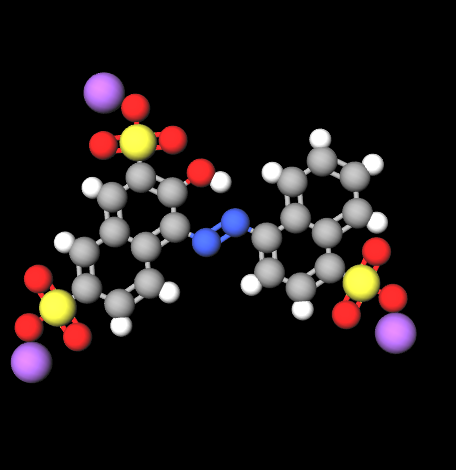 |
Molecular Formula C20H11N2Na3O10S3 C20H11N2O10S3.3Na
CAS 915-67-3
Molecular Weight 604.5 g/mol
EC number 213-022-2
UNII 37RBV3X49K
DTXSID2021232
Synonyms:
- Food Red 9
- Acid Red 27
- Amaranth Dye
- AR27 Compound
- FD and C Red No. 2
- Azorubin S
- Red Dye No. 2

