



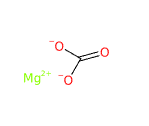
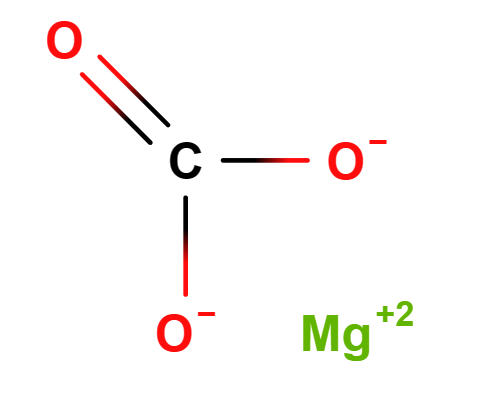
Anhydrous magnesium carbonate (Magnesium carbonate) is a chemical compound, a synthetic dye, magnesium salt of carbonic acid and is formed from hydrotalcite material.
The name describes the structure of the molecule:
- Magnesium refers to magnesium, a chemical element. Magnesium is known for its health benefits and chemical reactivity.
- Carbonates indicates that the compound is a salt or ester of carbonic acid. Magnesium carbonates can come in different forms, such as basic magnesium carbonate or hydrated magnesium carbonate.
Raw Materials and Their Functions
Hydrotalcite. A mineral material that serves as a source for the production of magnesium carbonates. Hydrotalcite is composed of layers of magnesium and aluminum hydroxides intercalated with carbonate anions.
Industrial Chemical Synthesis of Magnesium Carbonates
- Preparation of reagents. The main raw materials include sodium carbonate (Na₂CO₃) and magnesium sulfate (MgSO₄).
- Precipitation reaction. The production of Anhydrous magnesium carbonate begins with the reaction between sodium carbonate and magnesium sulfate in an aqueous solution. This reaction forms a precipitate of magnesium carbonate (MgCO₃).
- Filtration. The resulting suspension is filtered to separate the solid magnesium carbonate from the aqueous solution.
- Washing. The magnesium carbonate is washed with deionized water to remove any soluble impurities such as sodium sulfate.
- Drying. The washed magnesium carbonate is dried at controlled temperatures to remove residual moisture and obtain a dry powder.
- Grinding. The dried magnesium carbonate is ground to obtain a fine and uniform powder. This step may involve the use of ball mills or other grinding machinery.
- Classification. The dried powder is classified to ensure a uniform particle size. This step may involve sieving or the use of air classifiers.
- Stabilization. The Anhydrous magnesium carbonate powder is stabilized to ensure its stability during transportation and storage, preventing aggregation and degradation.
- Quality control. The Anhydrous magnesium carbonate undergoes rigorous quality testing to ensure it meets standards for purity, color intensity, and safety. These tests include chemical analysis, spectroscopy, and physical tests to determine particle size and rheological properties.
Industrially, it appears in the form of a white powder.

What it is used for and where
Food
It is an anti-caking agent on the European food additives list with the number E504 and used in cheeses, wines etc. and in the Colour Index International as CI 77713 dye.
Cosmetics
It is a restricted ingredient as IV/139, a Relevant Item in the Annexes of the European Cosmetics Regulation 1223/2009
- Absorbent. Absorbs substances dispersed or dissolved in aqueous solutions, water/oil, oil/water..
- Binder agent. Ingredient that is used in cosmetic, food and pharmaceutical products as an anti-caking agent with the function of making the product in which it is incorporated silky, compact and homogenous. The binder, either natural such as mucilage, gums and starches or chemical, may be in the form of a powder or liquid.
- Opacifying agent. This additive is inserted into formulations that may be translucent or transparent to make them opaque and less permeable to light.
- Colorant. Ingredient whose primary function is to colour the solution in which it is inserted in a temporary, semi-permanent or permanent manner, either alone or in the presence of complementary components added for colouration.
Medical
Magnesium carbonate is used against heartburn or indigestion. Unlike other magnesium salts (aspartate, citrate, gluconate, lactate, orotate, pyruvate) that are easily absorbed in the body, magnesium carbonate is slower. It is used as an effective treatment in hemodialysis patients with calcium-phosphoric problems (1) with some warning (3). In the human body it helps the development of muscles and bones.
Although positive long-term effects on coronary artery calcification have been found (2), it is believed that these studies still need to be further investigated to ensure that the product is effective.
In inappropriate doses it can cause diarrhea and stomach ache.
Magnesium salts are used in treatments for preserving the integrity of the blood system, urine pH, etc.
- aspartate
- citrate
- gluconate
- lactate
- orotate
- pyruvate
 |  |
 |  |
The most relevant studies on this ingredient have been selected with a summary of their contents:
Magnesium carbonate studies
- Molecular Formula: CMgO3 MgCO3
- Linear Formula: MgCO3 · x H2O
- Molecular Weight: 84.313 g/mol
- CAS: 546-93-0 7757-69-9 13717-00-5 13717-00-5 23389-33-5
- EC Number: 208-915-9 231-817-2 604-004-9
- UNIII: 0IHC698356
Synonyms:
- Magnesium carbonate
- Magnesium carbonate anhydrous
- Anhydrous Magnesium carbonate
- carbonic acid, magnesium salt (1:1), hydrate
- magnesium carbonate anhydrous
- CI 77713
- E504
- UNII-0IHC698356
- Caswell No. 530
- Magnesite dust
- Hydromagnesite
- Stan-mag magnesium carbonate
- nesquehonite

