Medicago Sativa Leaf Powder in cosmetics: pros and cons, INCI functions and safety
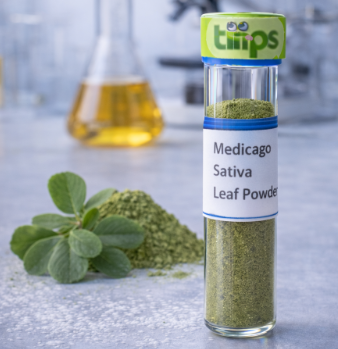
Medicago Sativa Leaf Powder is inserted in cosmetic products as a skin-conditioning agent. It is obtained from the leaves of the alfalfa plant or alfalfa grass, which belongs to the Fabaceae family.
Industrial Production Process
- Preparation of reagents. The main raw material includes Medicago sativa leaves (alfalfa leaves).
- Harvesting and preparation. Alfalfa leaves are harvested at peak maturity to ensure the maximum concentration of nutrients. The harvested leaves are then washed to remove dirt and impurities.
- Drying. The washed leaves are dried at a controlled temperature to preserve nutrients and bioactive compounds. Drying is carefully executed to avoid degradation of heat-sensitive compounds.
- Grinding. Once dried, the leaves are ground into a fine powder using specific mills to achieve the desired consistency.
- Sieving. The ground powder is sieved to ensure uniform particle size and to remove any larger particles.
- Stabilization. The leaf powder is stabilized to ensure its stability during transportation and storage, preventing oxidation and degradation.
- Quality control. The alfalfa leaf powder undergoes rigorous quality testing to ensure it meets standards for purity, efficacy, and safety. These tests include chemical analysis, spectroscopy, and microbiological testing.
What it is used for and where
Medicago Sativa Leaf Powder is extremely rich in vitamins, minerals, proteins, and antioxidants, making it a highly valued ingredient in cosmetic formulations for skin health. This powder is used for its exfoliating and purifying properties, helping to gently remove impurities and dead skin cells, promoting a brighter and revitalized complexion. It is ideal for inclusion in facial masks, body scrubs, and other exfoliating products, where it supports skin regeneration.
Cosmetics - INCI Functions
- Skin conditioning agent. It is the mainstay of topical skin treatment as it has the function of restoring, increasing or improving skin tolerance to external factors, including melanocyte tolerance. The most important function of the conditioning agent is to prevent skin dehydration, but the subject is rather complex and involves emollients and humectants that can be added in the formulation.
CAS 84082-36-0
EC number 281-984-0
Cosmetic Applications
Antioxidant Properties. This compound is rich in antioxidants that protect the skin from damage by free radicals and pollution, helping to prevent premature aging (1).
Revitalizing Effects. It nourishes and revitalizes the skin, improving brightness and overall tone due to its essential nutrients such as vitamins, minerals, and proteins.
Moisturization. Enhances skin hydration, helping to keep skin supple and reducing the appearance of fine lines (2).
Purification. Helps detoxify the skin by removing impurities and toxins, which improves skin clarity and health.
Versatile Applications. It can be used in a variety of cosmetic products, such as creams, serums, lotions, and masks, for its multiple beneficial properties for the skin.
Other Applications
Dietary Supplements. It is often used in supplements to leverage its nutritional benefits, improving overall health and wellness (3).
Natural Health Products. Used in herbal teas and other herbal products for its tonic and invigorating properties.
Animal Health Products. Also employed in animal supplements to enhance their nutrition and promote better overall health.
References_____________________________________________________________________
(1) Zagórska-Dziok M, Ziemlewska A, Nizioł-Łukaszewska Z, Bujak T. Antioxidant Activity and Cytotoxicity of Medicago sativa L. Seeds and Herb Extract on Skin Cells. Biores Open Access. 2020 Oct 23;9(1):229-242. doi: 10.1089/biores.2020.0015.
(2) Rodrigues, F., Palmeira-de-Oliveira, A., das Neves, J., Sarmento, B., Amaral, M. H., & Oliveira, M. B. (2013). Medicago spp. extracts as promising ingredients for skin care products. Industrial crops and products, 49, 634-644.
Abstract. Agro-industrial by-products have the potential to be used with different purposes thus providing economical advantage to otherwise disposable residues. In particular, the field of skin care products and cosmetics may benefit from these remaining materials. Hydro-alcoholic extracts of seven species of Medicago (M. minima, M. tornata, M. truncatula, M. rigidula, M. scutelata, M. segitalis and M. sativa) were screened for antioxidant, cytotoxicity and antimicrobial activities aiming at their application as functional ingredient in skin formulations. Antioxidant activity was evaluated by standard methods such as DPPH· and FRAP. In both methods the antioxidant activity of M. segitalis displayed the highest antioxidant activity (214.49 ± 6.69 μmol Trolox equivalent per g db for DPPH; 120.84 ± 1.86 μmol/mg db for FRAP). For DPPH M. rigidula showed the lowest antioxidant activity (127.18 ± 1.96 μmol Trolox equivalent per g db) and for FRAP M. minima showed the lowest one (58.05 ± 6.09 μmol per mg db). Also, the total phenolic and total flavonoid contents (TPC and TFC, respectively) were evaluated. The TPC of the different extracts varied from 21.96 mg to 36.41 mg GAE/g db sample, being the highest TPC obtained for M. minima and the lowest for the M. scutelata. TFC varied from 5.54 to 11.67 mg CEQ/g db sample. Linear negative correlations were established between the total phenol contents and for both the antioxidant activity methods. The extracts were also screened for cytotoxicity using MTS and LDH assays in two different skin cell lines (HaCaT and HFF-1) and showed low cytotoxicity. Preliminary assays for antimicrobial potential showed that extracts from Medicago display antibacterial activity, with MIC values of 31.3 μg/mL and 125 μg/mL for some Gram-positive and Gram-negative bacteria, respectively. Taken together, the results suggested that Medicago hydro-alcoholic extracts are a potential source of natural compounds with high levels of antioxidant activity, low cytotoxicity for skin cells and the ability to potentially prevent microbial infections of the skin due to its antimicrobial effect, as well as contribute as a natural preservative in cosmetic products. All referred above justify their possible uses in skin care products.
(3) Francis H, Debs E, Koubaa M, Alrayess Z, Maroun RG, Louka N. Sprouts Use as Functional Foods. Optimization of Germination of Wheat (Triticum aestivum L.), Alfalfa (Medicago sativa L.), and Radish (Raphanus sativus L.) Seeds Based on Their Nutritional Content Evolution. Foods. 2022 May 18;11(10):1460. doi: 10.3390/foods11101460.
Abstract. Wheat, alfalfa, and radish sprouts are well-renowned for their high nutritional content. However, their optimal imbibition and germination durations are rarely considered in the literature. In this study, reduced imbibition times of 3 h, 10 h, and 4 h were demonstrated for the wheat, alfalfa, and radish seeds, respectively. The evolution of their crude fat, proteins, polyphenols, antioxidant activity, and vitamins were investigated over 7 days of germination. The crude fat and protein loads of these sprouts slightly varied during germination, whereas the phenolic compounds and antioxidant activity maxed out at day 7, 5, and 6 for the wheat, alfalfa, and radish sprouts, respectively, with significant levels of catechin. The vitamins highly increased, showing noteworthy yet different peaks of growth depending on the seed and the vitamin analyzed. Interestingly, alfalfa and radish sprouts, taken at their optimal germination day, would decidedly contribute to meet our Recommended Daily Allowances (RDAs) of vitamins E, A, and B6. Overall, for a greater nutritional content and a potential use of these sprouts as nutraceutical ingredients, our results suggested to leave the wheat, alfalfa, and radish seeds to germinate only over 7, 4, and 6 days, respectively, after which their nutritional quality tended to decrease.




