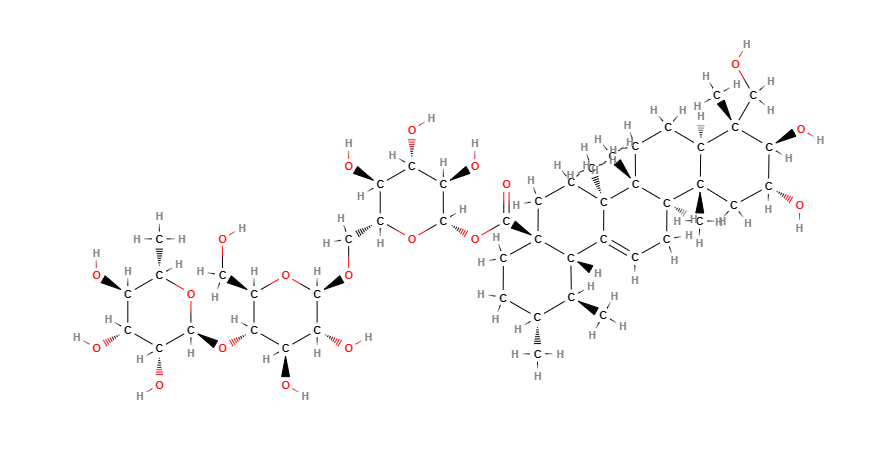
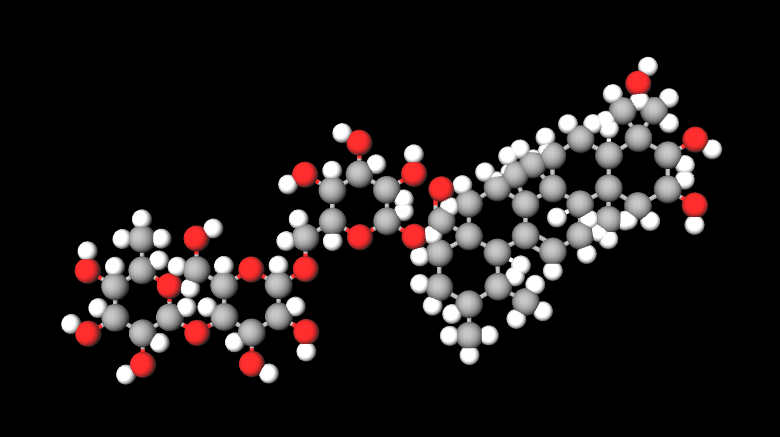
Asiaticoside is a triterpenoid saponin derived from various plants of the Apiaceae family, including Centella asiatica and Centella erecta.
Industrial Production Process
- Harvesting of Centella asiatica. The plants are harvested at full maturity, as they contain the highest concentration of active compounds at this stage.
- Drying and grinding. The collected plants are dried in controlled environments to preserve active and volatile compounds, then ground into powder to increase extraction efficiency.
- Solvent extraction. The powder is soaked in an organic solvent like ethanol or methanol to extract the triterpenoid compounds, heating and agitating the solution to enhance efficiency.
- Filtration and concentration. The solution is filtered to remove solids, and the solvent is then evaporated under vacuum to concentrate the triterpenoid extracts.
- Isolation of Asiaticoside. The concentrated extracts are purified using techniques like column chromatography to isolate Asiaticoside from related compounds.
- Final purification. The isolated Asiaticoside is further purified by recrystallization to remove impurities and improve purity.
- Quality control. The final product undergoes rigorous quality testing to verify its purity and compliance with standards.
What it is used for and where
Asiaticoside is a triterpenoid compound derived from the Centella asiatica plant. It is known for its healing, anti-inflammatory, and regenerative properties, making it a valuable ingredient in cosmetic products as well as in other fields.
Cosmetics - INCI Functions
- Antioxidant agent. Ingredient that counteracts oxidative stress and prevents cell damage. Free radicals, pathological inflammatory processes, reactive nitrogen species and reactive oxygen species are responsible for the ageing process and many diseases caused by oxidation.
- Skin conditioning agent. It is the mainstay of topical skin treatment as it has the function of restoring, increasing or improving skin tolerance to external factors, including melanocyte tolerance. The most important function of the conditioning agent is to prevent skin dehydration, but the subject is rather complex and involves emollients and humectants that can be added in the formulation.
- Perfuming. Unlike fragrance, which can also contain slightly less pleasant or characteristic odours, the term perfume indicates only very pleasant fragrances. Used for perfumes and aromatic raw materials.
Cosmetic Applications
Skin Regeneration. Asiaticoside stimulates collagen production, promoting cell regeneration and improving the appearance of scars, stretch marks, and signs of aging (1).
Anti-aging Properties. By supporting the synthesis of collagen and elastin, it helps reduce the appearance of wrinkles and fine lines, improving skin elasticity.
Soothing Effects. It reduces inflammation and calms irritated skin, making it ideal for sensitive or damaged skin.
Antioxidant Properties. It offers protection against free radical damage, preventing premature aging and improving overall skin health.
Versatile Applications. It can be used in various cosmetic products, such as serums, creams, lotions, and masks, to enhance their anti-aging and regenerative benefits.
Other Applications
Wound Healing. It is used in creams and ointments to accelerate wound and ulcer healing, thanks to its ability to stimulate the formation of new tissue (2).
Anti-inflammatory Properties. Studied for its anti-inflammatory properties, asiaticoside may be useful in treating chronic inflammatory conditions (3).
Cardiovascular Health. It can support blood circulation and help reduce cholesterol levels, supporting cardiovascular health (4).
Molecular Formula C48H78O19
Molecular Weight
CAS 16830-15-2
UNII PKO39VY215
EC Number 240-851-7
DTXSID30937476
Synonyms:
Asiaticosid
Centelase
Bibliografia_____________________________________________________________________
(1) Bylka W, Znajdek-Awiżeń P, Studzińska-Sroka E, Brzezińska M. Centella asiatica in cosmetology. Postepy Dermatol Alergol. 2013 Feb;30(1):46-9. doi: 10.5114/pdia.2013.33378. Epub 2013 Feb 20. PMID: 24278045; PMCID: PMC3834700.
Abstract. Centella asiatica known as Gotu Kola is a medicinal plant that has been used in folk medicine for hundreds of years as well as in scientifically oriented medicine. The active compounds include pentacyclic triterpenes, mainly asiaticoside, madecassoside, asiatic and madecassic acids. Centella asiatica is effective in improving treatment of small wounds, hypertrophic wounds as well as burns, psoriasis and scleroderma. The mechanism of action involves promoting fibroblast proliferation and increasing the synthesis of collagen and intracellular fibronectin content and also improvement of the tensile strength of newly formed skin as well as inhibiting the inflammatory phase of hypertrophic scars and keloids. Research results indicate that it can be used in the treatment of photoaging skin, cellulite and striae.
(2) Anand S, Rajinikanth PS, Arya DK, Pandey P, Gupta RK, Sankhwar R, Chidambaram K. Multifunctional Biomimetic Nanofibrous Scaffold Loaded with Asiaticoside for Rapid Diabetic Wound Healing. Pharmaceutics. 2022 Jan 24;14(2):273. doi: 10.3390/pharmaceutics14020273.
Abstract. Diabetes mellitus is a chronic disease with a high mortality rate and many complications. A non-healing diabetic foot ulcer (DFU) is one the most serious complications, leading to lower-extremity amputation in 15% of diabetic patients. Nanofibers are emerging as versatile wound dressing due to their unique wound healing properties, such as a high surface area to volume ratio, porosity, and ability to maintain a moist wound environment capable of delivering sustained drug release and oxygen supply to a wound. The present study was aimed to prepare and evaluate a polyvinyl alcohol (PVA)-sodium alginate (SA)-silk fibroin (SF)-based multifunctional nanofibrous scaffold loaded with asiaticoside (AT) in diabetic rats. The SEM findings showed that fibers' diameters ranged from 100-200 nm, and tensile strengths ranged from 12.41-16.80 MPa. The crosslinked nanofibers were sustained AT over an extended period. The MTT and scratch assay on HaCat cells confirmed low cytotoxicity and significant cell migration, respectively. Antimicrobial tests revealed an excellent anti-microbial efficacy against P. aeruginosa and S. aureus bacteria. In-vivo study demonstrated better wound healing efficacy in diabetic rats. In addition, the histopathological studies showed its ability to restore the normal structure of the skin. The present study concluded that developed multifunctional nanofibers have a great potential for diabetic wound healing applications.
(3) Liu S, Chen L, Li J, Sun Y, Xu Y, Li Z, Zhu Z, Li X. Asiaticoside Mitigates Alzheimer's Disease Pathology by Attenuating Inflammation and Enhancing Synaptic Function. Int J Mol Sci. 2023 Jul 26;24(15):11976. doi: 10.3390/ijms241511976.
Abstract. Alzheimer's disease (AD) is a prevalent neurodegenerative disorder, hallmarked by the accumulation of amyloid-β (Aβ) plaques and neurofibrillary tangles. Due to the uncertainty of the pathogenesis of AD, strategies aimed at suppressing neuroinflammation and fostering synaptic repair are eagerly sought. Asiaticoside (AS), a natural triterpenoid derivative derived from Centella asiatica, is known for its anti-inflammatory, antioxidant, and wound-healing properties; however, its neuroprotective function in AD remains unclear. Our current study reveals that AS, when administered (40 mg/kg) in vivo, can mitigate cognitive dysfunction and attenuate neuroinflammation by inhibiting the activation of microglia and proinflammatory factors in Aβ1-42-induced AD mice. Further mechanistic investigation suggests that AS may ameliorate cognitive impairment by inhibiting the activation of the p38 MAPK pathway and promoting synaptic repair. Our findings propose that AS could be a promising candidate for AD treatment, offering neuroinflammation inhibition and enhancement of synaptic function.
(4) Razali NNM, Ng CT, Fong LY. Cardiovascular Protective Effects of Centella asiatica and Its Triterpenes: A Review. Planta Med. 2019 Nov;85(16):1203-1215. doi: 10.1055/a-1008-6138.
Abstract. Centella asiatica, a triterpene-rich medicinal herb, is traditionally used to treat various types of diseases including neurological, dermatological, and metabolic diseases. A few articles have previously reviewed a broad range of pharmacological activities of C. asiatica, but none of these reviews focuses on the use of C. asiatica in cardiovascular diseases. This review aims to summarize recent findings on protective effects of C. asiatica and its active constituents (asiatic acid, asiaticoside, madecassic acid, and madecassoside) in cardiovascular diseases. In addition, their beneficial effects on conditions associated with cardiovascular diseases were also reviewed. Articles were retrieved from electronic databases such as PubMed and Google Scholar using keywords "Centella asiatica," "asiatic acid," "asiaticoside," "madecassic acid," and "madecassoside." The articles published between 2004 and 2018 that are related to the aforementioned topics were selected. A few clinical studies published beyond this period were also included. The results showed that C. asiatica and its active compounds possess potential therapeutic effects in cardiovascular diseases and cardiovascular disease-related conditions, as evidenced by numerous in silico, in vitro, in vivo, and clinical studies. C. asiatica and its triterpenes have been reported to exhibit cardioprotective, anti-atherosclerotic, antihypertensive, antihyperlipidemic, antidiabetic, antioxidant, and anti-inflammatory activities. In conclusion, more clinical and pharmacokinetic studies are needed to support the use of C. asiatica and its triterpenes as therapeutic agents for cardiovascular diseases. Besides, elucidation of the molecular pathways modulated by C. asiatica and its active constituents will help to understand the mechanisms underlying the cardioprotective action of C. asiatica.