



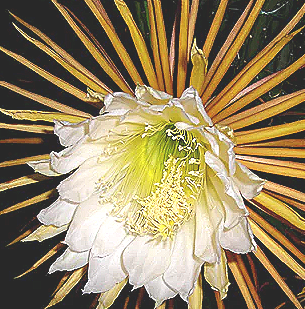
Cereus Grandiflorus Flower Powder is a product of natural origin derived from a cactus known as the "Queen of the Night" and belonging to the Cactaceae family.
The name describes the structure of the molecule:
- Cereus Grandiflorus is the scientific name for a plant commonly known as the Night-blooming cereus. This cactus is renowned for its large, fragrant flowers that bloom only at night.
- Flower Powder indicates that the product is a powdered form obtained from drying and grinding the flowers of Cereus Grandiflorus.
Industrial Production Process
- Flower collection. Cereus Grandiflorus flowers are harvested at night or early in the morning when they are fully open and at the peak of their bloom.
- Drying. The collected flowers are quickly dried to preserve their active ingredients. Drying can be done using natural sun drying or in controlled dehydrators that maintain low temperatures to protect heat-sensitive compounds.
- Grinding. Once dried, the flowers are ground into a fine powder. This process increases the surface area, facilitating the use of the product in various formulations.
- Sifting. The powder is sifted to ensure a uniform particle size and to remove any impurities or particle clumps.
- Quality control. Before packaging, Cereus Grandiflorus flower powder undergoes rigorous quality testing to verify the presence of active ingredients, microbiological purity, and the absence of contaminants.
- Storage. The powder is stored in airtight containers to protect it from moisture and light, thus preserving its quality until use.
What it is used for and where
Thids product is used in cosmetic products for its moisturizing and regenerative properties. It is known to help hydrate and soothe the skin, making it particularly suitable for products aimed at dry or sensitive skin. The abundance of antioxidants found in the flowers also provides anti-aging benefits, helping to protect the skin from free radical damage and promote a more youthful, rejuvenated appearance.
Cosmetics - INCI Functions
Exfoliant. When the skin shows photodamage, pigmentation disorders, acne, actinic keratoses, or scarring, it may be useful to perform a procedure, using exfoliating ingredients, which is called chemical peeling (chemoexfoliation or chemical exfoliation) and which should improve or restore the skin's appearance.
CAS 8007-78-1
EC number 232-364-3
Main uses and benefits of Cereus Grandiflorus Flower Powder
Antioxidant Properties. Rich in antioxidants, it helps protect the skin from free radical damage and combats signs of premature aging.
Soothing Effects. It is known for its ability to soothe irritated skin, making it ideal for post-sun exposure products or for sensitive skin.
Hydration. Provides a mild level of hydration, helping to keep the skin soft and smooth.
Skin Regeneration. It stimulates cell regeneration, helping to improve the appearance of damaged skin and promote a more even and radiant complexion.
Purifying. It can help purify the skin by removing impurities and toxins, thereby improving skin clarity and overall health.
Versatile Applications. This powder can be incorporated into various cosmetic products, including facial masks, creams, lotions, and serums, leveraging its multiple skin care benefits.

