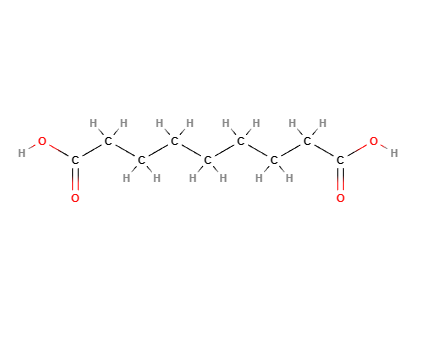
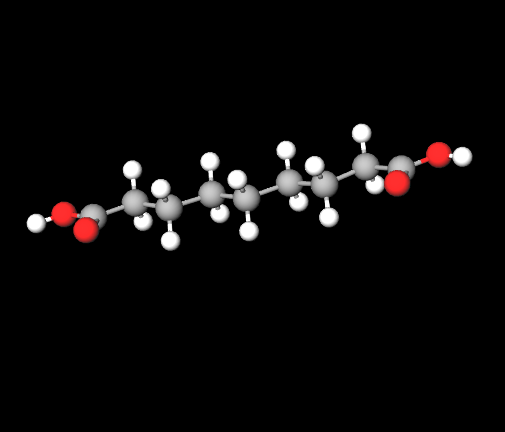
L'acido azelaico è un composto organico trovato naturalmente in molti cereali come grano, segale e orzo. È noto per le sue proprietà antibatteriche e antinfiammatorie ed è comunemente usato nel trattamento di condizioni dermatologiche (1) come l'acne e la rosacea.
Il nome definisce la struttura della molecola:
- Acido è una sostanza chimica che può rilasciare ioni di idrogeno e ha un pH inferiore a 7. Gli acidi sono comunemente usati in chimica e medicina per le loro proprietà reattive e benefici terapeutici.
- azelaico deriva dalla parola greca "azele" e si riferisce ad un acido dicarbossilico a nove carboni (C9).
Processo industriale di sintesi chimica
- Selezione. La produzione di acido azelaico inizia con la selezione dell'acido oleico, un acido grasso presente in molti oli vegetali.
- Ossidazione. L'acido oleico viene sottoposto a un processo di ossidazione ozonolitica, in cui l'ozono è usato per scindere i doppi legami dell'acido oleico, formando acido nonandioico (acido azelaico) e altri sottoprodotti.
- Purificazione. Dopo l'ossidazione, la miscela reattiva viene trattata per rimuovere impurità e isolare l'acido azelaico. Questo può includere passaggi come la distillazione sotto vuoto e la cristallizzazione.
- Cristallizzazione. L'acido azelaico purificato viene ulteriormente raffinato attraverso cristallizzazione, migliorando così la purezza e la qualità del prodotto finale.
- Asciugatura. Il prodotto cristallizzato viene poi asciugato per eliminare ogni traccia di solventi o umidità.
- Controllo qualità. Prima della spedizione, campioni di acido azelaico vengono testati per assicurare che rispettino le specifiche di purezza e qualità necessarie per le applicazioni industriali.
A cosa serve e dove si usa
L'acido azelaico è un composto naturale trovato nel grano, nella segale e nell'orzo, ed è comunemente utilizzato in dermatologia per le sue proprietà antibatteriche e anti-infiammatorie. L'acido azelaico agisce inibendo la crescita dei batteri che causano l'acne e riducendo la produzione di cheratina, un fattore che può ostruire i pori. È anche utilizzato per trattare l'iperpigmentazione, poiché ha la capacità di inibire l'attività della tirosinasi, un enzima coinvolto nella produzione di melanina. Questo lo rende efficace nel migliorare il tono della pelle e ridurre le macchie scure.
Cosmetica - Funzioni INCI
- Agente tampone. E' un ingrediente che può portare una soluzione alcalina o acida a un determinato livello di pH e impedirne la modifica, in pratica uno stabilizzatore di pH che può resistere efficacemente all’instabilità ed all'eventuale cambiamento del pH.
- Fragranza. Ha un ruolo decisamente importante nella formulazione di prodotti cosmetici in quanto fornisce la possibilità di migliorare, mascherare o aggiungere profumo al prodotto finale aumentandone la commerciabilità. E' in grado di creare un odore gradevole percepibile, mascherare un cattivo odore. Il consumatore si aspetta sempre di trovare un profumo gradevole o particolare in un prodotto cosmetico.
Principali utilizzi e benefici dell'acido azelaico
Trattamento dell'acne. L'acido azelaico aiuta a ridurre l'infiammazione e ha proprietà antibatteriche che lo rendono efficace nel trattare forme lievi e moderate di acne (2).
Riduzione delle macchie. È conosciuto per la sua capacità di schiarire la pigmentazione della pelle, inclusa quella causata da melasma o post-infiammazione, migliorando l'uniformità del tono della pelle.
Proprietà anti-infiammatorie. Offre benefici anti-infiammatori che aiutano a ridurre il rossore e l'irritazione associati a condizioni come la rosacea (3).
Prevenzione. Aiuta a prevenire l'intasamento dei pori e la formazione di comedoni, contribuendo a mantenere la pelle chiara.
Comedolitico e Cheratolitico. L'acido azelaico accelera il rinnovamento delle cellule della pelle, aiutando a rimuovere le cellule morte e a prevenire l'accumulo di cellule che possono portare a imperfezioni (4).
Sicurezza
È generalmente ben tollerato e può essere usato su tutti i tipi di pelle, inclusi quelli sensibili.
Molecular Formula C9H16O4
Molecular Weight 188.22 g/mol
CAS 123-99-9
UNII F2VW3D43YT
EC Number 204-669-1
DTXSID8021640
Synonyms:
Azelex
Finacea
monosodium azelate
nonanedioic acid
Bibliografia_____________________________________________________________________
(1) Searle T, Ali FR, Al-Niaimi F. The versatility of azelaic acid in dermatology. J Dermatolog Treat. 2022 Mar;33(2):722-732. doi: 10.1080/09546634.2020.1800579.
Abstract. Azelaic acid has numerous pharmacological uses in dermatology. Its anti-inflammatory and anti-oxidant properties are thought to correlate with its efficacy in papulopustular rosacea and acne vulgaris, amongst other cutaneous conditions. We conducted a review of the literature on the use of azelaic acid in dermatology using key terms 'acne', 'azelaic acid', 'dermatology', 'melasma', 'rosacea', searching databases such as MEDLINE, EMBASE and PubMed. Only articles in English were chosen. The level of evidence was evaluated and selected accordingly listing the studies with the highest level of evidence first using the Oxford Center of Evidence-Based Medicine 2011 guidance.This review found the strongest evidence supporting the use of azelaic acid in rosacea, followed by its use off-label in melasma followed by acne vulgaris. Weaker evidence is currently available to support the use of azelaic acid in several other conditions such as hidradenitis suppurativa, keratosis pilaris and male androgenic alopecia.Azelaic acid, as a monotherapy or in combination, could be an effective first-line or alternative treatment, which is well-tolerated and safe for a range of dermatological conditions.
(2) Chilicka K, Rogowska AM, Szyguła R, Dzieńdziora-Urbińska I, Taradaj J. A comparison of the effectiveness of azelaic and pyruvic acid peels in the treatment of female adult acne: a randomized controlled trial. Sci Rep. 2020 Jul 28;10(1):12612. doi: 10.1038/s41598-020-69530-w. PMID: 32724156; PMCID: PMC7387545.
Abstract. Chemical peels are widely used as therapeutic agents in dermatology and cosmetology. This study aims to explore the differences in the effectiveness of azelaic and pyruvic acid peels in the treatment of acne vulgaris. Eligibility criteria for participants were: female gender, 18-25 years of age, no dermatological treatment within the last 12 months and mild to moderate papulopustular acne. We treated 120 young women (with a mean age of 22 years old) with six peeling sessions at 2-week intervals. In the parallel clinical study design, one randomized group (n = 60, 50%) was treated using azelaic acid (AA), whereas the second group participated in pyruvic acid (PA) sessions. We evaluated the patients clinically twice (before and after treatment), using the Scale of Hellegren-Vincent Severity Symptoms to assess the acne diagnosis, and the Nati Analyzer to estimate the skin properties (oily skin, desquamation, porosity, and moisture). The clinical evaluation of the patients demonstrated a significant reduction of acne severity symptoms in both the AA and PA groups, after the peeling sessions. An effect was also found in terms of decreasing desquamation and the oiliness of the skin. PA showed a more significant reduction of greasy skin than AA. In conclusion, after the six peeling sessions using AA and PA, all patients showed better skin parameters in term of reduced oiliness and desquamation. Both AA and PA peelings are a safe and efficient treatment for mild acne, however, during the selection of one of the two acids, side effects, skin properties, and patients' preferences should be taken into account. This study was registered in the ISRCTN registry (registration number ISRCTN79716614, 17/01/2020).
(3) Searle T, Al-Niaimi F, Ali FR. Rosacea. Br J Hosp Med (Lond). 2021 Feb 2;82(2):1-8. doi: 10.12968/hmed.2020.0417.
Abstract. Rosacea is a common cutaneous condition affecting predominantly the face. It is historically characterised into four subtypes: erythematotelangiectatic, papulopustular, phymatous and ocular rosacea. This article describes the pathophysiology, clinical features and current treatment options for rosacea, and discusses updated diagnostic criteria. General guidance is required on the need to avoid possible triggers including dietary and environmental triggers. The strongest evidence supports the use of 0.75% metronidazole, topical azelaic acid or topical ivermectin for inflammatory rosacea. Erythema should be treated with brimonidine tartrate gel, oral medication such as beta blockers or vascular laser and light-based therapy. Oral doxycycline 40 mg modified release can be used as monotherapy or in combination with other treatments for recalcitrant disease. Further understanding of the pathogenesis of rosacea could allow identification and targeted avoidance of triggers and the development of new treatment modalities.
(4) Nazzaro-Porro M, Passi S, Picardo M, Breathnach AS, Zina G. Azelaic acid in the treatment of acne. G Ital Dermatol Venereol. 1989 Apr;124(4):175-84.
Abstract. This review is an update of the literature accumulated over the past 6 years following the original observation that topically applied azelaic acid, a non-toxic C9 dicarboxylic acid, has a beneficial therapeutic effect on acne vulgaris. These studies have shown that azelaic acid has a modulating influence on the process of keratinization, and that it acts as a keratolytic and anti-comedogenic agent. There is evidence that it inhibits mitochondrial and microsomal oxido-reductases, including 5-alpha-reductase, and that it may interfere with the process of sebogenesis. It has a spectrum of antimicrobial activity, both in vitro and in vivo, against aerobic microorganisms and is effective against the anaerobic Propionibacterium acnes. Extensive multi-centre clinical trials have established that topical azelaic acid (a 20% cream) is an effective treatment for all types of acne. It compares well with other agents, such as topical tretinoin or benzoyl-peroxide, or oral tetracycline. It is non-irritant, and does not give rise to allergic or photo-toxic reactions. Its use is not associated with teratogenicity, possible endocrine unbalance, or the disadvantages of antibiotic treatment. It can be applied for long periods, in recurrences, and as maintenance "spot" therapy against individual lesions.