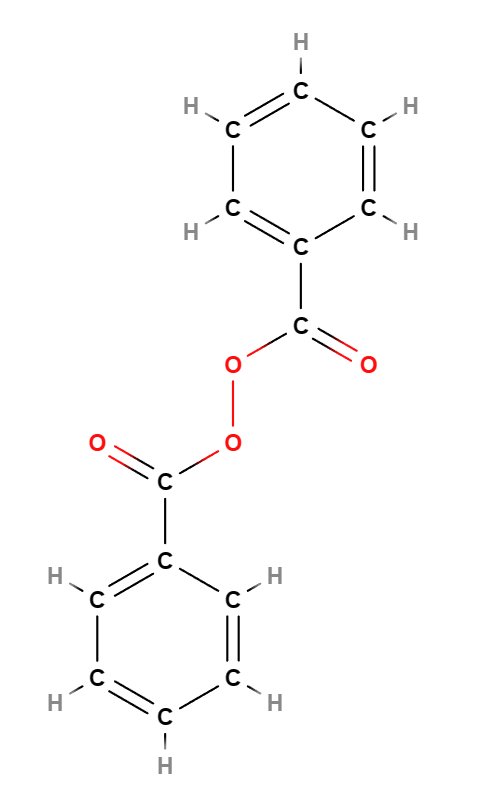
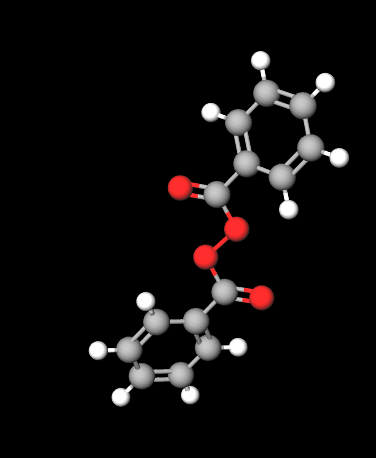
Il perossido di benzoile o benzoyl peroxide, è un composto organico utilizzato principalmente come agente antiacne. È efficace nel trattare l'acne riducendo il numero di batteri sulla pelle, diminuendo l'infiammazione e aiutando a sbloccare i pori ostruiti (1). Applicato sulla pelle sotto forma di gel o crema, il perossido di benzoile rilascia ossigeno, che uccide i batteri anaerobi e favorisce la desquamazione della pelle e il rinnovamento delle cellule.
Processo industriale di sintesi chimica
- Preparazione. La sintesi inizia con la reazione tra cloruro di benzoile e perossido di idrogeno in un ambiente di reazione controllato.
- Reazione. I reagenti sono miscelati sotto condizioni fredde e in presenza di un solvente come l'etere di petrolio per limitare la velocità della reazione e prevenire il surriscaldamento.
- Purificazione. Il composto formato viene purificato attraverso processi di precipitazione e filtrazione per rimuovere impurità e solvente in eccesso.
- Essiccazione. Dopo la purificazione, il benzoyl peroxide è essiccato con cura per ridurre al minimo la presenza di umidità, che può rendere instabile il composto.
- Condizionamento. Il prodotto essiccato è poi miscelato con additivi come fosfati o vari tipi di polveri inerti per stabilizzarlo e ridurre il rischio di decomposizione o esplosione.
- Controllo qualità. Ogni lotto di benzoyl peroxide prodotto viene sottoposto a rigorosi test di qualità e stabilità per assicurare la sicurezza e l'efficacia del prodotto finale.
A cosa serve e dove si usa
Cosmetica - Funzioni INCI
E' un ingrediente soggetto a restrizioni III/94 come Voce pertinente negli allegati del regolamento europeo sui cosmetici n. 1223/2009. Sostanza o ingrediente segnalato: Dibenzoyl peroxide- Concentrazione massima nella preparazione pronta all'uso 0,7% (dopo la miscelazione per l'uso)
Ossidante. Questo ingrediente ha la capacità di modificare la natura chimica di un altro ingrediente mediante l'aggiunta di ossigeno oppure tramite la rimozione di idrogeno.
Principali utilizzi e benefici del perossido di benzoile.
- Trattamento dell'acne. Il perossido di benzoile è uno degli ingredienti più efficaci per il trattamento topico dell'acne, grazie alla sua capacità di uccidere i batteri che causano l'acne e ridurre l'infiammazione.
- Proprietà antibatteriche. Uccide i batteri riducendo i lipidi sulla pelle e liberando ossigeno tossico per i batteri anaerobici (2).
- Effetto cheratolitico. Aiuta a prevenire la formazione di comedoni rimuovendo l'eccesso di cellule morte della pelle e promuovendo il rinnovamento cellulare (3).
- Riduzione dell'olio e delle impurità. Può aiutare a ridurre il sebo e le impurità che contribuiscono alla formazione dell'acne (4).
- Uso. Spesso utilizzato in combinazione con altri trattamenti per l'acne, come gli antibiotici topici o l'acido salicilico, per migliorare l'efficacia complessiva del trattamento.
- Disponibilità. Disponibile in varie forme, tra cui gel, creme, lozioni e lavaggi, permettendo agli utenti di scegliere la formulazione che meglio si adatta alla loro pelle.
Sicurezza
È uno dei trattamenti topici più comuni per l'acne lieve e moderata, ma può causare secchezza, arrossamento e desquamazione, particolarmente durante le prime settimane di trattamento.
Il perossido di benzoile è ritenuto efficace terapia antimicrobica alternativa per l'acne (5).
Molecular Formula C14H10O4
Molecular Weight 242.23 g/mol
CAS 94-36-0
UNII W9WZN9A0GM
EC Number 202-327-6
DTXSID6024591
Synonyms:
Peroxide, dibenzoyl
Dibenzoyl peroxide
Benzoyl superoxide
Bibliografia_____________________________________________________________________
(1) Kawashima M, Nagare T, Doi M. Clinical efficacy and safety of benzoyl peroxide for acne vulgaris: Comparison between Japanese and Western patients. J Dermatol. 2017 Nov;44(11):1212-1218. doi: 10.1111/1346-8138.13996. Epub 2017 Aug 9. PMID: 28791735; PMCID: PMC5697687.
Abstract. Benzoyl peroxide (BPO) has been well established as a common medication for acne vulgaris in many countries (e.g. in Europe and the USA), where clinical data have been accumulated over a long time. In Japan, the use of BPO for acne treatment was approved in 2014, and the results of clinical trials in Japanese patients have recently been reported. This review compares clinical study results between Japanese and Western patients. Clinical studies that had been performed in Western countries were searched on the basis of the criteria, double-blind studies of BPO monotherapy and comparison with a vehicle group. Two reports of Japanese studies were also selected by using the same criteria. Efficacy was assessed by comparing the mean difference between the BPO and the vehicle groups for reduction rate in the number of lesions from baseline, and there were no differences between Japanese and Western patients. Safety assessment also showed that the incidence of adverse events was higher in Japanese patients than in Western patients, but the characteristics of the adverse events were not different. Therefore, we conclude that there are no significant differences in the efficacy and safety of BPO between these patient populations. The efficacy and safety of long-term use in Japanese patients are also expected to be applicable to those in Western patients.
Stein Gold L, Baldwin H, Kircik LH, Weiss JS, Pariser DM, Callender V, Lain E, Gold M, Beer K, Draelos Z, Sadick N, Pillai R, Bhatt V, Tanghetti EA. Efficacy and Safety of a Fixed-Dose Clindamycin Phosphate 1.2%, Benzoyl Peroxide 3.1%, and Adapalene 0.15% Gel for Moderate-to-Severe Acne: A Randomized Phase II Study of the First Triple-Combination Drug. Am J Clin Dermatol. 2022 Jan;23(1):93-104. doi: 10.1007/s40257-021-00650-3.
(2) Eichenfield DZ, Sprague J, Eichenfield LF. Management of Acne Vulgaris: A Review. JAMA. 2021 Nov 23;326(20):2055-2067. doi: 10.1001/jama.2021.17633.
Abstract. Importance: Acne vulgaris is an inflammatory disease of the pilosebaceous unit of the skin that primarily involves the face and trunk and affects approximately 9% of the population worldwide (approximately 85% of individuals aged 12-24 years, and approximately 50% of patients aged 20-29 years). Acne vulgaris can cause permanent physical scarring, negatively affect quality of life and self-image, and has been associated with increased rates of anxiety, depression, and suicidal ideation. Observations: Acne vulgaris is classified based on patient age, lesion morphology (comedonal, inflammatory, mixed, nodulocystic), distribution (location on face, trunk, or both), and severity (extent, presence or absence of scarring, postinflammatory erythema, or hyperpigmentation). Although most acne does not require specific medical evaluation, medical workup is sometimes warranted. Topical therapies such as retinoids (eg, tretinoin, adapalene), benzoyl peroxide, azelaic acid, and/or combinations of topical agents are first-line treatments. When prescribed as a single therapy in a randomized trial of 207 patients, treatment with tretinoin 0.025% gel reduced acne lesion counts at 12 weeks by 63% compared with baseline. Combinations of topical agents with systemic agents (oral antibiotics such as doxycycline and minocycline, hormonal therapies such as combination oral contraception [COC] or spironolactone, or isotretinoin) are recommended for more severe disease. In a meta-analysis of 32 randomized clinical trials, COC was associated with reductions in inflammatory lesions by 62%, placebo was associated with a 26% reduction, and oral antibiotics were associated with a 58% reduction at 6-month follow-up. Isotretinoin is approved by the US Food and Drug Administration for treating severe recalcitrant nodular acne but is often used to treat resistant or persistent moderate to severe acne, as well as acne that produces scarring or significant psychosocial distress. Conclusions and relevance: Acne vulgaris affects approximately 9% of the population worldwide and approximately 85% of those aged 12 to 24 years. First-line therapies are topical retinoids, benzoyl peroxide, azelaic acid, or combinations of topicals. For more severe disease, oral antibiotics such as doxycycline or minocycline, hormonal therapies such as combination oral conceptive agents or spironolactone, or isotretinoin are most effective.
(3) Ly S, Kamal K, Manjaly P, Barbieri JS, Mostaghimi A. Treatment of Acne Vulgaris During Pregnancy and Lactation: A Narrative Review. Dermatol Ther (Heidelb). 2023 Jan;13(1):115-130. doi: 10.1007/s13555-022-00854-3.
(4) Titus S, Hodge J. Diagnosis and treatment of acne. Am Fam Physician. 2012 Oct 15;86(8):734-40.
Abstract. Acne is a chronic inflammatory skin disease that is the most common skin disorder in the United States. Therapy targets the four factors responsible for lesion formation: increased sebum production, hyperkeratinization, colonization by Propionibacterium acnes, and the resultant inflammatory reaction. Treatment goals include scar prevention, reduction of psychological morbidity, and resolution of lesions. Grading acne based on lesion type and severity can help guide treatment. Topical retinoids are effective in treating inflammatory and noninflammatory lesions by preventing comedones, reducing existing comedones, and targeting inflammation. Benzoyl peroxide is an over-the-counter bactericidal agent that does not lead to bacterial resistance. Topical and oral antibiotics are effective as monotherapy, but are more effective when combined with topical retinoids. The addition of benzoyl peroxide to antibiotic therapy reduces the risk of bacterial resistance. Oral isotretinoin is approved for the treatment of severe recalcitrant acne and can be safely administered using the iPLEDGE program. After treatment goals are reached, maintenance therapy should be initiated. There is insufficient evidence to recommend the use of laser and light therapies. Referral to a dermatologist should be considered if treatment goals are not met.
(5) Leyden, J. J., Hickman, J. G., Jarratt, M. T., Stewart, D. M., & Levy, S. F. (2001). The efficacy and safety of a combination benzoyl peroxide/clindamycin topical gel compared with benzoyl peroxide alone and a benzoyl peroxide/erythromycin combination product. Journal of Cutaneous Medicine and Surgery: Incorporating Medical and Surgical Dermatology, 5, 37-42.
Abstract. Background: Topical clindamycin and benzoyl peroxide have each demonstrated clinical efficacy in the treatment of acne vulgaris. When used in tandem, they promise greater efficacy than either individual agent through their antibacterial and anti-inflammatory effects. Objective: To determine the efficacy and safety of combination benzoyl peroxide/clindamycin compared with benzoyl peroxide or benzoyl peroxide/erythromycin in the treatment of acne. Methods: In this randomized, 10-week, multicenter, single-blind trial, 492 patients with moderate to moderately severe acne were treated twice daily with 5% benzoyl peroxide/1% clindamycin, 5% benzoyl peroxide, or 5% benzoyl peroxide/3% erythromycin and assessed every 2 weeks. Results: Compared with benzoyl peroxide, benzoyl peroxide/clindamycin demonstrated significantly greater reductions in inflammatory lesions (p = 0.04) and significantly greater overall improvement as assessed by physicians (p ? 0.04) and patients (p <0.001). Benzoyl peroxide/clindamycin demonstrated a nonsignificant trend for greater efficacy compared to benzoyl peroxide/erythromycin. Dry skin was the most frequent (?7.3%) adverse event with all three therapies. Conclusion: Benzoyl peroxide/clindamycin demonstrated improved efficacy and similar tolerability to benzoyl peroxide used alone and was similar to benzoyl peroxide/erythromycin, making this combination product an effective alternative antimicrobial therapy for acne.