



D&C Red 7 Lake is a chemical compound, an azo synthetic red dye.
The name describes the structure of the molecule:
D&C" stands for "Drugs and Cosmetics", indicating that this dye is approved for use in drugs and cosmetics in the USA. The prefix ensures that the dye meets certain safety standards for these applications.
Red 7. "Red 7" specifies the type of red within the dye catalog, identifying a particular shade of red.
Lake. In chemistry, "lake" refers to a type of insoluble dye. Lake pigments are created by precipitating a soluble dye with a metal (such as aluminum), making them insoluble in water and thus more stable in non-aqueous products like powdered cosmetics.
Chemical Industrial Synthesis Process
- Selection of base materials. The process begins with the selection of 3-hydroxy-2-naphthoic acid and aniline, which are the main chemical precursors.
- Condensation. The acid and aniline are fused together in the presence of an acid catalyst to form a diazonium salt.
- Coupling. The diazonium salt is then reacted with a coupling compound such as 2-naphthol, forming the crude pigment.
- Precipitation and filtration. The pigment is precipitated with water to remove excess salt and other impurities, followed by filtration to isolate the pigment.
- Drying. The filtered pigment is dried to further reduce moisture content.
- Laking. To stabilize the color and enhance resistance to light and chemicals, the pigment may be treated with substrates like barium or calcium salts.
- Quality control. Each batch of Pigment Red 57 undergoes quality testing to ensure compliance with required specifications.
It is a restricted ingredient as IV/27 (CI 15850) III/296 (Pigment Red 57) a Relevant Item in the Annexes of the European Cosmetics Regulation 1223/2009. Substance or ingredient reported: Disodium 3-hydroxy-4-[(4-methyl-2-sulphonatophenyl)azo]-2-naphthoate and its insoluble barium, strontium and zirconium lakes, salts and pigments
Safety
The problem with azo dyes (monoazo or diazo) is photocatalytic degradation (1) leading to oxidation and the subsequent formation of impurities such as aromatic amines (2), some of which have carcinogenic activity.
OPINION OF THE SCIENTIFIC COMMITTEE ON COSMETIC PRODUCTS AND NON-FOOD
PRODUCTS INTENDED FOR CONSUMERS.
CONCERNING
PIGMENT RED 57
Adopted by the SCCNFP during the 28th plenary meeting of 25 May 2004
"Pigment Red 57 (Lithol Rubine B and BK) is of low acute toxicity in rats and dogs. Repeated
and chronic oral administration to rodents up to 2 years, showed the kidney as a primary target
organ in the high doses. The lowest NOAEL (150 mg/kg/bw/day) was obtained in the 2 years
toxicity study in rats performed with the F1-generation of parent-animals pretreated at the same
dose levels. The SCF also used this study to derive an ADI for this compound.
There is no indication for corrosivity or comedogenic effects on the skin. Also no irritation on
mucous membranes was noted. From the results of the local lymph node assay it is concluded
that Pigment Red 57 is not a skin-sensitiser.
There was no convincing evidence of reproductive effects in rats and rabbits treated orally.
Pigment Red 57 (Lithol Rubine B) did not cause skin irritation in rabbits but induced skin
sensitisation in man. Diluted Lithol Rubine BK produced little irritation in man and rabbits and
failed to induce sensitisation in man.
Pigment Red 57 has been tested for the induction of gene mutations in bacterial cells and in the
mammalian cells and found negative. The in vivo study for the induction of the micronuclei is
inadequate for the evaluation.
None of the available carcinogenicity studies are reported in sufficient details to allow an
evaluation of the potential carcinogenicity of Pigment Red 57."
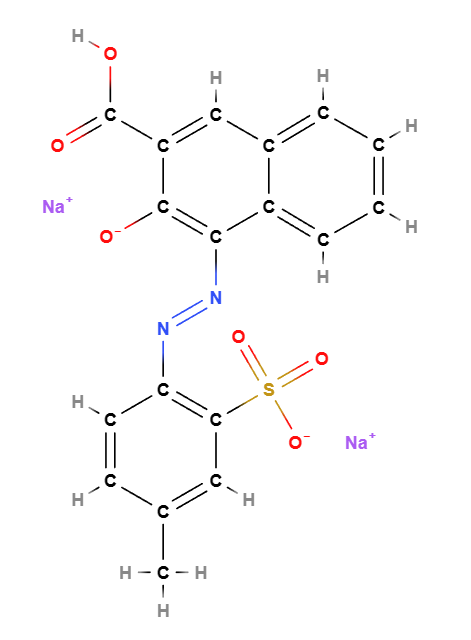 | 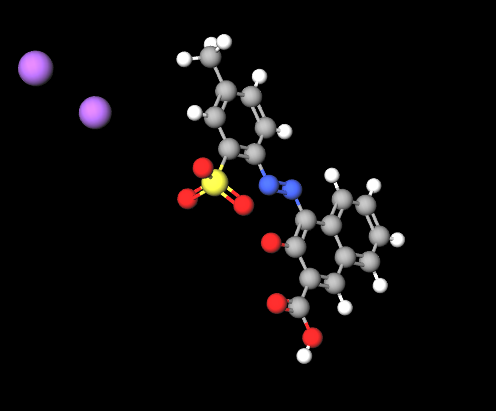 |
Chemical name: disodium;2-[(3-carboxy-2-oxidonaphthalen-1-yl)diazenyl]-5-methylbenzenesulfonate
Molecular Formula C18H12N2Na2O6S
Molecular Weight 430.3 g/mol
CAS 5281-04-9
UNII 481744AI4O
EC Number 227-497-9
DTXSID6064038
Synonyms:
D&C Red No. 6
Lithol Rubine B
Pigment Red 57
D&C Red No. 7
Lithol Rubine B Ca

