



Dibutyl Adipate is an ester obtained from the reaction between adipic acid and butanol. Esters are organic compounds that form when a carboxylic acid group of an acid reacts with the hydroxyl group of an alcohol, eliminating a molecule of water. In the case of Dibutyl Adipate, two molecules of butanol react with one molecule of adipic acid, forming the ester.
Chemical Industrial Synthesis Process
- The production of Dibutyl Adipate, an adipic acid ester used as a plasticizer in polymers and as an ingredient in cosmetics for its emollient properties, follows an esterification process. Here is a detailed overview of the process.
- Preparation. Adipic acid and butyl alcohol (butanol) are prepared as reagents for the esterification reaction. The purity of these reagents is crucial for the quality of the final product.
- Esterification. Adipic acid reacts with butyl alcohol in the presence of an acid catalyst, such as sulfuric acid, to form Dibutyl Adipate and water as a by-product. The reaction is typically conducted by heating the reactive mixture at controlled temperatures.
- Water Removal. Water produced as a by-product of the reaction is removed to shift the chemical equilibrium towards product formation and increase yield. This can be done using techniques such as azeotropic distillation.
- Purification. The crude Dibutyl Adipate is purified to remove impurities, reagent residues, and by-products. Purification can include vacuum distillation, which helps to achieve a high-purity product.
- Quality Control. The purified Dibutyl Adipate undergoes quality control checks to verify its purity, chemical composition, and physical properties. These tests can include gas chromatography (GC), infrared spectroscopy (IR), and molecular weight determination.
Appearance
Typically appears as an oily, transparent, and colorless liquid with a slight characteristic odor.
What it is for and where
It is used in numerous cosmetic, pharmaceutical and skincare products for its ability to improve the texture, stability, and consistency of formulations, as well as imparting a soft and smooth feeling on the skin.
Cosmetics - INCI Functions
Skin conditioning agent - Emollient. Emollients have the characteristic of enhancing the skin barrier through a source of exogenous lipids that adhere to the skin, improving barrier properties by filling gaps in intercorneocyte clusters to improve hydration while protecting against inflammation. In practice, they have the ability to create a barrier that prevents transepidermal water loss. Emollients are described as degreasing or refreshing additives that improve the lipid content of the upper layers of the skin by preventing degreasing and drying of the skin. The problem with emollients is that many have a strong lipophilic character and are identified as occlusive ingredients; they are oily and fatty materials that remain on the skin surface and reduce transepidermal water loss. In cosmetics, emollients and moisturisers are often considered synonymous with humectants and occlusives.
Film-forming agent. It produces, upon application, a very thin continuous film with an optimal balance of cohesion, adhesion and stickiness on skin, hair or nails to counteract or limit damage from external phenomena such as chemicals, UV rays and pollution.
Plasticiser. Ingredient added to the formulation with the purpose of retaining fragrance and colour, increasing flexibility, flowability, deformability, durability of various ingredients allowing better processing. It softens and makes flexible synthetic polymers that otherwise could not be easily processed, stretched or deformed.
Skin conditioning agent. It is the mainstay of topical skin treatment as it has the function of restoring, increasing or improving skin tolerance to external factors, including melanocyte tolerance. The most important function of the conditioning agent is to prevent skin dehydration, but the subject is rather complex and involves emollients and humectants that can be added in the formulation.
Solvent. It is the substance for dissolving or dispersing surfactants, oils, dyes, flavourings, bactericidal preservatives in solution.In fact, it dissolves other components present in a cosmetic formulation. Solvents are generally liquid (aqueous and non-aqueous).
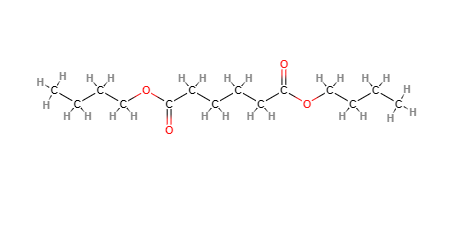 |
Molecular Formula C14H26O4
Molecular Weight
CAS 105-99-7
UNII F4K100DXP3
EC Number 203-350-4
DTXSID2021866
Synonyms
- Dibutyl hexanedioate
- Butyl adipate
- Di-n-butyl adipate

