



Chestnuts, Chestnut (Castanea sativa)
Description
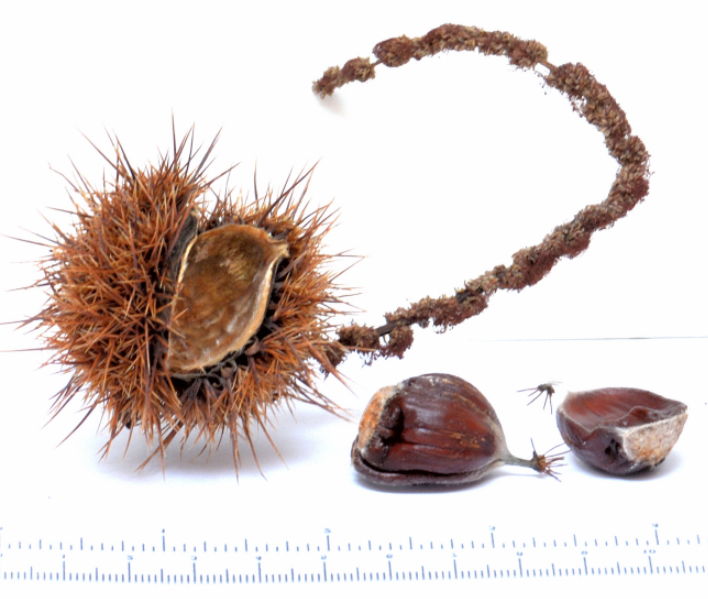
The chestnut is the nut of the sweet chestnut tree (Castanea sativa), a species traditionally widespread in temperate regions of Europe and particularly important in many Italian mountain and hill areas. Each nut is enclosed in a spiny burr that opens when ripe, revealing one or more brown, shiny fruits with a flat side and a pointed tip. Inside, the kernel is pale, firm when raw and becomes soft and floury when cooked, with a naturally sweet, characteristic flavour. Unlike most other tree nuts, chestnuts are low in fat and relatively rich in complex carbohydrates, fibre, certain minerals and B-group vitamins. They are naturally gluten free and become easily digestible after cooking (boiled, roasted or steamed). Chestnuts are eaten fresh in season, but also dried, milled into flour or processed into purees, creams and confectionery products; dried chestnuts and chestnut flour have historically been a staple carbohydrate source in many mountainous regions.
Botanical classification
Common name: sweet chestnut, castagna (fruit of the chestnut tree)
Botanical name: Castanea sativa
Family: Fagaceae
Origin: Southern Europe and Asia Minor
General features: large, long-lived deciduous tree with a broad crown, serrated lanceolate leaves, and fruits (chestnuts) enclosed in spiny burrs; cultivated both for nut production and for timber.
Cultivation and growing conditions
Climate
Adapted to temperate climates, typically in hilly and mountain areas.
Tolerates winter cold, but late spring frosts can damage buds, flowers, and young fruits.
Needs summers that are not excessively dry and a sufficiently long growing season to complete fruit development.
Sensitive to prolonged summer drought, which can cause irregular cropping, fruit drop, and smaller nuts.
Exposure
Prefers sunny or slightly airy positions.
Shading reduces productivity and nut quality.
Sites with frequent late frosts or strong winds should be avoided, as they can damage flowers and young shoots.
Soil
Prefers deep, well-drained, generally acidic to slightly acidic soils.
Does not tolerate very calcareous, compact, or waterlogged soils.
Grows best in soils rich in organic matter, with good water-holding capacity but without stagnation.
Irrigation
In traditional mountain orchards, chestnut is commonly grown without irrigation, relying on natural rainfall.
In more intensive systems, supplementary irrigation during hot, dry periods is beneficial, especially during nut enlargement, to improve yield and calibre.
Excessive irrigation in heavy soils should be avoided to reduce the risk of root rot and decline.
Temperature
Buds, flowers, and young fruits are sensitive to late spring frosts.
Very high summer temperatures combined with water stress negatively affect nut size and filling.
Performs best in areas with a climate broadly similar to viticulture areas: marked daily temperature range but without extreme cold or heat.
Fertilization
Responds well to organic amendments (compost, well-matured manure).
Mineral fertilization should be balanced:
nitrogen to support canopy growth,
phosphorus for root development and flowering,
potassium for nut quality and improved tolerance to water stress.
On very acidic or nutrient-poor soils, specific micronutrient additions may be useful based on soil analysis.
Crop care
Formative pruning in young trees, followed by light maintenance pruning to keep an open, well-aired canopy and regular fruiting.
Weed control under the canopy is important in the establishment phase.
Monitoring and management of major diseases (e.g. chestnut blight and ink disease), combined with appropriate cultural practices and, where possible, more tolerant material.
In traditional chestnut groves, management is often extensive, with periodic interventions for pruning, understorey control, and renewal.
Harvest
Harvest takes place in autumn, when burrs open naturally and release the nuts to the ground.
Nuts can be gathered manually or with mechanical aids.
Timely collection is important to limit decay and damage from wildlife.
Post-harvest, nuts are often subjected to curing or conservation processes (drying, cold storage, water treatments) to improve storability and reduce rot and sprouting.
Propagation
Commercial orchards are usually established with grafted plants on selected rootstocks chosen for vigour, adaptability, and disease tolerance.
Seedlings (from nuts) are mainly used to produce rootstocks that are grafted later.
Planting is carried out in late autumn or late winter, with spacing adapted to tree vigour and the chosen management system.
Indicative nutritional values per 100 g (fresh, raw chestnuts)
(Values may vary slightly with variety and origin.)
Energy: ~180–200 kcal
Water: ~50–55 g
Protein: ~2–3 g
Total carbohydrates: ~40–45 g
Starch: main fraction
Sugars: ~8–10 g
Dietary fibre: ~7–8 g
Total fat: ~1–2 g
First occurrence of lipid acronyms: SFA (saturated fatty acids, to be moderated when total intake is high), MUFA (monounsaturated fatty acids, generally favourable to lipid profile), PUFA (polyunsaturated fatty acids, involved in various metabolic functions). Later mentions will use these acronyms without bold.
SFA: ~0.3–0.4 g
MUFA: ~0.4–0.6 g
PUFA: ~0.3–0.4 g
Minerals (typical values)
Potassium: ~450–550 mg
Phosphorus: ~80–100 mg
Magnesium: ~30–35 mg
Calcium: ~25–30 mg
Iron: ~0.8–1 mg
Vitamins
B-group vitamins (B1, B2, B3, B6)
Folate
Vitamin C (significant in fresh chestnuts, partly reduced by cooking and drying)
(For dried chestnuts and chestnut flour, values are more concentrated in energy and nutrients due to lower water content.)
Key constituents
Complex carbohydrates
Starches (including some resistant starch) and natural sugars
Dietary fibre
Soluble and insoluble fibre contributing to satiety and intestinal health
Proteins
Modest but present protein content with a mixed amino-acid profile
Lipids
Low total fat with small amounts of sfa, mufa and pufa
Minerals
Potassium, phosphorus, magnesium, calcium and small amounts of iron and trace elements
Phytochemicals
Phenolic compounds and antioxidants (especially in the pellicle and shell)
Production process
Harvest
Chestnuts ripen in autumn (typically September–November); ripe burrs open and nuts fall to the ground, where they are collected manually or mechanically.
Sorting and cleaning
Removal of debris, damaged or mouldy fruits and separation by size and quality class.
Traditional conservation and drying
Methods such as water curing or storage in ventilated rooms for short-term use.
For long-term storage, chestnuts are dried in dedicated drying houses (e.g. “metato” in some Italian regions) or in modern dryers at controlled temperatures.
Shelling and peeling
Removal of the hard outer shell and inner brown pellicle using mechanical shellers and abrasive or thermal processes.
Milling (for flour)
Dried, peeled chestnuts are milled into a fine, naturally sweet, gluten-free flour.
Packaging
Fresh nuts: nets, crates or trays for short distribution chains.
Dried chestnuts and flour: sealed bags or containers protecting from moisture, insects and light.
Physical properties
Whole nut
Shiny, dark brown shell, firm and resistant.
Pale, creamy kernel with dense, starchy texture when raw.
Cooked nut
Soft, floury, slightly crumbly texture; pleasant sweetness.
Dried chestnut
Hardened, light-coloured kernel with reduced size and weight; intense sweetness.
Flour
Fine beige powder with sweet taste and characteristic aroma.
Moisture
High in fresh chestnuts; very low in dried chestnuts and flour, which strongly affects shelf-life.
Sensory and technological properties
Flavour
Characteristically sweet, mild and aromatic, with notes of cereal and vanilla-like accents.
Aroma
Delicate at room temperature, becoming more intense and toasted after roasting or baking.
Texture
After cooking, chestnuts become floury and creamy, suitable for purees, fillings and velvety preparations.
Functional behaviour in food
As whole nuts: good structure in soups, stuffings and side dishes, though prolonged cooking can cause fragmentation.
As dried nuts: can be rehydrated and used in soups, stews and desserts.
As flour:
Provides natural sweetness and a warm colour to baked goods.
Has no gluten, so it does not form elastic doughs; usually needs to be blended with other flours or binding agents.
Has good water-binding and thickening capacity for creams, soups and sauces.
Food applications
Fresh chestnuts
Boiled, roasted, steamed or cooked in stews and soups.
Used as side dishes or mixed with vegetables, meats or grains.
Dried chestnuts
Rehydrated and used in soups, traditional dishes, desserts and stuffings.
Eaten as snacks after cooking or baking.
Chestnut flour
Traditional preparations (castagnaccio, pancakes, crêpes, “necci”, biscuits and cakes).
Breads and focaccias (usually blended with other gluten-containing or gluten-free flours for structure).
Thickening agent in soups, sauces and creams, adding flavour and sweetness.
Industrial and artisanal products
Chestnut purée and crème, spreads, fillings, gnocchi, pasta, snacks and confectionery products.
Nutrition and health
Carbohydrates and glycaemic aspects
Chestnuts are a carbohydrate-rich food, providing mainly complex carbohydrates and some natural sugars; their glycaemic impact depends on portion size and preparation but is attenuated by the fibre content.
Fibre
The fibre fraction supports satiety, intestinal regularity and modulation of postprandial glycaemia.
Micronutrients
Potassium contributes to normal blood pressure and neuromuscular function.
Magnesium and phosphorus support energy metabolism and bone health.
B-group vitamins and folate contribute to normal energy production and nervous system function.
Vitamin C present in fresh chestnuts adds antioxidant and immune-support roles, although thermal processing reduces its content.
Lipids and cardiovascular profile
Low fat content and small amounts of sfa, mufa and pufa mean chestnuts contribute little to overall fat intake compared with other nuts; their profile is relatively favourable in the context of balanced diets.
Gluten-free profile
Chestnuts and chestnut flour are naturally gluten free and can be used in diets for coeliac disease and gluten sensitivity, subject to cross-contamination control.
Nota porzione
Typical serving: around 80–100 g of cooked chestnuts (approximately 5–7 medium-sized nuts) as part of a meal or snack.
For flour: about 30 g per serving in baked products, often combined with other flours.
Allergens and intolerances
Tree-nut allergy
Chestnuts are botanically distinct from many common tree nuts and are not among the most frequent nut allergens, but cross-reactions are possible in some individuals.
Latex–fruit syndrome
Cross-reactivity between chestnut allergens and natural rubber latex has been described; people with latex allergy should seek medical advice before consuming chestnuts.
Gluten
Chestnuts do not contain gluten; however, chestnut flour and processed products may be contaminated with gluten if produced in mixed facilities.
Storage and shelf-life
Fresh chestnuts
Highly perishable due to high moisture content; should be stored cool (refrigerated or in a fresh cellar) and well ventilated.
Typical shelf-life: 1–2 weeks under domestic conditions; longer under controlled atmosphere.
Dried chestnuts
Much longer shelf-life (several months) when kept in a cool, dry environment, protected from insects and rodents.
Chestnut flour
Should be stored in airtight containers away from heat and light; refrigeration or freezing helps to prevent rancidity and insect infestation.
Typical shelf-life: 6–12 months, depending on storage conditions.
Signs of spoilage
Presence of mould, off odours (acidic, musty), insect holes or larvae, or rancid smell in flour indicate that the product should not be consumed.
Safety and regulatory aspects
General safety
Chestnuts and chestnut products are considered safe when harvested, processed and stored according to good practices.
Contaminants
As with other nuts and fruits, controls for mycotoxins, pesticide residues and heavy metals are required by food safety regulations.
Gluten-free claims
Chestnut flour can be labelled “gluten free” when produced under controlled conditions that ensure gluten levels below the regulatory threshold (commonly <20 ppm).
Labelling
Ingredient names
Typical names: “chestnuts”, “dried chestnuts”, “chestnut flour”; in Italian contexts: “castagne”, “castagne secche”, “farina di castagne”.
Voluntary indications
“Gluten free” if legally compliant.
“Naturally sweet” (where allowed) due to intrinsic sugar content.
“Source of fibre” or “high in fibre” when compositional criteria are met.
Mandatory information
Country of origin, net weight, batch number, best-before date and storage instructions, according to applicable legislation.
Troubleshooting
Problem: Fresh chestnuts dry out and become hard quickly.
Possible causes: storage in warm, dry air; time elapsed since harvest.
Corrective actions: store in a cool, slightly humid environment; soak in water for some hours before cooking to improve texture.
Problem: Chestnuts are difficult to peel after cooking.
Possible causes: insufficient scoring of the shell; inadequate cooking time or method.
Corrective actions: score shells with a cross before cooking; roast or boil long enough; peel while still warm.
Problem: Chestnut flour forms lumps in doughs or creams.
Possible causes: flour added too quickly to liquids; high humidity in the flour.
Corrective actions: sift flour before use; disperse gradually into liquid under stirring; adjust hydration.
Problem: Baked goods with chestnut flour are too crumbly.
Possible causes: absence of gluten and insufficient binding.
Corrective actions: blend chestnut flour with more structured flours (e.g. rice, maize, wheat if gluten is allowed) or add binders (eggs, hydrocolloids such as xanthan or psyllium).
Sustainability and supply chain
Agro-ecological aspects
Chestnut groves in hilly and mountainous areas help prevent soil erosion, support biodiversity and maintain traditional agricultural landscapes.
Environmental impact
Chestnut cultivation typically involves low input of synthetic fertilisers and pesticides compared with intensive arable crops.
Socio-economic role
Chestnut production supports rural economies through fresh nuts, dried products, flours and certified designations of origin.
Valorisation of chestnut forests through sustainable management can improve both environmental health and economic returns.
Main INCI functions (cosmetics)
(For cosmetic ingredients such as Castanea Sativa Seed Extract, Castanea Sativa Shell Powder.)
Antioxidant: provides phenolic compounds that help protect skin and formulations from oxidative stress.
Skin conditioning and emollient: supports softness and comfort of the skin in creams and lotions.
Soothing: used in some formulations aimed at mildly sensitive or stressed skin.
Gentle exfoliant: finely ground shell powder can act as a mild physical exfoliant in scrubs.
Functional component in natural or “nut-based” product concepts.
Conclusion
Chestnuts (Castanea sativa) are a distinctive nut-fruit that combines tradition, flavour and interesting nutritional characteristics. Unlike most other nuts, they are low in fat and relatively rich in complex carbohydrates and fibre, with useful amounts of minerals and vitamins, making them a valuable energy source, especially in colder seasons and in physically demanding lifestyles. Their naturally sweet, aromatic flavour and versatile technological properties allow a wide range of culinary uses, from simple roasted chestnuts to flours, desserts and savoury dishes. Naturally gluten free and rooted in traditional agro-forestry systems, chestnuts also carry important environmental and cultural value. In both food and cosmetic applications, chestnut-derived ingredients offer a combination of sensory appeal, functionality and a strong link to regional identity and sustainability.
Studies
The fruit has been used by traditional medicine to treat various diseases, such as cardioprotective, neuroprotective, antispastic, as well as against diarrhea and bronchitis for its stringent properties.
Over the past 50 years, chestnut has been thoroughly studied and interesting results have emerged on the photoprotective ability of extracts of its leaves against UV rays, due to their antioxidant peculiarity (1).
Antiviral activity of chestnut wood extract against avian reovirus (2) has also been demonstrated.
The part called "burs" or hedgehog has a low protein content, but an interesting range of essential amino acids (arginine, leucina) and non-essential (asparctic acid and glutamic acid, as well as proline). The lipid extract contains tocoferols and tocotrienols (3).
Mini-glossary
SFA – Saturated fatty acids; fats that, when consumed in excess, can raise LDL (“bad”) cholesterol and increase cardiovascular risk.
MUFA – Monounsaturated fatty acids; fats generally associated with more favourable lipid profiles when they replace saturated fats in the diet.
PUFA – Polyunsaturated fatty acids; include omega-3 and omega-6 families, important for cell membranes, inflammatory regulation and cardiovascular health.

