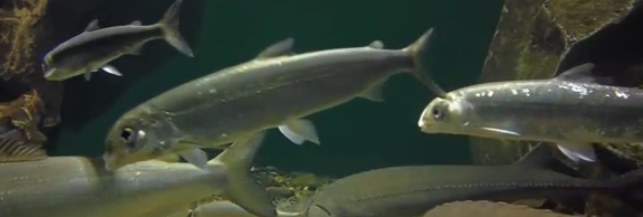
Il Coregone o lavarello, conosciuto con il nome scientifico di Coregonus lavaretus, è un pesce di acqua dolce appartenente alla famiglia dei Salmonidi. Ha un corpo allungato e leggermente compresso lateralmente, con una bocca piccola e una pinna dorsale ben sviluppata.
Habitat e Distribuzione
Il coregone è diffuso nelle acque dolci fredde e ossigenate dell'Europa settentrionale e centrale e predilige i grandi laghi e i bacini fluviali, dove vive in acque profonde.
Alimentazione
Si nutre principalmente di plancton, ma anche di piccoli invertebrati e larve di insetti e la sua dieta varia a seconda della stagione e dell'habitat.
Riproduzione
La riproduzione avviene in inverno. I coregoni depongono le uova su fondali sabbiosi o ghiaiosi. Le larve nascono in primavera e si nutrono di zooplancton.
Importanza Economica
Il coregone è apprezzato per le sue carni delicate e viene pescato sia per il consumo locale che commerciale ed è anche un pesce popolare tra gli appassionati di pesca sportiva.
Conservazione
Alcune popolazioni di coregone sono minacciate da inquinamento, eutrofizzazione e introduzione di specie invasive.
Sono in atto sforzi di conservazione per proteggere le popolazioni selvatiche e mantenere la biodiversità degli ecosistemi acquatici.
Utilizzi Culinari
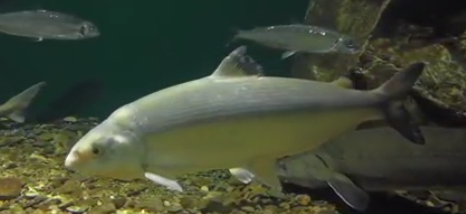
Frittura. Il coregonus può essere fritto in una pastella leggera o impanato per ottenere una crosta croccante e un interno morbido e succulento.
Al Forno. La cottura al forno è un metodo salutare per preparare il coregonus. Può essere cotto con erbe, limone e olio d'oliva per un sapore fresco e leggero.
Alla Griglia. Il coregonus è adatto alla griglia, dove può sviluppare una leggera affumicatura e una crosta leggermente croccante sulla pelle.
Affumicatura. Il coregonus può essere affumicato per creare un pesce affumicato dal sapore ricco e aromatico.
Sashimi. In alcune preparazioni, il coregonus può essere tagliato sottilmente e servito come sashimi, spesso accompagnato da salsa di soia e wasabi.
Zuppe e Stufati. Il coregonus è un ingrediente comune nelle zuppe e negli stufati di pesce, aggiungendo sapore e nutrienti.
Abbinamenti Culinari
Erbe Aromatiche. Il coregonus si abbina bene con erbe aromatiche come l'aneto, il prezzemolo e il timo.
Agrumi. Il succo di limone o l'arancia possono essere utilizzati per dare un tocco di freschezza al pesce.
Patate. Il coregonus può essere servito con purè di patate o patate arrosto come contorno tradizionale.
Verdure. Verdure come gli asparagi, i piselli o gli spinaci si sposano bene con il coregonus.
Altre Applicazioni
Conservazione. In alcune aree, i coregonus sono oggetto di programmi di conservazione per proteggere le popolazioni selvatiche e gli habitat acquatici.
Pesca Sportiva. Il coregonus è apprezzato dai pescatori sportivi per le sue dimensioni e la sua sfida nella cattura.
Ricerca
Gli studiosi utilizzano i coregonus per condurre ricerche sulla biologia dei pesci d'acqua dolce e sugli ecosistemi acquatici.
Bibliografia__________________________________________________________________________
Pyanov, D., Mezenova, O., Romanenko, N., Agafonova, S., Volkov, V., Kalinina, N., & Delmukhametov, A. (2022, September). A preliminary evaluation of the effect of fish protein hydrolysate in diet on the growth and survival of European whitefish (Coregonus lavaretus Linnaeus, 1758) juveniles. In AIP Conference Proceedings (Vol. 2636, No. 1, p. 020014). AIP Publishing LLC.
Abstract. Prior studies have measured the effects on productive performance of supplementing fish diets with fish protein hydrolysate (FPH) as an alternative protein source. Initial results have suggested a positive impact on fish health and this study aimed to investigate specifically the impact of a 5% substitution of FPH on European Whitefish juveniles. A 56-day manual feeding trial was conducted on two triplicate groups of 500 fish, consulting of a control diet group and 5% FPH diet group. A feeding rate of 3% of total biomass was applied with feeding being carried out three times a day. The specific growth rates and organosomatic indices recorded were not significantly different between the two groups. However, survival rate was significantly higher in the experimental group (88.67±2.30 % vs. 81.33±2.30 %). While the study did not identify any negative effects from the inclusion of FPH in diet on growth and morphophysiology, it is indicative that there may be a positive effect on the immune systems of fish. Additional research is required on the hematological, biochemical and immunological effects of FPH inclusion and the level of inclusion rate to determine its value as a sustainable protein source in aquaculture production.
Orban, Elena, et al. Nutritional quality and safety of whitefish (Coregonus lavaretus) from Italian lakes. Journal of Food Composition and Analysis 19.6-7 (2006): 737-746.
Abstract. Whitefish (Coregonus lavaretus) from Italian lakes of volcanic or artificial origin were studied in different seasonal periods for their nutritional properties and for some safety aspects. Fish fillets were characterized by good protein levels (17.6–20.4 g/100 g wet fillet) and low total lipid contents (1.1–4.2 g/100 g), variable during the year, the highest levels being attained in the summer season. Whitefish were also a good source of essential minerals like selenium, zinc and iron, while very low mercury levels were detected in all samples. Rubidium and caesium were found at significantly higher levels in muscle of fish from the lakes of volcanic origin. These minerals may represent elements of traceability of the origin of fish. Total lipids were mainly characterized by low cholesterol levels (43.0–60.4 mg/100 g wet fillet) and by high proportions of total n-3 polyunsaturated fatty acids (21.5–32.1% of total fatty acids). The qualitative analysis of the stomach content of whitefish evidenced a prevalence of zooplanktonic species, mainly Daphnia spp., in their diet. The levels of organochlorine pesticides and polychlorinated biphenyls detected in whitefish from the lakes under study were always well below the Italian and European action limits.
Gashkina, N. A., Moiseenko, T. I., Shuman, L. A., & Koroleva, I. M. (2022). Biological responses of whitefish (Coregonus lavaretus L.) to reduced toxic impact: Metal accumulation, haematological, immunological, and histopathological alterations. Ecotoxicology and Environmental Safety, 239, 113659.
Abstract. Bioaccumulation of the main pollutants in the organs of whitefish, as well as their haematological parameters, were examined dynamically over a 40-year period in historically contaminated Lake Imandra. A quantitative histological analysis was performed to assess the physiological state of whitefish and histopathologies of organs, as well as their physiological and biochemical functions in the current period of toxic load decline. Biological reactions of whitefish from the historically contaminated area have been greatly modified in contrast to those of whitefish from the never contaminated area of the lake, and this shift persisted even after approximately 20 years of toxic load decline. First, high antioxidant status supports the body's systems, smoothing over the negative consequences of metal toxicity, phagocytosis and inflammatory reactions. Moreover, the defence mechanism of whitefish from the historically contaminated area actively uses the oxidative systems of nonspecific immunity. Second, the adaptive strategy is aimed at improving gas exchange without compensatory proliferation of gill structure, which increases their functional surface and reduces the distance to the bloodstream, as well as increasing haemoglobin in maturing erythrocytes. Third, the higher efficiency of endo- and phagocytosis was confirmed by detecting increased monocytes and macrophages in the peripheral blood and decreased melano-macrophage centres in the fish kidney. Elevated accumulation of Fe, Cu, and Se may serve a sign of liver pathology, while elevated accumulation of Zn and Co already indicates kidney pathology, which is confirmed by histopathological alterations.
Vogt R, Hartmann S, Kunze J, Jupke JF, Steinhoff B, Schönherr H, Kuhnert KD, Witte K, Lamatsch DK, Wanzenböck J. Silver nanoparticles adversely affect the swimming behavior of European Whitefish (Coregonus lavaretus) larvae within the low µg/L range. J Toxicol Environ Health A. 2022 Nov 2;85(21):867-880. doi: 10.1080/15287394.2022.2102099.
Abstract. The aim of this study was to determine the effects of silver nanoparticles (AgNPs; speciation: NM-300 K) in the lab on the behavior of larvae in European Whitefish (Coregonus lavaretus), a relevant model species for temperate aquatic environments during alternating light and darkness phases. The behavioral parameters measured included activity, turning rate, and distance moved. C. lavaretus were exposed to AgNP at nominal concentrations of 0, 5, 15, 45, 135, or 405 µg/L (n = 33, each) and behavior was recorded using a custom-built tracking system equipped with light sources that reliably simulate light and darkness. The observed behavior was analyzed using generalized linear mixed models, which enabled reliable detection of AgNP-related movement patterns at 10-fold higher sensitivity compared to recently reported standard toxicological studies. Exposure to 45 µg/L AgNPs significantly resulted in hyperactive response patterns for both activity and turning rates after an illumination change from light to darkness suggesting that exposure to this compound triggered escape mechanisms and disorientation-like behaviors in C. lavaretus fish larvae. Even at 5 µg/L AgNPs some behavioral effects were detected, but further tests are required to assess their ecological relevance. Further, the behavior of fish larvae exposed to 135 µg/L AgNPs was comparable to the control for all test parameters, suggesting a triphasic dose response pattern. Data demonstrated the potential of combining generalized linear mixed models with behavioral investigations to detect adverse effects on aquatic species that might be overlooked using standard toxicological tests.
Ostaszewska, T., Krajnik, K., Adamek-Urbańska, D., Kasprzak, R., Rzepkowska, M., Luczynski, M., ... & Dabrowski, K. (2018). Effect of feeding strategy on digestive tract morphology and physiology of lake whitefish (Coregonus lavaretus). Aquaculture, 497, 32-41.
Abstract. The common whitefish (Coregonus lavaretus) plays an increasingly important role in European and North American aquaculture industry. At the same time a considerable decrease in whitefish abundance in natural waters is observed. Therefore, it is necessary to develop methods of whitefish rearing not only for commercial but also reintroduction purposes. Fish feeding with natural food (Artemia sp. nauplii) is much more expensive compared to the use of commercial feeds, and thus the attempts to develop optimal feeding strategies have been undertaken to obtain most satisfactory rearing effects at the lowest costs. The aim of the present study was to establish the best moment of commercial feed introduction (Otohime B1) and to evaluate the effects of various feeding strategies on morphological and physiological development of digestive tract in whitefish larvae. This was done using histological analysis of the digestive tract and measurements of digestive enzyme activity. The lowest mortality occurred in the group fed exclusively Artemia sp., while the highest was recorded in the group fed Otohime B1 diet exclusively. Histological analyses revealed no significant pathological alterations in the digestive tract, in all experimental groups. The analysis of digestive enzyme activity revealed the fastest development of gastric glands in fish fed only natural food, however, the intestinal epithelium developed at a similar rate in all groups. The results indicate that the initial feeding of larvae with natural food is not necessary in common whitefish pre-rearing when using the commercial feed Otohime B1, but the highest larval growth was observed in the group which was initially fed Artemia nauplii for one week before the transition to Otohime B1.




