

|

|
| App | Log in |
|
|
|
| App | Log in |

 | "Descrizione" by Handy23 (4244 pt) | 2023-Sep-30 21:00 |
Review Consensus: 9 Rating: 9 Number of users: 1
| Evaluation | N. Experts | Evaluation | N. Experts |
|---|---|---|---|
| 1 | 6 | ||
| 2 | 7 | ||
| 3 | 8 | ||
| 4 | 9 | ||
| 5 | 10 |
Raisin (Vitis vinifera L.) comes from a process of drying the grapes.
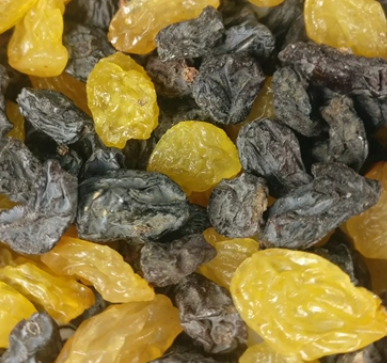
The addition of grape or grape derivatives to the diet may exert a certain benefit for the anti-inflammatory action carried out by the polyphenols contained in the berries and seeds of the grape, especially against colon cancer.
Raisin has 330 calories, contains fiber, sugar, magnesium, potassium and traces of iron. It also contains flavonoids (catechins, quercetins, kaempferol and rutin), traces of epicatechins and resveratrol (1).
However, the beneficial effects of the raisin are rather discordant.
This study (in vitro) attributes antioxidant and anti-inflammatory activity to the methanolic extract of two Greek raisin species (Corinthian e Sultanas) that have demonstrated in vitro preventive efficacy on colon cancer cells (2).
This other 3-month study by researchers at the University of Florida found no significant improvement and concludes that "Future studies need to include well-defined health outcomes to establish if the microbial changes resulting from raisin intake correlate with health benefits." (3).
However, raisin has a moderate glycemic index and a low insulin index so it has the potential to reduce the risk of developing diabetes or cardiovascular risks (4).
During processing, raisins can be treated with sulphites (sulphur dioxide) to extend its shelf life. Some people may be allergic to it, especially asthma sufferers.
Be careful not to let pets swallow it as they could have serious digestive problems (5).
References_______________________________________________________________________
(1) Association of raisin and raisin-containing food consumption with nutrient intake and diet quality in US children: NHANES 2001-2012. Fulgoni VL 3rd, Painter J, Carughi A. Food Sci Nutr. 2018 Oct 15;6(8):2162-2169. doi: 10.1002/fsn3.780.
(2) Chemopreventive properties of raisins originating from Greece in colon cancer cells. Kountouri AM, Gioxari A, Karvela E, Kaliora AC, Karvelas M, Karathanos VT. Food Funct. 2013 Feb 26;4(3):366-72. doi: 10.1039/c2fo30259d.
(3) Dietary raisin intake has limited effect on gut microbiota composition in adult volunteers. Wijayabahu AT, Waugh SG, Ukhanova M, Mai V. Nutr J. 2019 Mar 7;18(1):14. doi: 10.1186/s12937-019-0439-1
(4) Raisin consumption by humans: effects on glycemia and insulinemia and cardiovascular risk factors. Anderson JW, Waters AR. J Food Sci. 2013 Jun;78 Suppl 1:A11-7. doi: 10.1111/1750-3841.12071.
(5) Hemodialysis in a dog with acute renal failure from currant toxicity.
Stanley SW, Langston CE. Can Vet J. 2008 Jan;49(1):63-6.
Grape toxicity in dogs. Elwood S, Whatling C. Vet Rec. 2006 Apr 8;158(14):492.

