



Whole grain rolled oats
Description
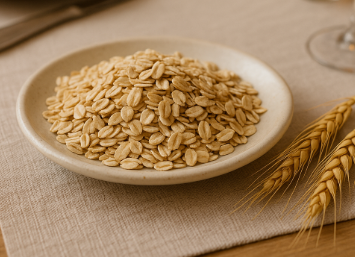
Whole grain rolled oats are produced by steam-softening and rolling whole oat grains, including bran, germ and endosperm.
They appear as flat, cream-colored flakes with a mild, slightly nutty flavour.
They are widely used in breakfast cereals, bakery, bars, beverages and functional foods due to their content of complex carbohydrates, fibre, beta-glucans, proteins, vitamins and minerals.
Indicative nutritional values per 100 g
Energy: 360–400 kcal
Carbohydrates: 55–65 g
sugars: 0.5–1.2 g
Fibre: 8–12 g (including beta-glucans)
Protein: 11–17 g
Lipids: 6–9 g
SFA (first occurrence – saturated fatty acids): 1–2 g
MUFA: 2–3 g
PUFA: 2–4 g
TFA: absent
Vitamins: thiamine (B1), vitamin E, folates
Minerals: iron, magnesium, phosphorus, zinc, manganese
Values vary with variety and processing.
Key constituents
Beta-glucans (soluble functional fibre)
Starch and complex carbohydrates
Avenin proteins
Lipids rich in unsaturated fatty acids
Phenolic antioxidants (avenanthramides, tocopherols)
B-group vitamins
Essential minerals
Production process
Cleaning of whole oat grains.
Heat stabilisation to inactivate lipolytic enzymes and prevent rancidity.
Steaming to soften grains.
Rolling/lamination into flakes of defined thickness.
Drying to target moisture content.
Screening and quality checks.
Packaging in moisture-barrier bags or bulk containers.
Process conducted under GMP/HACCP.
Physical properties
Appearance: flat, beige flakes.
Moisture: 10–12%
Bulk density: 250–450 g/L (depending on thickness)
Solubility: non-soluble but high water absorption
Shelf stability: good when properly stabilized against oxidation
Sensory and technological properties
Mild, slightly sweet and nutty flavour.
Excellent water absorption, improving viscosity and creaminess.
Beta-glucans contribute to thickening in beverages, porridges, and batters.
Provide structure and binding in bakery and snack products.
Help retain moisture and extend shelf-life in baked goods.
Food applications
Breakfast products: porridge, granola, muesli, overnight oats.
Bakery: cookies, muffins, oat bread, pancakes.
Snacks/Bars: protein bars, granola bars, energy bites.
Savory: soups, meat/vegetable patties, veggie burgers.
Beverages: oat-based smoothies, thickened drinks.
Baby food: cereal blends.
Nutrition & health
Oats provide complex carbohydrates for sustained energy release.
Beta-glucans support viscosity, satiety and metabolic modulation (health claims require regulatory approval).
Naturally rich in fibre, plant protein and micronutrients.
Suitable for balanced diets and widely used in health-oriented foods.
Portion note
Typical serving: 30–50 g for porridge.
In bakery: 5–20% of formulation.
In bars/snacks: 10–40%.
Allergens & intolerances
Oats contain their own gluten-like protein (avenin) and may be contaminated with other gluten-containing cereals.
Certified gluten-free oats must meet strict <20 ppm gluten criteria.
Naturally free from lactose and major allergens.
Storage & shelf-life
Store in a cool, dry place, protected from heat.
Use airtight packaging to avoid moisture uptake and odour absorption.
Shelf-life: 12–24 months depending on processing.
Risk of lipid oxidation if exposed to air/light for prolonged periods.
Safety & regulatory
Standard cereal ingredient; subject to control for:
mycotoxins,
pesticide residues,
heavy metals,
microbial load.
Must comply with GMP/HACCP.
Gluten-free labelling requires certified production and analytical verification.
Labeling
Declared as “whole rolled oats”, “whole grain rolled oats” or “rolled oats (whole grain)”.
In mixtures, must appear in descending order of weight.
“Gluten-free” permitted only when certified.
Troubleshooting
Hard texture in baked goods: reduce inclusion or hydrate flakes.
Excess water absorption: adjust liquid content or flake size.
Rancid notes: improper storage → use stabilized oats and sealed packaging.
Poor binding in bars: add binders (syrups, nut butters).
Sustainability & supply chain
Oats offer low environmental impact and grow well in rotation systems.
Require relatively little irrigation.
Sustainability enhanced through:
organic farming,
soil conservation,
careful handling of wastewater (monitored via BOD/COD).
By-products such as bran can be valorised.
Main INCI functions (cosmetics)
(as “Avena Sativa Kernel Flour/Meal/Extract”)
Skin conditioning
Soothing
Film forming
Used in gentle cleansers, masks, creams and products for sensitive skin.
Conclusion
Whole rolled oats are a nutritious, functional and versatile whole-grain ingredient, highly valued for their fibre content, beta-glucans, mild flavour and excellent technological performance.
They support structure, binding, creaminess and moisture retention across a wide variety of food applications. When produced under GMP/HACCP and properly stored, they are a safe, stable and high-quality ingredient for industrial, artisanal and household use.
Mini-glossary
SFA – Saturated fatty acids: minor lipid fraction in oats.
MUFA – Monounsaturated fatty acids: present in oat lipids.
PUFA – Polyunsaturated fatty acids: essential fats present in small quantities.
TFA – Trans fatty acids: not naturally present.
Beta-glucans: soluble dietary fibres with technological and physiological functions.
GMP/HACCP: food safety and quality management systems.
BOD/COD: indicators of environmental impact of wastewater.
Studies
Oats (Avena sativa) is native to the Mediterranean regions and belongs to the Poaceae family.
The active components are hypolysaccharides of mucilosis (β-glucan), proteins (glutelin and avenin) and flavonoids (1).

It contains a good amount of potassium and vitamin B and is one of the cereals that have a particularly low glycemic index.
Oat has been used for generations as a traditional herbal medicine for the symptomatic treatment of minor skin inflammations (such as sunburn) and is used as an aid in healing minor wounds.
It has been used by traditional medicine as a remedy for some dermatological pathologies, such as dry skin, atopic dermatitis, contact dermatitis and psoriasis.
Oat flakes are produced industrially through a steaming oat cooking process.
Rich in fiber, they carry out an action of containment of harmful LDL cholesterol.

