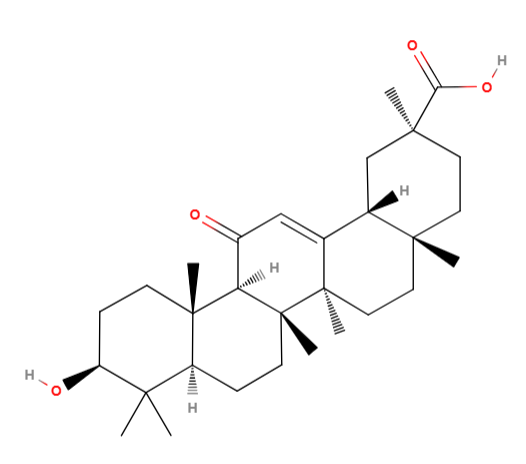
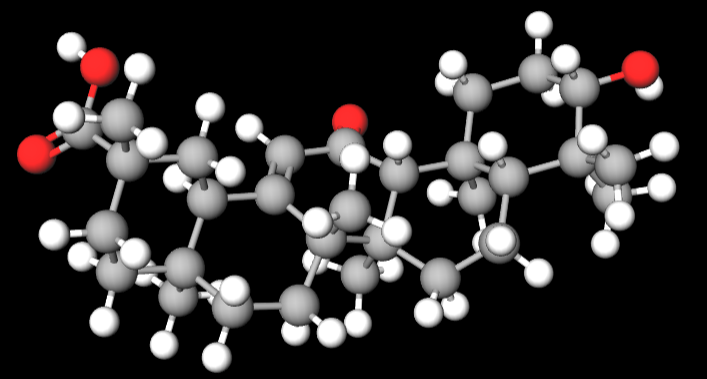
Acido glicirretinico (Glycyrrhetinic Acid) è un triterpenoide pentaciclico, il principale metabolita della glicirrizina, ottenuto dalla radice della pianta della liquirizia, Glycyrrhiza glabra, famiglia botanica Leguminosae.
Il nome definisce la struttura della molecola
- "Glycyrrhetinic" deriva da "Glycyrrhiza", che è il nome generico per la liquirizia. Indica che l'acido è un componente derivato dalla pianta di liquirizia.
- "Acid" indica che la sostanza ha proprietà acide.
Descrizione delle materie prime utilizzate nella produzione
- Radice di Glycyrrhiza glabra - La parte della pianta da cui viene estratta l'acido glicirretinico.
- Solvente - Ad esempio, acqua, alcol, o altri solventi organici utilizzati per estrarre l'acido dalla radice.
Processo di estrazione industriale passo per passo
- Raccolta e preparazione - Le radici di Glycyrrhiza glabra vengono raccolte, pulite e tritate.
- Estrazione - Le radici tritate vengono immerse nel solvente per un periodo determinato, permettendo all'acido glicirretinico di diffondersi nel solvente.
- Filtrazione - Dopo l'estrazione, la soluzione viene filtrata per rimuovere qualsiasi particella solida residua.
- Isolamento - L'acido glicirretinico viene separato da altri componenti attraverso metodi come la cromatografia.
- Purificazione - Processi successivi possono essere utilizzati per purificare ulteriormente l'acido.
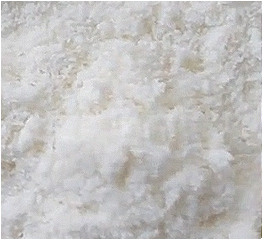
Si presenta in forma di polvere bianca.
A cosa serve e dove si usa
Medicina
La letteratura scientifica ha messo in rilievo le proprietà antinfiammatorie, antiossidanti e antimicrobiche dell'Acido glicirretinico, ma anche la sua tossicità verso le normali linee cellulari (1). Altri studi riportano interessanti effetti citotossici e possibili applicazioni di questo acido come agente antitumorale (2).
Cosmetica
Agente condizionante della pelle. Rappresenta il perno del trattamento topico della pelle in quanto ha la funzione di ripristinare, aumentare o migliorare la tolleranza cutanea a fattori esterni, compresa la tolleranza dei melanociti. La funzione più importante dell'agente condizionante è prevenire la disidratazione della pelle, ma il tema è piuttosto complesso e coinvolge emollienti ed umettanti che possono essere aggiunti nella formulazione.
- Molecular Formula C30H46O4
- Molecular Weight 470.7 g/mol
- CAS 471-53-4
- UNII P540XA09DR
- EC Number 207-444-6
- DTXSID9020669
- Nikkaji J5.943I
Sinonimi:
Bibliografia_____________________________________________________________________
(1) Kowalska A, Kalinowska-Lis U. 18β-Glycyrrhetinic acid: its core biological properties and dermatological applications. Int J Cosmet Sci. 2019 Aug;41(4):325-331. doi: 10.1111/ics.12548. Epub 2019 Jun 28. PMID: 31166601.
Abstract. Recently, attention has been focused on identifying natural herbal compounds with high biological activity, especially antioxidative, anti-inflammatory and antimicrobial properties, for preventing and controlling various skin conditions, including inflammation-related diseases such as atopic dermatitis and UV-induced skin photoaging. One key active plant ingredient is 18β-glycyrrhetinic acid (GA), the main metabolite of glycyrrhizin (GL), obtained from licorice root. The review examines the valuable biological properties of GA, particularly those playing key roles in the treatment of various dermatological disorders in humans. The review highlights the key anti-inflammatory, antioxidant and antimicrobial properties of GA and its toxicity towards normal cells lines. It also examines the physicochemical properties of GA and presents methods of increasing its penetration through the stratum corneum and bioaccumulation with the use of modern delivery systems such as liposomes and nanoemulsions. © 2019 Society of Cosmetic Scientists and the Société Française de Cosmétologie.
(2) Hussain H, Ali I, Wang D, Hakkim FL, Westermann B, Ahmed I, Ashour AM, Khan A, Hussain A, Green IR, Shah STA. Glycyrrhetinic acid: a promising scaffold for the discovery of anticancer agents. Expert Opin Drug Discov. 2021 Dec;16(12):1497-1516. doi: 10.1080/17460441.2021.1956901.
Abstract. Introduction: Oleanane-type pentacyclic triterpenes named glycyrrhetinic acids (GAs) featuring a C-30 carboxylic acid group, are extracted from the licorice (Glycyrrhiza uralensis). Numerous biological properties of GA have been reported and have attracted researchers from all over the world in recent years due to the peculiar GA scaffold-based semisynthetic cytotoxic effects. Areas covered: This review represents the applications of semisynthetic derivatives of GA for the development of future cancer treatments. Included in the review are important structural features of the semisynthetic GAs crucial for cytotoxic effects. Expert opinion: Numerous semisynthetic GA derivatives illustrated excellent cytotoxic effects toward various cancer cells. Notably the C-3(OH) at ring A along with C30-CO2H at ring E as vital structural features, make GA very appealing as a lead scaffold for medicinal chemistry, since these two groups permit the creation of further chemical diversity geared toward improved cytotoxic effects. Furthermore, numerous GA derivatives have been synthesized and indicate that compounds featuring cyanoenone moieties in ring A, or compounds having the amino group or nitrogen comprising heterocycles and hybrids thereof, illustrate more potent cytotoxicity. Furthermore, GA has a great capability to be conjugated with other anticancer molecules to synergistically enhance their combined cytotoxicity.