



BHT: properties, uses, pros, cons, safety
Description
BHT or Hydroxy toluene butylate or Butylated hydroxytoluene or Toluene hydroxylated butylate or 2,6-di-tert-butyl-p-cresol, is an organic compound primarily used as an antioxidant. Its main function in cosmetics, food, and industrial products is to prevent oxidation and spoilage, extending the shelf life of products. It is widely used in cosmetics, foods, pharmaceuticals, and industrial products to protect oxygen-sensitive ingredients.
Chemical Composition and Structure
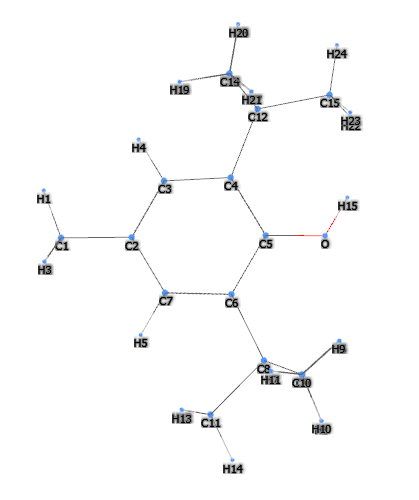
BHT is a phenolic derivative with the chemical formula C15H24O. Its structure consists of an aromatic ring with two tert-butyl groups positioned ortho to the hydroxyl (-OH) group, giving BHT excellent antioxidant properties. This structure allows BHT to donate an electron to free radicals, effectively interrupting the chain reactions that lead to oxidation.
Physical Properties
2,6-di-tert-butyl-p-cresol typically appears as a white or pale yellow crystalline powder. It is lipophilic, meaning it dissolves well in fats and oils, making it suitable for use in oil-based formulations. It has high thermal and chemical stability, making it effective even in small concentrations to prevent oxidative deterioration.
Production Process
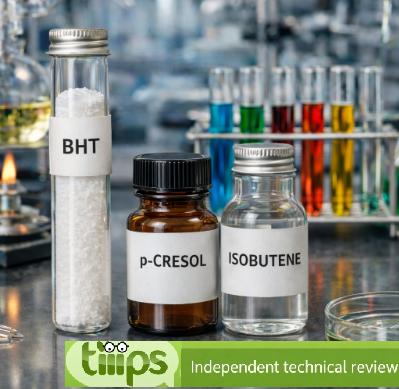
BHT is synthesized through the reaction of p-cresol (an aromatic compound) with isobutylene in the presence of an acid catalyst. This process yields the final compound, 2,6-di-tert-butyl-p-cresol, which is then purified for use in various products.
- Preparation. The raw materials are p-cresol (a phenol) and isobutene (a hydrocarbon).
- Alkylation. p-cresol is reacted with isobutene in the presence of a catalyst, such as sulphuric acid, at a controlled temperature and pressure. This process is known as alkylation and attaches the tert-butyl groups to the p-cresol molecule.
- Separation. The reaction mixture is then separated to isolate the 2,6-di-tert-butyl-p-cresol by various methods, including distillation, in which the mixture is heated and the components that vaporise at different temperatures are separated.
- Purification. The separated product is purified to remove any unreacted materials and by-products by processes such as washing, filtration and drying.
- Quality control. The final product is tested to ensure that it meets the necessary quality standards.
It appears as a white, stable but photosensitive powder. Flammable. Incompatible with oxidising agents, acid chlorides, bases, brass, acid anhydrides, copper, copper alloys, steel.
What it is used for and where
Food
A synthetic antioxidant generally considered safe in food. It has the ability to control free radicals by eliminating peroxyl radicals and to control free radical generation by inhibiting or retarding oxidation (1). The FDA-authorised maximum use dose is 0.02% in meat and meat products from the meat processing industry.
Ingredient included in the list of European food additives as E321, antioxidant.
Cosmetics
BHT is a restricted ingredient as a Relevant Item in the Annexes of the European Cosmetics Regulation 1223/2009. Ingredient at risk: 2,6-Di-Tert-Butyl-4-Methylphenol
Product Type, body parts: a) Mouthwash b) Toothpaste c) Other leave-on and rinse-off products. Maximum concentration in ready for use preparation a) 0,001 % b) 0,1 % c) 0,8 %
From 1 July 2023 cosmetic products containing that substance and not complying with the restrictions shall not be placed on the Union market. From 1 January 2024 cosmetic products containing that substance and not complying with the restrictions shall not be made available on the Union market.
It is included in formulations of shower gels, shampoos, lipsticks as an antioxidant to improve the stability of fat-soluble cosmetics and prevent their deterioration.
Antioxidant agent. Ingredient that counteracts oxidative stress and prevents cell damage. Free radicals, pathological inflammatory processes, reactive nitrogen species and reactive oxygen species are responsible for the ageing process and many diseases caused by oxidation.
Fragrance. It plays a decisive and important role in the formulation of cosmetic products as it provides the possibility of enhancing, masking or adding fragrance to the final product, increasing its marketability. It is able to create a perceptible pleasant odour, masking a bad smell. The consumer always expects to find a pleasant or distinctive scent in a cosmetic product.
Other uses
Also used in petroleum products, rubber, plastic foam as an antioxidant stabiliser, polyester resin, ABS resin, polyethylene, polystyrene, cellulose, transformer oil, white and clear latex.
In natural rubber processing it acts as an antioxidant and stabiliser
Safety
BHT is a skin and eye irritant but no conclusions can be drawn on the additive's potential for skin sensitisation. It is considered safe by EFSA in animal feed (2) but this study recommends monitoring and limiting its use (3) and suggests that BHT consumption should not exceed 0.5 mg/kg body weight (4).
For more information:
Typical commercial product characteristicsBHT Butylated Hydroxy Toluene
| Appearance | White powder |
| Boiling Point | 265ºC |
| Melting Point | 69-71ºC |
| Flash Point | 127ºC |
| Density | 1.048 |
| PSA | 20.23000 |
| Vapor Pressure | 0.0±0.6 mmHg at 25°C |
| Vapor density | 7.6 |
| LogP | 5.32 |
| Refraction Index | 1.499 |
| Sulphate SO4 | ≤ 0.002 w/% |
| Arsenic | ≤ 1 mg/kg |
| Cauterized residue | ≤ 0.004 w/% |
| Free phenol (p-cresol) | ≤ 0.01 w/% |
| Water | ≤0.1% |
| Safety |  |
 |  |
 |  |
- Molecular Formula C15H24O
- Linear Formula [(CH3)3C]2C6H2(CH3)OH
- Molecular Weight 220.356 g/mol
- Exact Mass 220.182709
- UNII: 1P9D0Z171K
- CAS: 128-37-0
- DSSTox Substance ID
- IUPAC 2,6-ditert-butyl-4-methylphenol
- InChl= 1S/C15H24O/c1-10-8-11(14(2,3)4)13(16)12(9-10)15(5,6)7/h8-9,16H,1-7H3
- InChl Key NLZUEZXRPGMBCV-UHFFFAOYSA-N
- SMILES CC1=CC(=C(C(=C1)C(C)(C)C)O)C(C)(C)C
- EC Number: 204-881-4
- FEMA Number: 2184
- PubChem Substance ID 329749182
- MDL number MFCD00011644
- Beilstein Registry Number 1911640
Synonyms
- 2,6-Di-tert-butyl-4-methylphenol
- Butylated hydroxytoluene
- Butylhydroxytoluene
- 2,6-Di-tert-butyl-p-cresol
- 2,6-Di-t-butyl-4-methylphenol
- Ionol
- Parabar 441
- Paranox 441
- 2,6-Di-tert-butyl-4-cresol
- DBPC
- Dibunol
- Stavox
- Phenol, 2,6-bis(1,1-dimethylethyl)-4-methyl-
- BHT
- Ionol CP
- Antrancine 8
- Butylated hydroxytoluol
- Vulkanox KB
- Impruvol
- Topanol
- Dalpac
- 2,6-ditert-butyl-4-methylphenol
- Di-tert-butyl-p-cresol
- Dibutylated hydroxytoluene
- Deenax
- Ionole
- Vianol
- Antioxidant KB
- 3,5-Di-tert-butyl-4-hydroxytoluene
- Antioxidant 4K
- Sumilizer BHT
- Topanol O
- Topanol OC
- Vanlube PC
- Antioxidant DBPC
- Sustane BHT
- Tenamene 3
- Vanlube PCX
- Antioxidant 29
- Antioxidant 30
- Nonox TBC
- Tenox BHT
- Chemanox 11
- Ionol 1
- Agidol
- Catalin CAO-3
- Advastab 401
- Ionol (antioxidant)
- BUKS

