



Osmanthus fragrans leaf extract is obtained from a shrub Osmanthus fragrans belonging to the Oleaceae family and, is a common ingredient in cosmetics and skin care products, as well as in some beverages and foodstuffs. Osmanthus fragrans is known for its aromatic properties, often described as a mixture of jasmine and apricot.
The name describes the structure of the molecule
- "Osmanthus" is the genus of the plant
- "fragrans" denotes the species, and also is a nod to the distinctive and pleasant scent of its blooms.
- "Leaf extract" indicates that the ingredient is derived from the osmanthus leaves.
Description of raw materials used in production
The leaves of Osmanthus fragrans are the primary raw material for this extract. They are harvested, dried, and then subjected to an extraction process to derive beneficial compounds.
Synthesis process
- Leaf harvesting - Mature leaves are harvested from the plant.
- Drying - The leaves are dried to preserve essential oils and other compounds.
- Extraction - The dried leaves are then immersed in a solvent, like alcohol or water, to extract the beneficial compounds.
- Separation - After a set period, the solvent is separated, leaving behind the concentrated leaf extract.
- Purification - The extract is purified to remove any impurities.
- Packaging - The purified extract is then packaged for sale or used as an ingredient in various products.
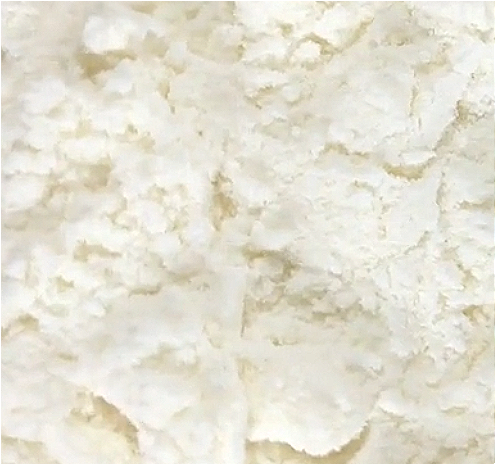
The extract appears as a yellowish powder
What it is for and where
Cosmetics
Humectant. Hygroscopic compound used to minimise water loss in the skin and to prevent it from drying out by facilitating faster and greater absorption of water into the stratum corneum of the epidermis. The epidermis is the most superficial of the three layers that make up human skin (epidermis, dermis and hypodermis) and is the layer that maintains hydration in all three layers. In turn, the epidermis is composed of five layers: horny, the most superficial, granular, spinous, shiny, and basal. Humectants have the ability to retain the water they attract from the air in the stratum corneum and have the function of moisturising the skin. They are best used before emollients, which are oil-based.
Skin conditioning agent. It is the mainstay of topical skin treatment as it has the function of restoring, increasing or improving skin tolerance to external factors, including melanocyte tolerance. The most important function of the conditioning agent is to prevent skin dehydration, but the subject is rather complex and involves emollients and humectants that can be added in the formulation.
Applications
Cosmetics and Skin Care Products - Due to its antioxidant and moisturizing properties, Osmanthus fragrans leaf extract might be used in creams, lotions, and other skincare items.
Hair Care Products - Some hair care items might contain this extract to tap into its nourishing and conditioning properties.
Perfumery - While the leaves aren't as fragrant as the flowers, the extract might still be used in some formulations to give a green note or leverage its therapeutic properties.
Traditional Medicine
In some medical traditions, leaf extract is used to treat a variety of ailments, although scientific research has sometimes failed to confirm some of these uses. Indeed, studies on the positive biological activities of Osmanthus fragrans referred to the bioactive principles of this plant, and the mechanism responsible for these extracts and ingredients has not been well identified (1).
Studies
Yang J, Gu T, Lu Y, Xu Y, Gan RY, Ng SB, Sun Q, Peng Y. Edible Osmanthus fragrans flowers: aroma and functional components, beneficial functions, and applications. Crit Rev Food Sci Nutr. 2023 Jun 7:1-14. doi: 10.1080/10408398.2023.2220130.
Abstract. Osmanthus fragrans (O. fragrans) has been cultivated in China for over 2,500 years as a traditional fragrant plant. Recently, O. fragrans has drawn increasing attention due to its unique aroma and potential health benefits. In this review, the aroma and functional components of O. fragrans are summarized, and their biosynthetic mechanism is discussed. The beneficial functions and related molecular mechanism of O. fragrans extract are then highlighted. Finally, potential applications of O. fragrans are summarized, and future perspectives are proposed and discussed. According to the current research, O. fragrans extracts and components have great potential to be developed into value-added functional ingredients with preventive effects on certain chronic diseases. However, it is crucial to develop efficient, large-scale, and commercially viable extraction methods to obtain the bioactive components from O. fragrans. Furthermore, more clinical studies are highly needed to explore the beneficial functions of O. fragrans and guide its development into functional food products.
Le DD, Lee YE, Lee M. Triterpenoids from the leaves of Osmanthus fragrans var. aurantiacus with their anti-melanogenesis and anti-tyrosinase activities. Nat Prod Res. 2022 Dec;36(24):6414-6420. doi: 10.1080/14786419.2022.2035384.
Abstract. Excessive production of melanin causes various dermatological disorders including hyperpigmentation. To search for anti-melanogenesis candidates from natural products, we discovered that leaves of Osmanthus fragrans var. aurantiacus (OFA) suppressed melanin production. The extract of OFA leaves and its fractions were subjected to bioactivity-guided separation by targeting active constituents and a total of four triterpenoids were obtained: 3α,24-dihydroxyurs-12-en-28 oic acid (1), pomolic acid (2), maslinic acid (3), and corosolic acid (4). Compounds 1 and 2 were isolated from this plant for the first time. All compounds were evaluated for their inhibitory activities against melanin production and tyrosinase activity. Active compounds were further investigated to understand their mechanisms of action. Results revealed that they significantly down-regulated TYRP-1 and TYRP-2 expression levels. Our results clarified the whitening property of this plant and provided evidence that active constituents of this plant possessed anti-melanogenesis effect and anti-tyrosinase activity for the first time.
Song HY, Jeong DE, Lee M. Bioactivity-Guided Extract Optimization of Osmanthus fragrans var. aurantiacus Leaves and Anti-Inflammatory Activities of Phillyrin. Plants (Basel). 2021 Jul 28;10(8):1545. doi: 10.3390/plants10081545.
Abstract. The aim of this study was to identify the optimal extraction conditions for leaves of Osmanthus fragrans var. aurantiacus. Inhibitory effects of various extracts on NO production were compared. Antioxidant evaluations for total phenol and flavonoid contents were carried out using various extracts of O. fragrans var. aurantiacus leaves obtained under optimal extraction conditions that showed the greatest effect on NO production. The optimal method for extracting O. fragrans var. aurantiacus leaves resulted in an extract named OP OFLE. OP OFLE showed DPPH and ABTS radical scavenging activities in a concentration-dependent manner. Phillyrin (PH) was isolated as a major compound from OP OFLE by HPLC/DAD analysis. OP OFLE and PH reduced inducible nitric oxide (iNOS) and cyclooxygenase (COX)-2 protein expression and downregulated proinflammatory cytokines such as interleukin (IL)-1β, IL-6, IL-8, and tumor necrosis factor (TNF)-α in LPS-stimulated RAW 264.7 and HT-29 cells. To determine the signal pathway involved in the inhibition of NO production, a Western blot analysis was performed. Results showed that OP OFLE decreased phosphorylation of extracellular regulated kinase (pERK) 1/2 and the expression of nuclear factor-kappa B (NF-κB). Our results suggest that extracts of O. fragrans var. aurantiacus leaves and its major components have biological activities such as antioxidative and anti-inflammatory properties.

