



Gluconato di rame è un composto chimico, un sale di rame dell'acido D-gluconico.
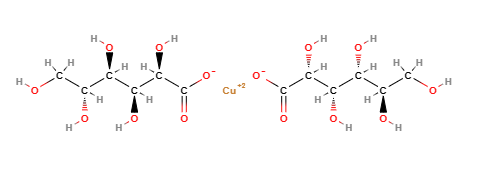
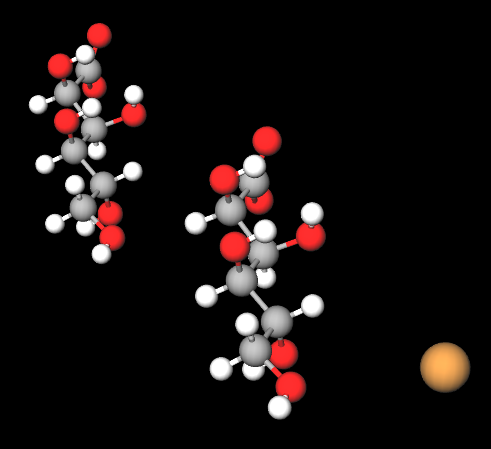
Il nome "gluconato di rame" deriva dalla sua composizione chimica: un ion rame (Cu2+) combinato con un ione gluconato (C6H11O7-).
Il gluconato di rame viene tipicamente sintetizzato facendo reagire il carbonato di rame o l'idrossido di rame con l'acido gluconico. La reazione viene eseguita in una soluzione acquosa, e il gluconato di rame precipita dalla soluzione. Il precipitato viene quindi raccolto, lavato e asciugato per ottenere il composto puro.
Ecco un semplice esempio di come può essere fatto:
- Preparazione delle soluzioni. Una soluzione di carbonato di rame o idrossido di rame e una soluzione di acido gluconico.
- Reazione. Aggiungendo la soluzione di acido gluconico alla soluzione di carbonato di rame o idrossido di rame la reazione produce gluconato di rame e acqua.
- Isolamento del prodotto. Il precipitato di gluconato di rame può essere raccolto per filtrazione, quindi lavato e asciugato per ottenere il composto puro.
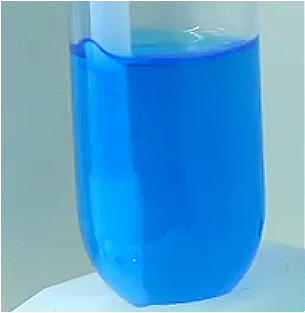
Si presenta in forma di polvere o liquido blu o celeste.
A cosa serve e dove si usa
Gluconato di rame viene spesso utilizzato come integratore di rame. Il rame è un elemento traccia essenziale che è vitale per la salute di tutti gli esseri viventi (umani, piante, animali e microrganismi).
Cosmetica
- Agente condizionante della pelle. Rappresenta il perno del trattamento topico della pelle in quanto ha la funzione di ripristinare, aumentare o migliorare la tolleranza cutanea a fattori esterni, compresa la tolleranza dei melanociti. La funzione più importante dell'agente condizionante è prevenire la disidratazione della pelle, ma il tema è piuttosto complesso e coinvolge emollienti ed umettanti che possono essere aggiunti nella formulazione.
- Protettivo della pelle. Crea una barriera protettiva sulla pelle per difenderla da sostanze nocive, irritanti, allergeni, agenti patogeni che possono provocare varie condizioni infiammatorie. Questi prodotti possono anche migliorare la barriera cutanea naturale e nella maggior parte dei casi ne occorrono più di uno per raggiungere un risultato efficace.
Integratore Alimentare
Il gluconato di rame viene utilizzato come integratore alimentare per prevenire o trattare la carenza di rame. Il rame è un minerale traccia essenziale necessario per la sopravvivenza. Si trova in tutti i tessuti corporei e svolge un ruolo nella produzione di globuli rossi e nel mantenimento delle cellule nervose e del sistema immunitario.
Additivo Alimentare
Viene utilizzato come additivo alimentare per arricchire gli alimenti con rame.
Farmaceutici
Nell'industria farmaceutica, il gluconato di rame viene utilizzato in prodotti progettati per prevenire o trattare le carenze di rame.
Alimentazione Animale
Viene anche utilizzato come integratore nell'alimentazione animale per garantire che gli animali ricevano una quantità adeguata di rame nella loro dieta.
 |  |
 | 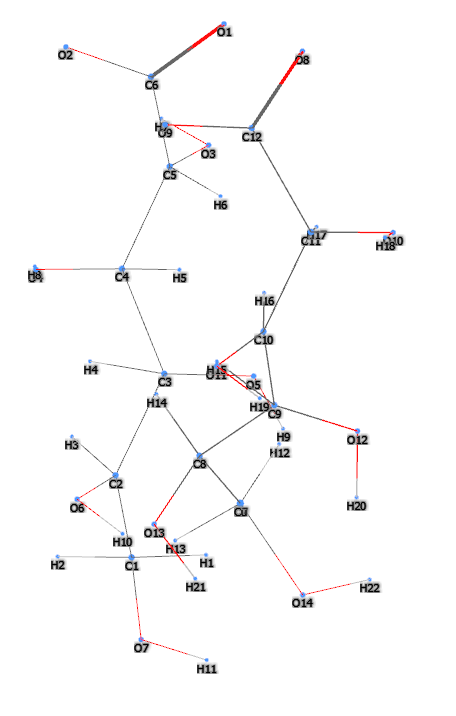 |
- Molecular Formula C12H22CuO14
- Molecular Weight 453.84 g/mol
- CAS 527-09-3
- UNII RV823G6G67
- EC Number 208-408-2 235-844-0
- Nikkaji J6.667B
Compendio degli studi più significativi con riferimento a proprietà, assunzione, effetti.
García-Martínez BA, Montes S, Tristán-López L, Quintanar-Guerrero D, Melgoza LM, Baron-Flores V, Ríos C. Copper biodistribution after acute systemic administration of copper gluconate to rats. Biometals. 2021 Jun;34(3):687-700. doi: 10.1007/s10534-021-00304-1.
Abstract. Neurodegenerative disorders have been linked to the decrease of copper concentrations in different regions of the brain. Therefore, intake of micronutrient supplements could be a therapeutic alternative. Since the copper distribution profile has not been elucidated yet, the aim of this study was to characterize and to analyze the concentration profile of a single administration of copper gluconate to rats by two routes of administration. Male Wistar rats were divided into three groups. The control group received vehicle (n = 5), and the experimental groups received 79.5 mg/kg of copper orally (n = 4-6) or 0.64 mg/kg of copper intravenously. (n = 3-4). Blood, striatum, midbrain and liver samples were collected at different times. Copper concentrations were assessed using atomic absorption spectrophotometry. Copper concentration in samples from the control group were considered as baseline. The highest copper concentration in plasma was observed at 1.5 h after oral administration, while copper was quickly compartmentalized within the first hour after intravenous administration. The striatum evidenced a maximum metal concentration at 0.25 h for both routes of administration, however, the midbrain did not show any change. The highest concentration of the metal was held by the liver. The use of copper salts as replacement therapy should consider its rapid and discrete accumulation into the brain and the rapid and massive distribution of the metal into the liver for both oral and intravenous routes. Development of controlled-release pharmaceutical formulations may overcome the problems that the liver accumulation may imply, particularly, for hepatic copper toxicity.
Abe M, Usuda K, Hayashi S, Ogawa I, Furukawa S, Igarashi M, Nakae D. Carcinogenic risk of copper gluconate evaluated by a rat medium-term liver carcinogenicity bioassay protocol. Arch Toxicol. 2008 Aug;82(8):563-71. doi: 10.1007/s00204-008-0294-x.
Abstract. Carcinogenic risk and molecular mechanisms underlying the liver tumor-promoting activity of copper gluconate, an additive of functional foods, were investigated using a rat medium-term liver carcinogenicity bioassay protocol (Ito test) and a 2-week short-term administration experiment. In the medium-term liver bioassay, Fischer 344 male rats were given a single i.p. injection of N-nitrosodiethylamine at a dose of 200 mg/kg b.w. as a carcinogenic initiator. Starting 2 weeks thereafter, rats received 0, 10, 300 or 6,000 ppm of copper gluconate in diet for 6 weeks. All rats underwent 2/3 partial hepatectomy at the end of week 3, and all surviving rats were killed at the end of week 8. In the short-term experiment, rats were given 0, 10, 300 or 6,000 ppm of copper gluconate for 2 weeks. Numbers of glutathione S-transferase placental form (GST-P) positive lesions, single GST-P-positive hepatocytes and 8-oxoguanine-positive hepatocytes, and levels of cell proliferation and apoptosis in the liver were significantly increased by 6,000 ppm of copper gluconate in the medium-term liver bioassay. Furthermore, hepatic mRNA expression of genes relating to the metal metabolism, inflammation and apoptosis were elevated by 6,000 ppm of copper gluconate both in the medium-term liver bioassay and the short-term experiments. These results indicate that copper gluconate possesses carcinogenic risk toward the liver at the high dose level, and that oxidative stress and inflammatory and pro-apoptotic signaling statuses may participate in its underlying mechanisms.
Cai DH, Zhang CL, Liu QY, He L, Liu YJ, Xiong YH, Le XY. Synthesis, DNA binding, antibacterial and anticancer properties of two novel water-soluble copper(II) complexes containing gluconate. Eur J Med Chem. 2021 Mar 5;213:113182. doi: 10.1016/j.ejmech.2021.113182.
Abstract. In this paper, two new Cu(II) complexes, [Cu(Gluc)(HPB)(H2O)]Gluc (CuG1) and [Cu(Gluc)(HPBC)(H2O)]Gluc (CuG2) (where HPB = 2-(2'-pyridyl)benzimidazole, HPBC = 5-chloro-2-(2'-pyridyl)benzimidazole, Gluc = d-Gluconic acid), with good water solubility were synthesized and characterized. These complexes exhibited a five-coordinated tetragonal pyramidal geometry. The DNA binding and cleavage properties of the complexes were investigated using multi-spectroscopy, viscosity measurement, molecular docking and gel electrophoresis analysis methods. The results showed that the complexes could interact with DNA by insertion and groove binding, and cleave CT-DNA through a singlet oxygen-dependent pathway in the presence of ascorbic acid. The studies on antibacterial and anticancer activities in vitro demonstrated that both complexes had good inhibitory activity against three Gram-positive bacteria (Staphylococcus aureus, Bacillus subtilis, Listeria monocytogenes) and one Gram-negative bacterium (Escherichia coli) and good cytotoxic activity toward the tested cancer cells (A549, HeLa and SGC-7901). CuG2 showed higher antimicrobial and cytotoxic activities than CuG1, which was consistent with their binding strength and cleavage ability to DNA, indicating that their antimicrobial and cytotoxic activities may be related to the DNA interaction. Moreover, the cell-based mechanism studies have indicated that CuG1 and CuG2 could arrest the cell cycle at G2/M phase, elevate the levels of intracellular reactive oxygen species (ROS) and decrease the mitochondrial membrane potential (MMP). The results showed that the complexes could induce apoptosis through DNA-damaged and ROS-mediated mitochondrial dysfunction pathways. Finally, the in vivo antitumor study revealed that CuG2 inhibited tumor growth by 50.44%, which is better than that of cisplatin (40.94%). Copyright © 2021 Elsevier Masson SAS.
Curcio, A., Romano, A., Marchitto, N., Pironti, M., & Raimondi, G. (2018). Efficacy and Safety of a New Formulation of Ferric Sodium EDTA Associated with Vitamin C, Folic Acid, Copper Gluconate, Zinc Gluconate and Selenomethionine Administration in Patients with Secondary Anaemia. J Blood Lymph, 8(224), 2.
Abstract. Anemia is a global problem since two billion people are affected by blood cells disorders. Anemia may reduce the quality of life of affected patients and may also to get worse the outcome and quality of life of patients with comorbidities as kidney failure, heart failure, arrhythmia, coronary heart disease and so on. In patients with coronary heart disease, anginal episodes may increase in frequency and severity, and patients with kidney failure may have an increased number of re-hospitalizations. Here we report the effectiveness of the therapy with Ferric Sodium EDTA, in combination with vitamin C, folic acid, copper gluconate, zinc gluconate and selenomethionine (FERACHEL FORTE®) that has shown several advantages in daily clinical practice.

