



D&C Yellow No. 10 or
Quinoline Yellow is a chemical azo compound, derived from quinophthalone, a dye used in a variety of industries:
- Food
- Cosmetics. Nail polishes, cold soaps, liquid detergents.
- Pharmaceuticals. Tablets
- Textile. Fabrics
- Plastic
- etc
The synthesis process takes place in different steps:
- Preparation of the diazonium salt. An aromatic amine is treated with nitrous acid (usually generated in situ from sodium nitrite and a strong acid) to form a diazonium salt. This reaction typically takes place in an aqueous and acidic environment and at low temperatures to stabilise the diazonium group.
- Coupling reaction. The diazonium salt is then reacted with a phenol or aniline in a basic or slightly acidic solution to form the azo dye.
- Isolation and purification. The resulting dye is isolated, usually by filtration, and then purified, often by recrystallisation.
What it is for and where
Cosmetics
It is a restricted ingredient as IV/82 a Relevant Item in the Annexes of the European Cosmetics Regulation 1223/2009. Ingredient or substance at risk: 1H-Indene-1,3(2H)-dione, 2-(2-quinolinyl)-, sulfonated, sodium salts
Cosmetics - INCI Functions
Colorant. This ingredient has the function of colouring the solution in which it is inserted in a temporary, semi-permanent or permanent manner, either alone or in the presence of the complementary components added for colouring.
Labeled with the number E104 in the list of European food color additives and internationally known as CI 47005.
It is also used to add color to non-food producing animal feed at a maximum dose of 500 mg/kg of feed.
Safety
Regulatory data on the genotoxicity and/or mutagenicity of this compound are still controversial. This study finds that, even with in vitro testing, this dye could cause harmful effects in humans if it is metabolized or absorbed through the skin (1).
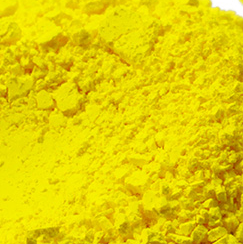
Typical optimum characteristics of the commercial colour Chinoline Yellow
| Colour Index n | 47005 |
| Food colour n. | Yellow 13 |
| F.D. & C. No. | Yellow 10 |
| Volatile matter (chloride and sulfate) Max | 30% |
| Solubility in water at 20°C | 120g/l |
| Combined ether extract. Max | 0.20% |
| Insoluble in water. Max | 0.20% |
| Class | Xanthene |
| Light stability | 4 |
| Stability at 100°C | 4 |
| Alkali stability | 4 |
| Subsidiary dyes. Max | 1.50% |
| Intermediate dyes. Max | 0.50% |
| Lead | <10ppm |
| Arsenic | <3ppm |
| Mercury | <1ppm |
| Heavy Metals | <20ppm |
 |  |
 |  |
- Molecular Formula : C18H9NNa2O8S2
- Molecular Weight : 477.369 g/mol
- CAS : 100208-62-6 8004-92-0
- EC Number 616-849-0
- UNII 35SW5USQ3G
- InChI=1S/C18H11NO8S2.2Na/c20-17-11-3-1-2-4-12(11)18(21)15(17)13-6-5-9-7-10(28(22,23)24)8-14(16(9)19-13)29(25,26)27;;/h1-8,15H,(H,22,23,24)(H,25,26,27);;/q;2*+1/p-2
- InChl Key FZUOVNMHEAPVBW-UHFFFAOYSA-L
- SMILES C1=CC=C2C(=C1)C(=O)C(C2=O)C3=NC4=C(C=C(C=C4C=C3)S(=O)(=O)[O-])S(=O)(=O)[O-].[Na+].[Na+]
- IUPAC disodium;2-(1,3-dioxoinden-2-yl)quinoline-6,8-disulfonate
- DSSTox Substance ID DTXSID0041721 DTXSID70873122
- NACRES NA.47
Synonyms :
- CI 47005
- E104
- Acid Yellow 3
- Yellow 13
- Yellow 10
- Lemon Yellow ZN 3
- Quinoline Yellow S
- Quinoline yellow WS
- Sodium 2-(1,3-dioxo-2,3-dihydro-1H-inden-2-yl)quinoline-6,8-disulfonate
- 2-(2-Quinolyl)-1,3-indandione disulfonic acid disodium salt
- dipotassium 2-(1,3-dioxo-2H-inden-2-yl)quinoline-6,8-disulfonate
- disodium 2-(1,3-dioxo-2H-inden-2-yl)quinoline-6,8-disulfonate
- 2-(1,3-Dioxoindan-2-yl)quinoline-6,8-bis(sulfonic acid sodium) salt
- disodium 2-(1,3-dioxo-2,3-dihydro-1h-inden-2-yl)-6,8-quinolinedisulfonate
- disodium 2-(1,3-dioxo-2,3-dihydro-1H-inden-2-yl)quinoline-6,8-disulfonate

