



Alkyldimethylbenzylammonium chloride: properties, uses, pros, cons, safety
Alkyldimethylbenzylammonium chloride best known as Benzalkonium chloride is a member of the quaternary ammonium salts (“quats”), in practice a mixture of alkyl-benzyldimethylammonium chlorides with alkyl chains of different lengths. In cosmetics it is used mainly as an antimicrobial preservative and, in some formulations, as a cationic surfactant with an antistatic effect (especially on hair). It is effective but has a “strong” profile: the formula must be designed to minimize irritation and avoid contact with mucosa/eyes.
Presented for the first time as antimicrobial agents by Domagk in 1935.
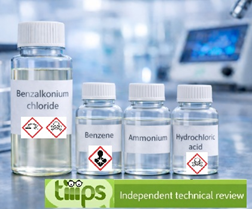
The name describes the structure of the molecule.
- Benz- indicates the presence of a benzene ring, which is a six-membered cyclic structure with three double bonds.
- alkonium indicates the presence of a quaternary ammonium group, which is a nitrogen atom with four substituents and a positive charge.
- chloride refers to the chloride anion (Cl-) that balances the positive charge of the alkonium cation.
Definition
From a chemical-functional standpoint, benzalkonium chloride is a cationic surfactant: the quaternary ammonium moiety provides a permanent positive charge, which interacts with microbial membranes and negatively charged surfaces. Because it is a mixture of homologues, it does not have a single absolute formula/molecular weight valid for all grades, even though some databases list “representative” formulas.
Production process
Industrially it is obtained by quaternization (formation of the quaternary ammonium salt) starting from tertiary amines and benzyl reagents, followed by purification and standardization (assay, chain-length distribution, residuals). For cosmetic use, critical points are purity, control of impurities, and definition of the commercial grade (active content, solvent/vehicle, viscosity).
Key constituents
The functional component is the mixture of alkylbenzyldimethylammonium chlorides (C12–C18 homologues in variable proportions). Trace components (within specification) may include solvents/water of the commercial grade and process residues. Performance (antimicrobial and sensorial) depends mainly on assay, chain distribution, and compatibility with the surfactant/polymer system of the formula.
Identification data and specifications
| Characteristic | Value | Note |
|---|---|---|
| INCI name | Benzalkonium chloride | cosmetic denomination |
| Synonyms | benzalkonium chloride; alkyl-dimethyl-benzyl-ammonium chloride | “quat” |
| Family | quaternary ammonium | cationic surfactant |
| Common CAS numbers | 8001-54-5; 63449-41-2; 68391-01-5; 68424-85-1; 85409-22-9 | typical list for the mixture |
| EC number (EINECS) | 264-151-6 | commonly used EU identifier |
| Molecular formula | not unique (mixture) | some sources list “representative” formulas |
| Typical cosmetic functions | preservative, antimicrobial, antistatic (depending on product) | depends on declared use |
Physicochemical properties (indicative)
| Characteristic | Indicative value | Note |
|---|---|---|
| Physical state | viscous liquid or solid/gel | depends on grade and assay |
| Water solubility | good (many grades) | often supplied in aqueous/alcoholic solution |
| Oil solubility | low | typical of quats |
| Surfactant behavior | cationic | possible incompatibility with anionics |
| Antimicrobial activity | high vs many bacteria and yeasts | more variable on spores |
| Stability | good under suitable conditions | sensitive to anionic interactions |
| Formulation compatibility | often critical with anionics | may precipitate or lose efficacy |
Functional role and mechanism of action
As a preservative, it primarily acts by interacting with microbial membranes, altering permeability and viability. As a cationic surfactant/antistatic, it can adsorb onto surfaces (hair/skin), reducing electrostatic charges and contributing to a “conditioning” feel in some haircare formulas. In practice, its efficacy may decrease if the formula contains high levels of anionic surfactants or anionic polymers, which can inactivate it or cause incompatibilities (haze/precipitation).
Main uses
Cosmetics
Typical in:
products requiring an antimicrobial preservative function (at low levels, within applicable limits)
selected haircare products with antistatic/conditioning aims (carefully checking compatibility with surfactants)
certain “hygienic”/specific cleansers where a quat is compatible with the overall design
It is a restricted ingredient V/54 and III/65 as a Relevant Item in the Annexes of the European Cosmetics Regulation 1223/2009. Substance or ingredient reported: Benzalkonium chloride, bromide and saccharinate
INCI Functions
Antimicrobial agent. This ingredient is able to suppress or inhibit the growth and replication of a broad spectrum of microorganisms such as bacteria, fungi and viruses by making the stratum corneum temporarily bactericidal and fungicidal.
Antistatic agent. Static electricity build-up has a direct influence on products and causes electrostatic adsorption. The antistatic ingredient reduces static build-up and surface resistivity on the surface of the skin and hair.
Deodorant agent. When substances that give off an unpleasant odour are included in cosmetic formulations (typical examples are methyl mercaptan and hydrogen sulphide derived from garlic), deodorants attenuate or eliminate the unpleasant exhalation.
Preservative. Any product containing organic, inorganic compounds, water, needs to be preserved from microbial contamination. Preservatives act against the development of harmful microorganisms and against oxidation of the product.
Surfactant - Dispersing agent. Surfactant ingredient with cleaning properties that acts as a dispersing agent, capable of creating a barrier between particles by dispersing them and improving the separation between particles during the dispersion process. The particles undergo wetting, separation and then stabilisation of the suspension.
Pros and cons
Pros
Effective antimicrobial/preservative in suitable systems.
Can provide a useful antistatic contribution in some hair products.
Relatively easy to standardize as a process ingredient (known assay, controllable quality).
Cons
Potential skin/eye irritation: requires cautious formulation and appropriate target use.
Often critical compatibility with anionics (risk of efficacy loss or instability).
“Strong” sensorial profile in some bases (may feel stripping or poorly tolerated in leave-on if not well balanced).
Particular attention needed to avoid eye contact.
Safety, regulatory, and environmental aspects
Safety profile (practical)
Benzalkonium chloride is an effective biocide but can be irritating; finished-product safety depends on concentration, product type (rinse-off vs leave-on), application area, and the formulation system. In the European Union it is included among permitted preservatives with specific use conditions; additionally, for “non-preservative” functions, dedicated entries/limitations apply.
Allergen
Not a typical fragrance allergen. Reactions reported are more often irritant in nature or contact sensitization in predisposed subjects, especially with repeated exposure or inadequate concentrations.
Contraindications and cautions
Use caution on very sensitive skin, compromised barrier, periocular area, and high-frequency use products. In formulation: verify stability, compatibility with anionics, and reduce the likelihood of eye/mucosal contact (instructions for use, product design).
Conclusion
Benzalkonium chloride is a cosmetic ingredient whose primary role is antimicrobial preservation, and secondarily antistatic in some contexts. It is technically effective, but requires rigorous formulation to limit irritation, ensure compatibility, and meet applicable use conditions.
Studies
Benzalkonium chloride solutions for hospital use tend to be neutral to alkaline, non-corrosive on metal surfaces, non-staining, and safe to use on all washable surfaces. Is also added to drug products as preservative for multiple dose containers (1).
Benzalkonium chloride (BAK) is used as a preservative in several ophthalmic antiglaucoma agents. There are numerous reports on the effects of BAK on corneal epithelial cells in vitro (2).
Safety
In the package leaflet of a widely used eye drops, Visumidriatic, in the Warnings and Precautions it is written: Benzalkonium chloride can also cause eye irritation especially if you have dry eye or discomfort to the cornea (the uppermost transparent layer of the eye). If you experience an abnormal feeling in the eye, burning or pain after using this medicine, talk to your doctor.
Benzalkonium chloride (BAK) is the most commonly used eye drop preservative. Benzalkonium chloride has been associated with toxic effects such as “dry eye” and trabecular meshwork degeneration, but the underlying biochemical mechanism of ocular toxicity by BAK is unclear. This study propose a mechanistic basis for BAK's adverse effects (3).
This 2020 study by Jingyi Wang et al. warns of the toxicity of benzalkonium chloride to the epithelial cells of the Meibomian gland, which secretes, via its ducts, the human tear film, a major source of lipids (4).
This study from 2022, although written by employees of a private company, is well documented and reaffirms that Benzalkonium Chloride, used in approximately 70% of ophthalmic formulations, is well known to cause cytotoxic damage to conjunctival and corneal epithelial cells, resulting in signs and symptoms of ocular surface disease (5).
The most relevant studies on this ingredient have been selected with a summary of their contents:
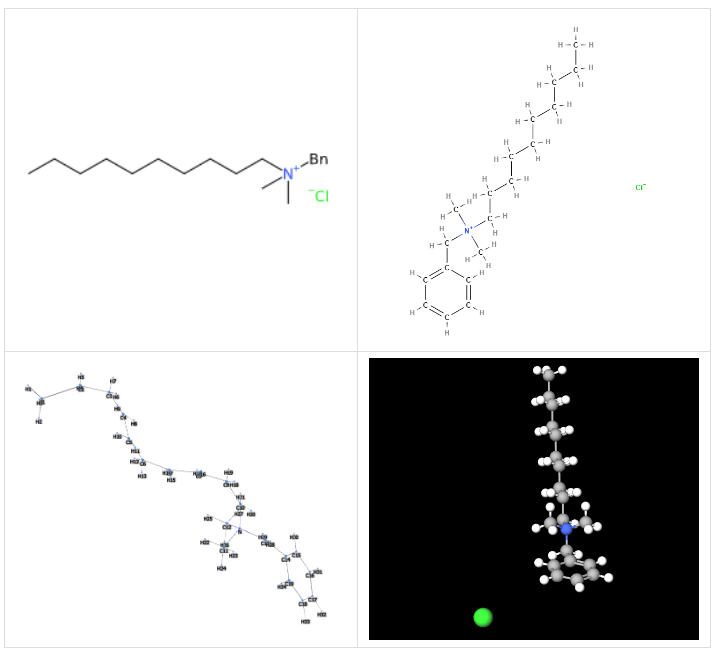
- Formula molecolare: C22H40ClN
- Peso molecolare: 354.0 g/mol
- CAS: 8001-54-5 1641-93-6 63449-41-2 68391-01-5 68424-85-1 85409-22-9
- EC Number: 216-695-0 264-151-6 269-919-4 270-325-2 287-089-1
- Alkyl dimethyl benzyl ammonium chloride
- Benzyldimethyldecylammonium chloride
- Benzenemethanaminium, N-Decyl-N,N-Dimethyl-, Chloride
- Benzenemethanaminium, N-decyl-N,N-dimethyl-, chloride
- N-Capryl-N,N-dimethylbenzylammonium chloride
- Quaternary ammonium compounds, benzyl-C8-18-alkyldimethyl, chlorides
- Benzyl(decyl)dimethylammonium chloride
- Benzenemethanaminium, N-decyl-N,N-dimethyl-, chloride (1:1)
- C8-18-Alkydimethylbenzyl ammonium chlorides
- Benzyldimethyl(mixed alkyl)ammonium chloride
- decyldimethylbenzylammonium chloride
- Alkylbenzyldimethylammonium chlorides, benzyl-C8-18-alkyldimethyl
- decyldimethylbenzyl ammonium chloride
- N-Benzyl-N-decyl-N,N-dimethylammonium chloride
- benzyl-decyl-dimethylazanium chloride
- Ammonium, alkyl(C14-16)dimethylbenzyl-, chlorides
- benzyl-decyl-dimethyl-ammonium chloride
- Roccal

