



E1518 (Triacetin)
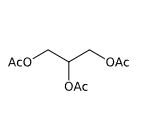
is a short-chain triglyceride, also known as glyceryl triacetate, is obtained by a chemical process of acetylation of the three hydroxy groups of glycerol.
The name defines the structure of the molecule:
- Triacetin refers to a triester that is derived from glycerol and acetic acid. The prefix "tri-" indicates that there are three acetic acid molecules esterified to each glycerol molecule.
The synthesis process takes place in several stages:
- Preparation of glycerin. The process begins with the preparation of glycerin, which is commercially available.
- Esterification. Glycerol reacts with acetic acid in the presence of an acid catalyst, often sulfuric acid. The reaction is heated, which initiates the esterification process. This reaction causes the formation of triacetin and water.
- Separation. The reaction mixture is allowed to cool. Triacetin, being less polar than water, will separate from the reaction mixture.
- Purification. Triacetin is then purified. This typically involves distillation, where triacetin is heated and vapors are collected and condensed. This process helps to remove any remaining impurities.
- Quality control. The final product is tested to ensure it meets the specifications required for use in the intended applications. This includes checking its purity, color and smell.
It is in the form of an odourless and colourless clear liquid, starts to sublimate when heated to 160°C and at 300°C, decomposes to chlorine and phosphorus trichloride. Soluble in water, soluble in carbon disulphide, carbon tetrachloride and benzoyl chloride. In moist air it is hydrolysed into phosphoric acid and hydrochloric acid, producing white, irritating smoke.
What it is used for and where
Triacetin is often used as a food additive because of its wetting, solvent and plasticizer properties. In pharmaceuticals, it is used as a plasticizer in the production of gelatin capsules. In cosmetics, it is used for its moisturizing and emollient properties.
Medical
Triacetin is both the shortest chain triglyceride (SCT), which contains fatty acids with two carbon atoms, and the only triglyceride that is up to 6 per cent soluble in water. Its approval by the Food and Drug Administration as a safe human food ingredient has led to a series of studies examining its potential as a therapeutic agent (1).
Triacetin-mediated acetate supplementation may provide a new safe chemotherapeutic adjuvant to reduce the growth of glioma tumours, particularly the more rapidly proliferating glycolytic and hypoacetylated mesenchymal glioma tumours (2).
As a substrate for lipase determination.
Food
As a food additive, the influence of the choice of aromatic solvent between propylene glycol (PG) or triacetin (TA) was investigated during the accelerated shelf life test (ASL) of biscuits and tartlets. In particular, the differential effect on the stability of added vanillin, the natural baked marker compound 5- (hydroxymethyl) furfural (HMF), specific oxidative rancidity markers (2,4-decadienal, 2,4-heptadienal) and the structural parameters of hardness and fractureability. More HMF was formed during baking of biscuits prepared with TA; these biscuits were also more stable to oxidative degradation and vanillin loss during ageing than biscuits prepared with PG. Fresh TA biscuits were significantly more brittle than fresh PG biscuits. There was no impact of the choice of solvent on hardness. Sensory evaluation of hardness, vanilla flavour and oily note were tested during the ASL-tests. There was no significant impact on the retention of sensory ratings for PG or TA biscuits (3).
Labelled as a humectant with the number E1518 in the European food additives list. Used in cooking food and dairy products to promote fermentation.
Cosmetics and fragrances
Humectant, plasticiser, solvent and fixative for fragrances, also used in dye synthesis and perfume fixative.
Antimicrobial agent. This ingredient is able to suppress or inhibit the growth and replication of a broad spectrum of microorganisms such as bacteria, fungi and viruses by making the stratum corneum temporarily bactericidal and fungicidal.
Film-forming agent. It produces, upon application, a very thin continuous film with an optimal balance of cohesion, adhesion and stickiness on skin, hair or nails to counteract or limit damage from external phenomena such as chemicals, UV rays and pollution.
Fragrance. It plays a decisive and important role in the formulation of cosmetic products as it provides the possibility of enhancing, masking or adding fragrance to the final product, increasing its marketability. It is able to create a perceptible pleasant odour, masking a bad smell. The consumer always expects to find a pleasant or distinctive scent in a cosmetic product.
Plasticiser. Ingredient added to the formulation with the purpose of retaining fragrance and colour, increasing flexibility, flowability, deformability, durability of various ingredients allowing better processing. It softens and makes flexible synthetic polymers that otherwise could not be easily processed, stretched or deformed.
Solvent. It is the substance for dissolving or dispersing surfactants, oils, dyes, flavourings, bactericidal preservatives in solution.In fact, it dissolves other components present in a cosmetic formulation. Solvents are generally liquid (aqueous and non-aqueous).
Other uses
Chromatographic fixative, solvent, hardener, curing agent that can absorb carbon dioxide from natural gas. Non-toxic and non-irritating. Environmentally friendly plasticiser containing no phthalates. can be used as a plasticiser and solvent of printing ink, nitrocellulose, cellulose acetate, ethacellulose and ellulose acetate butyrate. In casting, it is used as a moulding sand hardener. Application generally takes place in a spray chamber where triacetin is applied to the filter in the form of an aqueous aerosol.
For more information: Triacetin studies
Typical commercial product characteristics Triacetin
| Appearance | Clear colorless liquid |
| Boiling Point | 258.0±0.0°C at 760 mmHg |
| Melting Point | 3°C(lit.) |
| Flash Point | 148.9±0.0°C |
| Density | 1.2±0.1 g/cm3 |
| Acidity | ≤0.005% |
| Arsenic | ≤1 ppm |
| Heavy metal Pb | ≤5 ppm |
| Sulphated Ash | ≤0.02% |
| Water | ≤0.05% |
| Arsenic | ≤1 ppm |
| Heavy Metals (As Pb) | ≤5 ppm |
| Viscosity | 21-30 at 20°C |
| PSA | 78.90000 |
| LogP | -0.24 |
| Refraction Index | 1.435 |
| Vapor density | 7.52 |
| Vapor Pressure | 0.0±0.5 mmHg at 25°C |
| Water Solubility | 64.0 g/L (20 ºC) |
| Specific Gravity | 1.159-1.164 |
 |  |
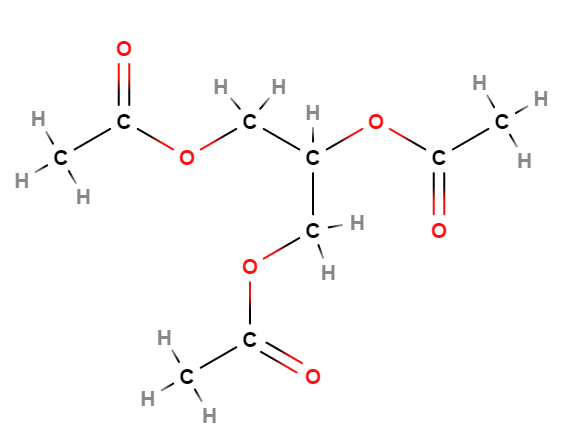 | 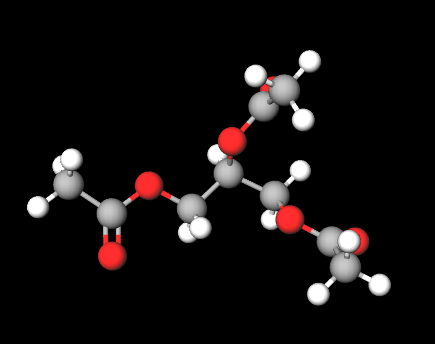 |
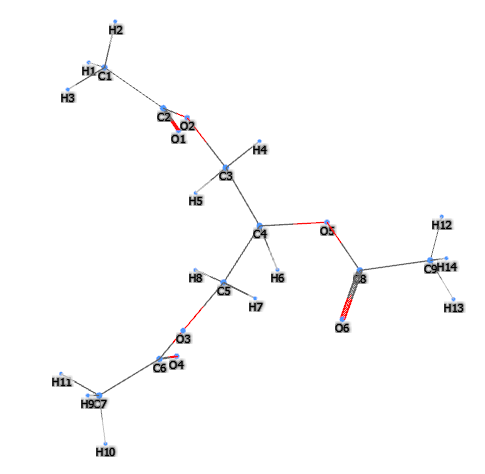
- Molecular Formula C9H14O6
- Linear Formula (CH3COOCH2)2CHOCOCH3
- Molecular Weight 218.2
- Exact Mass 218.079041
- CAS 102-76-1
- UNII XHX3C3X673
- EC Number 203-051-9
- DSSTox Substance ID
- IUPAC 2,3-diacetyloxypropyl acetate
- InChI=1S/C9H14O6/c1-6(10)13-4-9(15-8(3)12)5-14-7(2)11/h9H,4-5H2,1-3H3
- InChl Key URAYPUMNDPQOKB-UHFFFAOYSA-N
- SMILES CC(=O)OCC(COC(=O)C)OC(=O)C
- MDL number MFCD00008716
- PubChem Substance ID 329757844
- ChEBI 9661
- RXCUI 10756
- ICSC 1203
- Beilstein 1792353
- NSC 757364 4796
- RTECS AK3675000
- FEMA 2007
- JECFA 920
- NACRES NA.22
Synonyms :
- 1,2,3-propanedioltriacetate
- 1,2,3-propanedioltriethanoate
- 1,2,3-Propanetriol triacetate
- 1,2,3-Propanetriol triacetate, 9CI
- 1,2,3-Propanetriol, 1,2,3-triacetate
- 1,2,3-triacetoxypropane
- 1,2,3-Triacetylglycerol
- 1,2,3-triacetyl-glycerol
- 1,2,3-triacetyl-sn-glycerol
- 1,3-bis(acetyloxy)propan-2-yl acetate
- 1,3-Propanetriol, triacetate
- 102-76-1
- 2-(Acetyloxy)-1-[(acetyloxy)methyl]ethyl acetate
- 2,3-diacetyloxypropyl acetate
- 2-acetyloxy-1-(acetyloxymethyl)ethyl acetate
- 3-Triacetoxypropane
- 4-02-00-00253 (Beilstein Handbook Reference)
- AB00052112_06
- AC1L1KKQ
- AC1Q1L9A
- AC1Q1LBU
- Acetic, 1,2,3-propanetriyl ester
- Acetin
- Acetin, tri-
- ACMC-1C1GI
- AI3-00661
- AKOS009028851
- ANW-14741
- Blekin
- BRN 1792353
- BSPBio_002896
- C9H14O6
- CAS-102-76-1
- CCG-39680
- CCRIS 9355
- CHEMBL1489254
- CJ-05210
- CJ-24005
- CTK0H6703
- D00384
- D0Q6DX
- DivK1c_000740
- E 1518
- EBD5636
- EC 203-051-9
- EN300-19216
- Enzacetin
- Enzactin
- EOIEy xEao yen
- EOIEyOOEao yen
- Estol 1581
- Euzactin
- Ey x(3/4)<<
- FT-0626753
- Fungacet
- Fungacetin
- G0086
- Glycerin triacetate
- Glycerine triacetate
- Glycerol triacetate
- Glycerol triacetate tributyrin
- Glyceryl triacetate
- Glyped
- HMS1921G05
- HMS2092O09
- HMS2232I22
- HMS502E22
- HSDB 585
- HY-B0896
- I14-2610
- IDI1_000740
- J-000781
- KBio1_000740
- KBio2_001361
- KBio2_003929
- KBio2_006497
- KBio3_002116
- KBioGR_000823
- KBioSS_001361
- Kesscoflex TRA
- Kodaflex triacetin
- KS-00000YQB
- KSC176O0H
- LMGL03012615
- LS-2356
- MCULE-6622854116
- MFCD00008716
- MLS002152946
- MolPort-001-787-791
- Motisil
- NCGC00091612-01
- NCGC00091612-02
- NCGC00091612-03
- NCGC00091612-04
- NCGC00091612-05
- NCGC00091612-06
- NCGC00091612-07
- NCGC00091612-09
- NCGC00254207-01
- NCGC00259294-01
- NINDS_000740
- NSC 4796
- NSC4796
- NSC-4796
- NSC757364
- NSC-757364
- Pharmakon1600-01500585
- propane-1,2,3-triyl triacetate
- RP27112
- RTR-033474
- S168
- s4581
- SBB060703
- SBI-0051540.P002
- SCHEMBL3870
- SMR001224538
- SPBio_000878
- Spectrum_000881
- SPECTRUM1500585
- Spectrum2_000939
- Spectrum3_001368
- Spectrum4_000362
- Spectrum5_001376
- SR-05000002079
- SR-05000002079-1
- ST51046833
- Tox21_111155
- Tox21_111155_1
- Tox21_201745
- Tox21_300111
- TR-033474
- tri-acetin
- Triacetine
- Triacetinum
- Triacetyl glycerin
- Triacetyl glycerol
- triacetylglycerin
- Triacetylglycerol
- Triacetyl-glycerol
- Vanay
- WLN: 1VO1YOV1 & 1OV1
- XHX3C3X673
- Z1258578263
- ZINC1530705

