



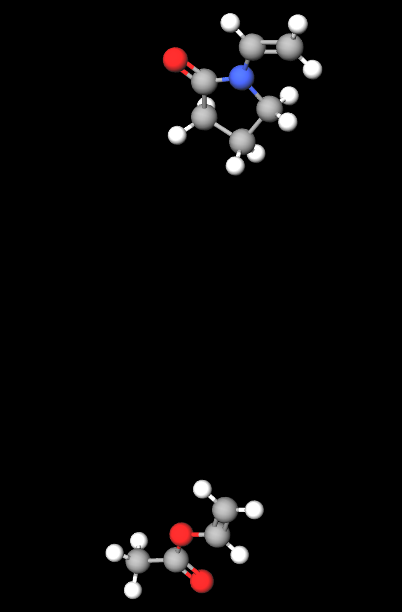
E1208 (Polyvinylpyrrolidone vinyl acetate copolymer or PVP/VA Copolymer) is a chemical compound, copolymer or copolymers that can be random or linear and are produced synthetically by the process of 'radical polymerisation' whereby a conversion of double bonds present in the monomer unit takes place, transforming them into saturated ones. This is the product of conventional radical copolymerisation of N-vinyl-2-pyrrolidone and vinyl acetate in a propan-2-ol solution with initiators.
The ratios of vinyl acetate to vinylpyrrolidone. can vary between 30/70 and 70/30. Polymers with 30%, 50%, 60% and 70% vinylpyrrolidone content are produced in isopropanol and ethanol. Polyvinylpyrrolidone vinylacetate copolymers with a vinylpyrrolidone content of 60 and 70 per cent are either 50 per cent aqueous solutions or solids.
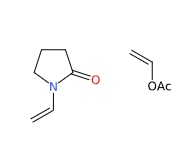
The name describes the structure of the molecule:
- Polyvinylpyrrolidone (PVP) is a synthetic polymer used for its film-forming and adhesive properties. It is known for its ability to form thin, transparent films and is often used in hair products like gels and hairsprays.
- vinyl acetate is a monomer that, when polymerized, forms a flexible and adhesive polymer. It is used to add hold and flexibility to products.
- The term "copolymer" indicates that the compound is formed by the combination of two or more different monomers, in this case, PVP and vinyl acetate.
Origin. Chemically synthesized by combining polyvinylpyrrolidone and vinyl acetate.
Industrial Production Process
- Polymerization. PVP and vinyl acetate are combined in a polymerization process to form the copolymer.
- Purification. The copolymer is purified to remove impurities and achieve the desired quality.
- Quality Control. Each batch of the copolymer undergoes quality testing to ensure its properties and safety.
It appears as a white to yellowish-white powder or flakes, with an average particle size of 50-130 μm freely soluble in water, ethanol, ethylene chloride and ether, or as a transparent liquid soluble in water, ethanol, isopropanol.
What it is used for and where
Binding/coating agent
Food
In 2009, an application was submitted to the European Commission for authorisation of polyvinylpyrrolidone vinylacetate in solid food supplements: 'Food supplements in solid form, including capsules, tablets and the like, except chewing tablets. Polyvinylpyrrolidone vinylacetate copolymer improves the strength and adhesion of the coating film and increases the rate of application.
Authorization was allowed in 2018. Full text:
The additive is authorised to be used in the following category(ies):
17.1Food supplements supplied in a solid form (COMMISSION REGULATION (EU) 2018/1497
of 8 October 2018
amending Annex II to Regulation (EC) No 1333/2008 of the European Parliament and of the Council as regards food category 17 and the use of food additives in food supplements
(Text with EEA relevance), applicable from 29/10/2018)
Individual restriction(s) / exception(s)ML = 100000 mg/kg, except food supplements in chewable form
It is labelled with the number E1208 in the European food additives list as a coating agent.
Medical and Pharmaceuticals
Polyvinylpyrrolidone vinylacetate copolymer is usually associated with low concentrations of active pharmaceutical ingredients and the mechanism of drug release is controlled by the polymer (1).
Safety
According to the opinion of Commission Regulation (EU) No 264/2014 of 14 March 2014, polyvinylpyrrolidone vinyl acetate copolymer as a binding/coating agent in solid food supplements is not expected to present safety concerns (2).
The most relevant studies on this ingredient have been selected with a summary of their contents:
Typical commercial product characteristics PVP/VA Copolymer
| Appearance | White powder |
| Nitrogen content | 7,0-8,0 % |
| pH | 3,0 – 7,0 |
| Vinyl acetate | 42,0 % |
| Free vinyl acetate | 5 mg/kg |
| Total ash | 0,1 % |
| Free N-vinylpyrrolidone | 5 mg/kg |
| Hydrazine | 0,8 mg/kg |
| Peroxide | 400 mg/kg |
| Propan-2-ol | 150 mg/kg |
| As | 3 mg/kg |
| Pb | 2 mg/kg |
| Mercury | 1 mg/kg |
| Cadmium | 1 mg/kg |
 |  |
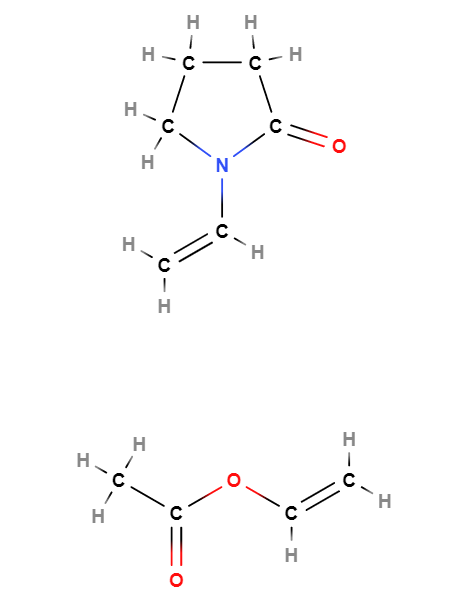 |  |
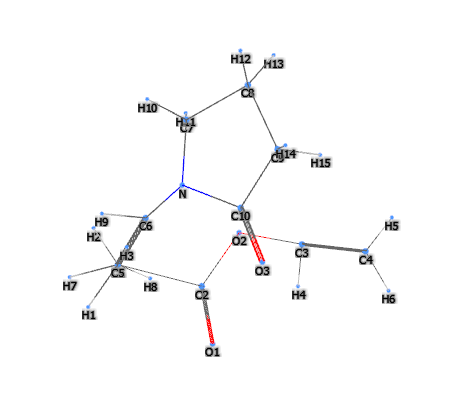
- Molecular Formula (C6H9NO)n(C4H6O2)m C10H15NO3
- Viscosity average molecular weight Between 26 000 and 46 000 g/mol
- CAS 25086-89-9
- UNII
- EC Number 607-540-1
- DSSTox Substance ID DTXSID80897056
- IUPAC ethenyl acetate;1-ethenylpyrrolidin-2-one
- InChl=1S/C6H9NO.C4H6O2/c1-2-7-5-3-4-6(7)8;1-3-6-4(2)5/h2H,1,3-5H2;3H,1H2,2H3
- InChl Key FYUWIEKAVLOHSE-UHFFFAOYSA-N
- SMILES CC(=O)OC=C.C=CN1CCCC1=O
- MDL number MFCD00134018
- NACRES NA.23
- RTECS AH3539000
- NSC 114026 114025 114024 114023
Synonyms
- Vinylpyrrolidone/ vinylacetate copolymers
- Poly(1-vinylpyrrolidone-co-vinyl acetate)
- kolima35
- gaf-s630
- Cholest-8(14)-ene-3,6-diyl diacetate

