FD & C Red No. 3 o CI 45430 o Eritrosina è un colorante chimico sintetico di color rosso con iodio.
Il nome definisce la struttura della molecola.
- FD & C indica che il colore è approvato dalla Food and Drug Administration (FDA) degli Stati Uniti per l'uso in alimenti, farmaci e cosmetici. (1969, 1982)
- Red No. 3 si riferisce a un particolare colore rosso, noto anche come Eritrosina, che è un colorante sintetico.
Descrizione delle materie prime utilizzate nella produzione.
- L'acido gallico e la 3,4-diidrossi benzaldeide sono le principali materie prime utilizzate nella produzione della eritrosina. Queste sostanze sono coinvolte nella preparazione del componente di xantina del colorante.
Riassunto passo-passo del processo di produzione industriale.
- Produzione di 3,4-Diidrossi benzaldeide. L'acido gallico può essere trattato termicamente per produrre 3,4-diidrossi benzaldeide.
- Sintesi della Eritrosina. La 3,4-diidrossi benzaldeide è coinvolta nella preparazione della xantina, che viene successivamente convertita in eritrosina attraverso ulteriori passaggi sintetici.
- Purificazione. La eritrosina grezza è purificata attraverso vari processi, tra cui la cristallizzazione, la filtrazione e la purificazione cromatografica.
- Essiccazione e Granulazione. Il colorante purificato è poi essiccato e trasformato in una forma solida stabile, che può essere una polvere o dei granuli.
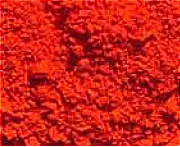
Forma e colore. La eritrosina si presenta come una polvere cristallina di colore rosa-rosso.
Applicazioni commerciali.
FD&C Red No. 3 è utilizzato in varie applicazioni nell'industria alimentare, cosmetica e farmaceutica per conferire un colore rosa o rosso ai prodotti. Trova impiego in confetteria, prodotti da forno, cosmetici, e alcuni farmaci e integratori alimentari.
Si presenta in forma di polvere rossa.
Sicurezza
Usato nei dentifrici e in alimentazione viene considerato sicuro per la salute se la massima concentrazione non supera lo 0.0025% (25 ppm), tuttavia diversi studi hanno rilevato come questo colorante possa creare problemi per la salute umana (1).
Ha un effetto sulla tiroide ed è considerato dalla letteratura scientifica agente tumorale secondario (2).
E' etichettato con il numero E127 nella lista degli additivi alimentari europei.
Formula molecolare C20H6I4Na2O5 C20H6I4Na2O5H2O
Peso molecolare : 879.86 g/mol
CAS 16423-68-0
Sinonimi:
- FD & C Red No. 3
- 2-(2,4,5,7-Tetraiodo-6-hydroxy-3-oxo-3H-xanthene-9-yl)benzoic acid
- Sodium 2',4',5',7'-tetraiodo-3-oxo-3H-spiro[isobenzofuran-1,9'-xanthene]-3',6'-bis(olate)
- 2',4',5',7'-Tetraiodofluorescein, disodium salt
- Disodium 2-(2,4,5,7-tetraiodo-6-oxido-3-oxoxanthen-9-yl)benzoate
- 9-(o-Carboxyphenyl)-6-hydroxy-2,4,5,7-tetraiodo-3H-xanthene-3-one disodium salt monohydrate
- Disodium 9-(O-carboxyphenyl)-6-hydroxy-2,4,5,7-tetraiodo-3H-xanthen-3-one monohydrate
- Disodium 3',6'-dihydroxy-2',4',5',7'-tetraiodospiro(isobenzofuran-1(3H),9'-(9H)xanthen)-3-one
- C.I.Solvent Red 140
- Erythrosinic acid
Bibliografia_____________________________________________________________________
(1) Chequer FM, Venancio VP, Almeida MR, Aissa AF, Bianchi MLP, Antunes LM. Erythrosine B and quinoline yellow dyes regulate DNA repair gene expression in human HepG2 cells. Toxicol Ind Health. 2017 Oct;33(10):765-774. doi: 10.1177/0748233717715186.
Abstract. Erythrosine B (ErB) is a cherry pink food colorant and is widely used in foods, drugs, and cosmetics. Quinoline yellow (QY) is a chinophthalon derivative used in cosmetic compositions for application to the skin, lips, and/or body surface. Previously, ErB and QY synthetic dyes were found to induce DNA damage in HepG2 cells. The aim of this study was to investigate the molecular basis underlying the genotoxicity attributed to ErB and QY using the RT2 Profiler polymerase chain reaction array and by analyzing the expression profile of 84 genes involved in cell cycle arrest, apoptosis, and DNA repair in HepG2 cells. ErB (70 mg/L) significantly decreased the expression of two genes ( FEN1 and REV1) related to DNA base repair. One gene ( LIG1) was downregulated and 20 genes related to ATR/ATM signaling ( ATR, RBBP8, RAD1, CHEK1, CHEK2, TOPB1), nucleotide excision repair ( ERCC1, XPA), base excision repair ( FEN1, MBD4), mismatch repair ( MLH1, MSH3, TP73), double strand break repair ( BLM), other DNA repair genes ( BRIP1, FANCA, GADD45A, REV1), and apoptosis ( BAX, PPP1R15A) were significantly increased after treatment with QY (20 mg/L). In conclusion, our data suggest that the genotoxic mechanism of ErB and QY dyes involves the modulation of genes related to the DNA repair system and cell cycle.
(2) Poulsen E. Case study: erythrosine. Food Addit Contam. 1993 May-Jun;10(3):315-23. doi: 10.1080/02652039309374154.
Abstract. Erythrosine (FD & C Red No. 3) is an iodine-containing food colour which was used as an example in the application of the proposed approach of data-derived safety factors. The effect of erythrosine on the thyroid and the mechanism by which the effect is induced has been central to the discussion of the establishment of an Acceptable Daily Intake (ADI), or not, and a short account is given of the effect of erythrosine on the thyroid. The evaluation of erythrosine as a secondary tumorigenic agent was based on the evaluations of the Joint FAO/WHO Expert Committee on Food Additives (JECFA) and the Scientific Committee for Food of the Commission of the European Communities (SCF). In the proposed decision tree scheme, three different possibilities were examined. One was based on the long-term data and the second on the hormone data in the rat; the third was based on the NOEL for hormonal changes in humans. The three approaches with different NOEL and default values resulted in the following ADIs: 0.25, 0.3 and 0.1 mg/kg bw. The cases are discussed and it is concluded that the ADI based on the NOEL in human studies seems most appropriate. As there is most uncertainty about the default value for human pharmacokinetic variability, it is suggested that further human studies might elucidate this point.




