



Orthosiphon Stamineus Leaf Extract (Orthosiphon stamineus): properties, uses, pros, cons, safety
Orthosiphon Stamineus Leaf Extract is a botanical extract obtained from the leaves of Orthosiphon stamineus (family Lamiaceae), a plant also known as java tea / cat’s whiskers. In cosmetics it is mainly used as a skin conditioning ingredient, with formulation interest linked to its polyphenolic fraction (e.g., rosmarinic acid) and methoxylated flavonoids (e.g., sinensetin, eupatorin), whose presence and levels strongly depend on the extraction process and standardization.
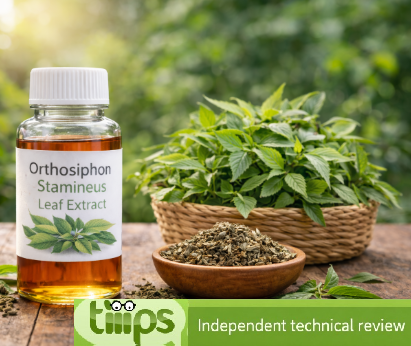
Definition
It is a cosmetic ingredient of plant origin consisting of a complex mixture of natural compounds extracted from the leaf matrix. The qualitative profile depends on critical process variables: solvent (water, ethanol, hydroalcoholic blends, glycols/glycerin), drug/solvent ratio, temperature, time, and clarification/concentration steps. For reliable use in formulation, specifications and (when applicable) standardization to analytical markers are key.
Production process
A typical supply chain includes: selection and cleaning of leaves, controlled drying, milling, extraction (aqueous / hydroalcoholic / glycolic), filtration and clarification, concentration (often under vacuum), optional standardization to markers, and final stabilization (ready-to-use solution or powder via drying). In cosmetics, quality control focuses on microbiological load, contaminants (e.g., heavy metals), batch-to-batch consistency (color/odor/markers), and the verification of residual solvents when relevant.
Key constituents
Representatively, the extract may contain (in variable proportions): rosmarinic acid (polyphenol), sinensetin and eupatorin (methoxylated flavonoids), and a fraction of characteristic diterpenes (often cited as orthosiphols/related derivatives). In general, hydroalcoholic extractions or selected organic solvents may enrich some fractions (e.g., methoxylated flavonoids) compared to purely aqueous extractions.
Phytochemical analysis shows polyphenols, bioactive proteins, flavonol glycosides and a lot of potassium with anti-inflammatory, antioxidant, antibacterial and vasodilator activity (1).
Identification data and specifications
| Parameter | Value | Note |
|---|---|---|
| INCI name | Orthosiphon Stamineus Leaf Extract | label denomination |
| Origin | plant | from Orthosiphon stamineus (Lamiaceae) |
| Plant part used | leaves | botanical raw material |
| CAS number | 84012-29-3 | commonly reported identifier |
| EC number (EINECS/ELINCS) | 281-674-5 | EU identifier |
| Cosmetic function | skin conditioning | main function in ingredient databases |
| Commercial form | liquid or powder | depends on grade (solution/glycolic/powder) |
| Typical solvents/carriers | water, ethanol, glycerin/glycols | depending on finished product |
Physico-chemical properties (indicative)
| Parameter | Indicative value | Note |
|---|---|---|
| Appearance | liquid or powder | depends on standardization and carrier |
| Color | yellow–brown | influenced by polyphenols and concentration |
| Odor | mild, herbal | varies with solvent and purity |
| Solubility | good in water/glycerin/glycols (if hydrophilic) | depends on form and carrier |
| Stability | sensitive to light and oxidation | possible color/odor drift over time |
| Formulation pH range | generally compatible with skin pH | verify marker stability |
| Interactions | possible interactions with polymers/cationics | more likely at high polyphenol content |
Functional role and rationale of use
In cosmetics, its use is consistent with a skin conditioning contribution and support for comfort. From a technical perspective, the phenolic fraction can be leveraged in formulas with “botanical” positioning, including narratives linked to an antioxidant profile of the finished formula. Perceivable outcomes depend on dosage, stability (oxidation/photo-stability), and the delivery system (emulsion, gel, lotion).
Main uses
Orthosiphon Stamineus is used in traditional medical medicine as a treatment for rheumatism, inflammation of the kidneys and urinary tract, kidney stones and to reduce LDL cholesterol and blood pressure.
Cosmetics - INCI Functions
Skin conditioning agent. It is the mainstay of topical skin treatment by restoring, increasing or improving skin tolerance to external factors, including melanocyte tolerance. The most important function of the conditioning agent is to prevent skin dehydration, but the subject is rather complex and involves emollients and humectants.
In practice, it is found in:
Face care: “comfort” creams/serums, formulas targeting dull/tired-looking skin, products with botanical storytelling.
Body care: light lotions and gels where “botanical care” positioning and good sensorial profile are desired.
Functional/claim-driven products: formulas where marker consistency (when declared) supports profile repeatability.
In practice, it is found in:
Face care: “comfort” creams/serums, formulas targeting dull/tired-looking skin, products with botanical storytelling.
Body care: light lotions and gels where “botanical care” positioning and good sensorial profile are desired.
Functional/claim-driven products: formulas where marker consistency (when declared) supports profile repeatability.

