



Orthosiphon Stamineus Extract (Orthosiphon stamineus): properties, uses, pros, cons, safety
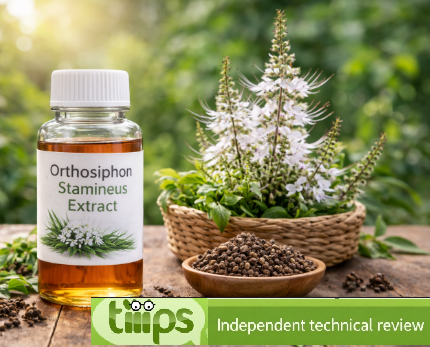
Orthosiphon Stamineus Extract is an extract obtained from the leaves of Orthosiphon stamineus (family Lamiaceae), a plant also known as java tea or cat’s whiskers. In cosmetics it is mainly used as a skin conditioning ingredient and, depending on the extraction method, it can be valued for its content of polyphenols and methoxylated flavonoids. In herbal practice, Orthosiphon leaf preparations are traditionally associated with supporting urinary function (a phytotherapeutic use context, distinct from cosmetics).
Definition
It is a botanical extract (a complex mixture) obtained from dried or fresh leaves, with a composition profile that depends on: botanical source, raw material quality, extraction solvent (water, ethanol, or hydroalcoholic mixtures), drug/solvent ratio, temperature, and processing time. It is therefore not a single molecule: quality depends on standardization (analytical markers) and batch-to-batch consistency.
Production process
A typical manufacturing chain includes: leaf selection and cleaning, controlled drying, milling, extraction (aqueous or hydroalcoholic), clarification/filtration, concentration (often under vacuum), possible standardization to markers (e.g., specific polyphenols), and final stabilization (solution, glycolic extract, or powder via spray-drying). For cosmetic applications, key controls include microbiological purity, solvent residues, heavy metals, and marker consistency.
Key constituents
Representatively, the extract may contain: rosmarinic acid (a polyphenol), sinensetin and eupatorin (flavonoids), and a fraction of diterpenes (e.g., orthosiphols, when present). The real profile varies significantly with the solvent: hydroalcoholic extracts tend to concentrate certain phenolic fractions more than purely aqueous extracts.
Identification data and specifications
| Characteristic | Value | Note |
|---|---|---|
| INCI name | Orthosiphon Stamineus Extract | cosmetic denomination |
| Plant part used | leaves | as per ingredient repertories |
| Origin | botanical | extract of Orthosiphon stamineus (Lamiaceae) |
| CAS number | 84012-29-3 | commonly reported identifier |
| EC number (EINECS) | 281-674-5 | EU identifier |
| Typical cosmetic function | skin conditioning | primary database function |
Physicochemical properties (indicative)
| Characteristic | Indicative value | Note |
|---|---|---|
| Appearance | liquid (glycolic/hydroalcoholic) or powder | depends on commercial grade |
| Color | yellow–brown | depends on polyphenols and concentration |
| Odor | mild, herbal | depends on solvent and purity |
| Solubility | good in water and/or glycols (if hydrophilic extract) | depends on form (solution vs powder) |
| Stability | sensitive to light and oxidation | packaging and antioxidants can help |
| Practical formulation pH range | generally compatible with skin pH | verify for marker stability |
| Interactions | possible complexation with polymers/cationics | depends on matrix and polyphenol level |
Functional role and mechanism of action
In cosmetics, its use is consistent with skin conditioning: improving comfort, supporting a perception of more “even” skin, and contributing to the sensory profile of the finished product. From a technical perspective, polyphenols may be positioned within an antioxidant-support narrative; real-world transferability depends on dose, marker stability, and the delivery system.
Main uses
Orthosiphon Stamineus is used in traditional medical medicine as a treatment for rheumatism, inflammation of the kidneys and urinary tract, kidney stones and to reduce LDL cholesterol and blood pressure.
Phytochemical analysis shows polyphenols, bioactive proteins, flavonol glycosides and a lot of potassium with anti-inflammatory, antioxidant, antibacterial and vasodilator activity (1).
Cosmetics - INCI Functions
Skin conditioning agent. It is the mainstay of topical skin treatment by restoring, increasing or improving skin tolerance to external factors, including melanocyte tolerance. The most important function of the conditioning agent is to prevent skin dehydration, but the subject is rather complex and involves emollients and humectants.
Supplements and herbal teas (use context): Orthosiphon leaf preparations are traditionally used to support diuresis and urinary tract function; for oral-use extracts, standardization and local regulatory compliance are critical.
Pros and cons
Pros
Can support a botanical and polyphenol-based positioning.
Good versatility: available as glycolic extract, hydroalcoholic extract, or powder, with relatively straightforward incorporation into many bases.
Contributes to skin conditioning without heavy sensorial impact when properly dosed.
Cons
Batch variability if standardization is lacking (clear markers/specifications needed).
Potential instability of some markers to light and oxidation, impacting color/odor over time.
In complex systems, polyphenols may interact (e.g., color shifts or compatibility issues with some polymers), so formulation checks are needed.
Safety, regulatory, and environmental aspects
Safety profile (practical)
In cosmetics, the core issue is extract quality (microbiology, solvent residues, contaminants) and finished-product compatibility for sensitive skin. Botanical extracts, while often well tolerated, can cause irritation in predisposed individuals if the product is rich in solvents, fragrance, or if the extract is highly concentrated.
Allergen
Not a classic fragrance allergen. However, as with many botanical extracts, individual sensitization cannot be excluded; in practice, the evaluation must be made on the finished product.
Contraindications and cautions
For cosmetic use: caution in periocular formulas and on highly compromised skin barrier, especially if the extract is in alcoholic vehicles or at high concentration. For oral use (if relevant): Orthosiphon preparations are associated with a diuretic effect and may require caution with diuretic therapies or renal conditions, in line with phytotherapeutic guidance.
Conclusion
Orthosiphon Stamineus Extract is a leaf extract from Orthosiphon stamineus (Lamiaceae) used mainly for skin conditioning, with formulation interest related to polyphenols and flavonoids. Technical value depends on standardization and in-formula stability; key watch-outs are managing batch variability, light/oxidation stability, and finished-product tolerability.

