



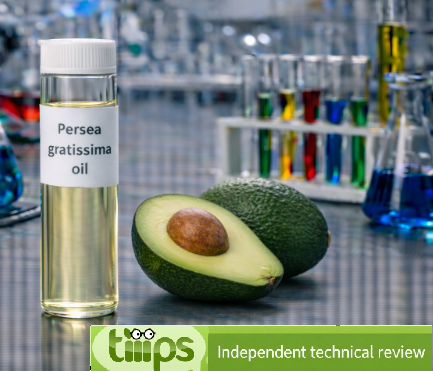
Persea gratissima oil (avocado oil)
Fixed oil obtained from the pulp (and/or fruit) of Persea americana (syn. Persea gratissima, family Lauraceae), used as an emollient and skin conditioning agent; in suitable grades, also used as an edible oil
Synonyms: avocado oil; refined avocado oil; cold-pressed avocado oil (grade-dependent)
INCI / functions: skin conditioning (emollient)
Definition
Persea gratissima oil is a vegetable oil composed mainly of triglycerides (glycerol esters) with a lipid profile dominated by unsaturated fatty acids—primarily oleic acid and, in variable proportions, linoleic acid. Saturated fatty acids (e.g., palmitic and stearic) are present as well, together with an unsaponifiable fraction that may include phytosterols and tocopherols (vitamin E), with levels influenced by cultivar, origin, and refining degree.
From a practical formulation standpoint, avocado oil is often perceived as more “substantial” than other oleic-rich oils, translating into a more nourishing sensorial contribution and a more evident lipid film. Grade selection (refined vs cold-pressed) directly affects key parameters such as acid value, peroxide value, oxidative stability, and residual color/odor, with consequences for shelf life and sensorial repeatability of the finished product.
Persea gratissima is a plant native to Mexico and Central America that belongs to the Lauraceae family.
Composition: 71% monounsaturated fatty acids (good), 13% polyunsaturated fatty acids (good), 16% saturated fatty acids (bad).
Oleic acid is the main monounsaturated fatty acid with anti-inflammatory activity, and palmitic acid the main saturated fat.
Note: the oil contains mostly MUFA (monounsaturated fatty acids) and PUFA (polyunsaturated fatty acids), with a smaller fraction of SFA (saturated fatty acids). The abbreviations are defined in the mini-glossary.
Main uses
Food.
In food-grade quality, avocado oil is used as an edible oil and lipid ingredient. Its use is linked to a generally mild organoleptic profile and suitability as a seasoning oil or fat component in preparations, with quality specifications including oxidation control (peroxides), acidity, and identity parameters. In food applications, safety management (compliance with contaminant limits) and potential allergen considerations for sensitized individuals are also relevant (avocado allergy exists and, in some people, can be associated with latex cross-reactivity).
Cosmetics.
In cosmetics, Persea gratissima oil is primarily used as an emollient in creams, lotions, body oils, massage products, cleansing oils, and lip products. It is selected to improve comfort and reduce the sensation of dryness, supporting a softer after-feel and better spreading. In emulsions it can increase the “richness” of the oil phase and improve touch, but sensorial balance matters: on combination skin or in lightweight concepts it may feel more “present,” so it is often modulated with lighter esters or blended with other oils.
In haircare it is used in masks, pre-shampoo oils, and some leave-on products to increase perceived softness and shine. Here too, “weight” perception depends on hair type and the overall formula structure: on fine hair, lower levels or combinations with lower-residue lipids are typically preferred.
Cosmetics
Skin conditioning agent. It is the mainstay of topical skin treatment by restoring, increasing or improving skin tolerance to external factors, including melanocyte tolerance. The most important function of the conditioning agent is to prevent skin dehydration, but the subject is rather complex and involves emollients and humectants.
CAS: 8024-32-6 EC number 232-428-0
Medicine.
Not a therapeutic active; it may appear as a vehicle/emollient in specific finished products under applicable requirements.
Pharmaceutical.
May be used as a lipid excipient/vehicle in topical (and, in some contexts, oral) preparations when compliant with required specifications; in these cases, controls for oxidation, acidity, and purity are essential.
Industrial use.
Primarily used in personal care; other uses depend on technical specifications and cost.
Calories (energy value)
| Parameter | Value |
|---|---|
| Energy value | About 3700 kJ / 900 kcal per 100 g (oil: almost entirely lipids) |
Identification data and specifications
| Identifier | Value |
|---|---|
| INCI name | Persea Gratissima Oil |
| Origin | fixed oil from the fruit of Persea americana (syn. Persea gratissima, Lauraceae) |
| CAS number | 8024-32-6 (some SDS also list 8007-72-5 as an alternative entry) |
| EC/EINECS number | 232-428-0 |
| Physical state | liquid |
| Variability note | composition and key parameters depend on cultivar, process, and grade (refined/cold-pressed) |
Chemical-physical properties (indicative)
| Property | Value | Note |
|---|---|---|
| Density (20–25 °C) | ~0.907–0.925 g/mL | typical range from commercial specifications |
| Refractive index (20 °C) | ~1.460–1.470 | identity/quality indicator |
| Iodine value | ~64–95 g I₂/100 g | linked to degree of unsaturation |
| Saponification value | ~185–205 mg KOH/g | typical for triglyceride oils |
| Acid value | typically <8 mg KOH/g (spec) | hydrolysis/quality index |
| Peroxide value | typically a specification limit (e.g., ≤10–20 meq O₂/kg) | primary oxidation index |
| Unsaponifiables | typically <2% | grade-dependent |
Indicative lipid composition
| Fraction | Typical range | Note |
|---|---|---|
| Oleic acid (C18:1) | ~50–74% | often the dominant component |
| Linoleic acid (C18:2) | ~6–20% | cultivar- and grade-dependent |
| Palmitic acid (C16:0) | ~5–25% | saturated; influences body/touch |
| Palmitoleic acid (C16:1) | ~1–12% | characteristic contribution in some lots |
| Stearic acid (C18:0) | up to ~3% | saturated |
| Linolenic acid (C18:3) | up to ~3% | higher oxidation sensitivity |
Functional role and practical mechanism
| Function | What it does in formula | Technical note |
|---|---|---|
| Emollient | improves softness and skin comfort | surface lipid film |
| Skin conditioning | reduces drag and improves slip | useful in creams/lotions and massage products |
| Lipophilic carrier | solubilizes oil-soluble ingredients and fragrances | manage oxidative stability |
| Sensory modifier | provides body and “richness” | balance in lightweight concepts or on fine hair |
Formulation compatibility
In O/W and W/O emulsions, avocado oil is generally compatible and easy to incorporate, but oxidative stability should be controlled. The presence of PUFA (variable level) supports the need to control peroxide/acid values of the raw material and to evaluate an antioxidant strategy consistent with the formula (selection and dosing depend on architecture and product positioning).
In anhydrous systems (body oils, massage oils, lip products), compatibility is typically high; the main risks are odor/color drift over time and lot-to-lot sensorial differences if specifications are not tight. In haircare, higher levels may enhance a coating feel and perceived heaviness; this is commonly managed via blends (lighter esters, other oils) or application concepts that limit residue.
For acne-prone skin or “ultra-light” concepts, the key issue is often not technical compatibility but sensorial balance—between perceived nourishment and residual oiliness—so validation on the finished product under realistic use conditions is recommended.
Use guidelines (indicative)
| Application | Typical range | Technical note |
|---|---|---|
| Face/body creams and lotions | 1–15% | adjust to sensorial target |
| Body and massage oils | 10–100% | control PV/AV and fragrance stability |
| Lip products (sticks/balms) | 2–20% | wax synergy and oxidative stability |
| Hair masks/creams | 0.5–5% | slip and softness; watch build-up |
| Hair oil / pre-shampoo | 5–100% | adjust for fine hair and rinsability |
| Lightweight leave-on hair | 0.2–3% | often blended with lighter esters |
Quality, grades, and specifications
| QC parameter | What to check |
|---|---|
| Identity | INCI, CAS/EC alignment and documentation (SDS/CoA) |
| Acid value | hydrolysis index; impacts odor and stability |
| Peroxide value | primary oxidation; affects shelf life |
| Refractive index/density | lot-to-lot repeatability indicators |
| Fatty acid profile | authenticity and performance/sensorial consistency |
| Unsaponifiables | sensorial contribution; spec consistency |
| Contaminants | heavy metals, pesticides (if food-grade), process residues |
| Storage | manage light/heat/oxygen exposure to limit oxidation |
Safety, regulatory, and environment
In cosmetics, safety must be assessed on the finished product (use area, frequency, population). Persea gratissima oil is widely used as an emollient with generally good tolerability; however, as with other plant-derived ingredients, sensitization potential exists in predisposed individuals. Avocado allergy is documented and, in some cases, may be associated with latex cross-reactivity: for leave-on products intended for sensitive users, risk management based on raw material specifications and finished-product assessment is advisable.
In manufacturing, applying GMP (Good manufacturing practice; benefit: reduces variability and operational risk) improves control and repeatability. Where adopted as an approach, HACCP (Hazard analysis and critical control points; benefit: strengthens prevention and quality control at critical process points) supports preventive management of sensitive points.
Formulation troubleshooting
| Problem | Possible cause | Recommended intervention |
|---|---|---|
| Rancid odor / yellowing | oxidation (high PV, unsuitable storage) | select low-PV lots, manage air/light/heat exposure, evaluate a compatible antioxidant |
| Feel too “rich”/greasy | high level or combination with heavy lipids | reduce %, use lighter esters, optimize oil phase and texturizers |
| Emulsion instability | unsuitable emulsifier or unbalanced oil phase | retune HLB/emulsifier, adjust oil-phase structure, thermal stress testing |
| Cold haze | fraction crystallization, grade variability | select more controlled/refined grade, define cold test, optimize storage |
| Lot-to-lot sensorial variability | origin/process differences | set limits on fatty acids, RI/density, PV/AV; qualify suppliers |
Conclusion
Persea gratissima oil is a versatile vegetable oil used mainly as an emollient and skin conditioning agent, with a sensorial contribution that is often more nourishing and structured than many other oils. Quality and formulation success depend critically on specifications (PV/AV, identity parameters, fatty acid profile) and careful management of oxidative stability. In leave-on products and sensorially light concepts, oil-phase balancing is decisive to deliver comfort without excessive residual feel.
Mini-glossary
MUFA: monounsaturated fatty acids; health note: when replacing some saturated fats, they may support a more favorable dietary lipid profile within the overall diet.
PUFA: polyunsaturated fatty acids; health note: include essential fatty acids such as linoleic; more oxidation-prone, so oil stability is a technical focus.
SFA: saturated fatty acids; health note: excessive dietary intake is often associated with less favorable profiles, while in this oil they are typically a smaller share.
Peroxide value (PV): indicator of primary oxidation in oils.
Acid value (AV): index of free fatty acids; linked to quality and hydrolysis.
GMP: Good manufacturing practice; benefit: reduces variability and contamination.
HACCP: Hazard analysis and critical control points; benefit: strengthens prevention and control at critical process points.

