



Aloe barbadensis leaf juice: properties, uses, pros, cons, safety
(Aloe barbadensis; Asphodelaceae)
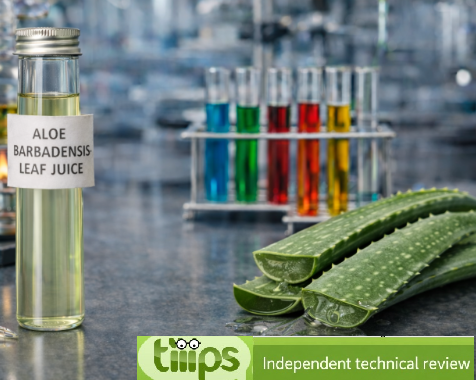
Aloe barbadensis leaf juice is the juice obtained from the leaves of Aloe barbadensis (a botanical synonym commonly associated with Aloe vera). In cosmetics it is used mainly as a skin conditioning ingredient, with a formulation profile typical of botanical raw materials with high water content and a polysaccharide fraction.
Synonyms: aloe vera leaf juice (descriptive use in some commercial contexts); aloe juice (descriptive).
Definition
Aloe barbadensis leaf juice is defined as the juice expressed from aloe leaves. From a “substance” standpoint, it is not a single molecule but a mixture in which water is predominant, with a variable portion of dissolved and colloidal solids. In practice, the fraction of cosmetic interest is often associated with polysaccharides (with variability depending on species, leaf portion used, processing, and stabilization), plus minor components such as minerals and low-molecular-weight plant constituents.
For cosmetic use, the factors that drive perceived quality and repeatability are primarily: standardization of solids/markers, control of undesired components (notably anthraquinone fractions when present), and microbiological stability of the raw material (given that it is typically an aqueous ingredient).
It contains antioxidant vitamins (A, C, E, B12), niacin, riboflavin and folic acid to improve skin epithelialisation, thanks to the antioxidant and anti-inflammatory activities of these components.
Aloe barbadensis or Aloe vera is one of the 400+ species of Aloe, a cactus, a slow-growing perennial succulent plant belonging to the Liliaceae family.
For more information: Aloe barbadensis
Main uses
Food.
It is marketed as a beverage or ingredient in certain food supply chains; however, cosmetic “leaf juice” does not necessarily correspond to a food-grade material. Food use requires dedicated specifications and sector-specific regulatory/quality compliance.
Cosmetics.
Main use in leave-on and rinse-off products (creams, lotions, gels, mild cleansers, after-sun) where it supports a formula positioning oriented to comfort, a softer skin feel, and perceived hydration support, in combination with humectants and film-forming systems.
INCI functions
Skin conditioning agent. It is the mainstay of topical skin treatment by restoring, increasing or improving skin tolerance to external factors, including melanocyte tolerance. The most important function of the conditioning agent is to prevent skin dehydration, but the subject is rather complex and involves emollients and humectants.
Identification data and specifications
| Characteristic | Value |
|---|---|
| INCI name | Aloe barbadensis leaf juice |
| common name | aloe juice |
| reference plant | Aloe barbadensis (commonly associated with Aloe vera) |
| botanical family | Asphodelaceae |
| CAS number | 85507-69-3 / 94349-62-9 |
| EC/EINECS number | 287-390-8 / 305-181-2 |
| molecular formula | not applicable (mixture) |
| molecular weight | not applicable as a single value (mixture) |
| typical commercial form | stabilized liquid, concentrate, or reconstitutable powder (grade-dependent) |
| energy value (practical note) | not applicable in cosmetics |
Physico-chemical properties (indicative)
| Characteristic | Value | Note |
|---|---|---|
| chemical nature | aqueous mixture of plant components | not a “pure” substance |
| water solubility | high / complete (as a matrix) | typically an aqueous ingredient |
| microbiological sensitivity | potentially high | requires microbiological control and suitable stabilization |
| pH stability | grade-dependent | pH extremes may affect stability and performance |
| process sensitivity | possible sensitivity to prolonged heat stress | advisable to limit severe processing in the finished formula |
| critical parameters | total solids, markers/standardization, specific impurities | drive repeatability and quality |
Functional role and practical mechanism of action
In formulas, Aloe barbadensis leaf juice functions mainly as a skin conditioning ingredient and as an aqueous component with a polysaccharide fraction that can contribute to feel (light film, reduced perceived dryness) when properly integrated into the humectant system and rheological structure. Real performance is strongly dependent on raw-material quality (standardization) and the formulation context (humectants, polymers, preservatives, fragrance, packaging).
Formulation compatibility
Compatibility is generally good in emulsions and aqueous gels, with attention to three practical areas: microbiological stability (aqueous raw materials), compatibility with preservatives and fragrances (which can influence odor/color over time), and pH management. In “clean” systems or with reduced preservation, the ingredient should be selected with robust specifications and validated through challenge testing and accelerated finished-product stability.
Use guidelines (indicative)
Use should follow the supplier’s technical documentation (grade, assay/standardization, pH window, preservation requirements). In development, it is useful to implement controls on: finished-product pH, organoleptic stability (color/odor), microbiology, and, where available, consistency of declared markers. Packaging with good oxygen barrier and appropriate in-use contamination management support shelf-life, especially for high-water leave-on products.
Quality, grades, and specifications
Key quality points include: standardization (total solids or markers), impurity profile, contaminants (pesticides/trace metals per applicable specifications), and microbiological controls. In addition, for aloe-based ingredients, management of the anthraquinone fraction is relevant: some cosmetic safety evaluations emphasize keeping such components at very low levels, consistent with supply-chain and supplier specifications.
Safety, regulatory, and environment
Cosmetic safety depends on ingredient quality and the assessment of the finished product. For aloe, the practical focus is on: microbiological control (aqueous raw material), supply-chain purity/impurities, and management of undesired components (notably anthraquinone fractions, where relevant). Based on available evaluations, certain independent cosmetic safety assessments consider Aloe barbadensis preparations usable under stated conditions and concentrations, with the recommendation to maintain anthraquinones at very low levels.
Implementation of GMP (good manufacturing practice; benefit: reduces variability and contamination) is particularly important for aqueous botanical ingredients to ensure repeatability and microbiological control.
Formulation troubleshooting
Microbiological instability or abnormal odor over time.
Typical cause: high initial bioburden or insufficient preservation for an aqueous ingredient. Action: grade qualification, compatible preservative strategy, challenge testing, and process/packaging control.
Color/turbidity shifts or loss of expected feel.
Typical cause: incompatibility with pH, fragrances, or preservatives, or batch variability. Action: remain within the recommended pH window, perform compatibility screening, and tighten standardization specifications.
Conclusion
Aloe barbadensis leaf juice is an aqueous cosmetic botanical ingredient used primarily for skin conditioning. Performance in formula depends less on a single “active” and more on grade quality (standardization, impurities, microbiology) and compatibility with pH, preservatives, and packaging. A robust supplier-qualification approach and finished-product stability program are decisive for repeatable results.
Mini-glossary
Polysaccharides: high-molecular-weight carbohydrates; in some botanical matrices they contribute to viscosity and a light film.
Markers/standardization: analytical parameters used to make a natural raw material more reproducible.
GMP: good manufacturing practice; benefit: improves quality control and reduces contamination/variability.

