



Lavandula angustifolia water: properties, uses, pros, cons, safety
(Lavandula angustifolia; Lamiaceae)
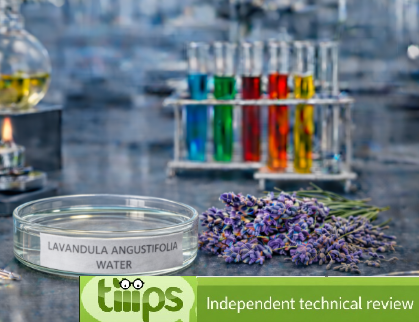
Lavandula angustifolia water is an aromatic water (hydrosol) obtained as the aqueous phase of steam distillation of true lavender. In cosmetics it is mainly used to provide a softer “lavender” olfactory contribution compared with the essential oil, and to support a botanical sensory positioning in leave-on and rinse-off formulas. On the market it may also appear under related entries (for example “flower water” or “flower/leaf/stem water”), which are not always fully interchangeable in terms of declared function and specifications.
Definition
Lavandula angustifolia water is an aqueous mixture with variable composition, consisting primarily of water with small fractions of water-soluble/steam-carried volatile components (trace terpenoids and odor-active molecules typical of lavender). Variability depends on the raw material (origin and harvesting), distillation parameters, any filtration steps, and microbiological management (an inherently higher microbiological exposure risk compared with an oil).
From a formulation standpoint, the operational parameters are: odor, potential haze, microbiological stability, preservative compatibility, and batch-to-batch consistency.
Main uses
Cosmetics.
Used in toners, mists, lotions, gels, cleansers, and “fresh/botanical” products as a fragrancing or characterizing aqueous fraction. Depending on the INCI entry and the reference database, the reported function can be centered on fragrance; for related entries (e.g., flower/leaf/stem water) additional functions such as humectant or perfuming may be reported, but these should be considered dependent on the specific entry and supplier.
INCI Functions
Fragrance. It plays a very important role in the formulation of cosmetic products as it allows perfume to be enhanced, masked or added to the final product, improving its commercial viability. The consumer always expects to find a pleasant scent in a cosmetic product.
Medicine.
It is not a therapeutic active within the scope of a cosmetic technical report. In traditional medical medicine Lavender is used as a medical plant in the treatment of inflammation, depression and stress, due to its sedative and anxiolytic action, thrombotic and antimicrobial properties.
Cultivation
The reference plant is Lavandula angustifolia (Lamiaceae), cultivated in temperate regions. Hydrosol quality can be influenced by origin, harvest period, and distillation conditions; therefore, in industrial practice, specifications and incoming checks (odor, clarity, microbiological conformity) are central.
For more information: LAVENDER
Key constituents
Composition is typically dominated by water, with traces of aromatic components consistent with lavender. In practical terms, trace odor-active molecules associated with lavender may be present (for example fractions attributable to linalool/linalyl acetate or related components), at levels dependent on process and raw material. For formulators, the most useful controls remain organoleptic profile, stability, and microbiological specifications, rather than individual markers, unless the producer offers standardization.
Nutritional use note and bioactive compounds
In a cosmetic context this is not a “nutritional” ingredient. The technical interest is linked to: sensory contribution (odor), quality/clarity, microbiological robustness, and stability over time. Any references to “bioactives” should be handled cautiously and, if used for claims, require evidence at the finished product level.
Identification data and specifications
| Characteristic | Value |
|---|---|
| INCI name | Lavandula angustifolia water |
| INCI functions | fragrance |
| CAS number | Commonly reported: 90063-37-9; some dossiers may also show 8000-28-0 in relation to inventory registrations or related entries (verify supplier SDS) |
| EC/EINECS number | 289-995-2 (commonly reported) |
| Botanical family | Lamiaceae |
| Substance type | Aromatic water / hydrosol (variable-composition mixture) |
| Molecular formula | Not applicable (mixture) |
| Molecular weight | Not applicable as a single value (mixture) |
| Typical preparation | Steam distillate / steam distillation |
| Typical commercial appearance | Aqueous liquid; clear or slightly opalescent (grade-dependent) |
Indicative physico-chemical properties
| Characteristic | Indicative value | Note |
|---|---|---|
| Chemical nature | Aqueous phase with aromatic traces | Variable with raw material and distillation |
| Solubility | Miscible with water | Compatibility depends on preservatives and other phases |
| pH stability | Matrix-dependent | Extreme pH may change odor/clarity |
| Light/oxygen stability | Generally good, but variable | Odor may fade or change under stress and contamination |
| Thermal stability | Sensitive to prolonged stress | Risk of odor loss and microbiological issues if poorly managed |
| Critical parameters | Odor, clarity, microbial load, storage | Essential for repeatability and safety |
Functional role and practical mechanism of action
The main role is sensory: it delivers a softer “lavender” note than the essential oil and can support perceptions of freshness and naturality. Performance depends on concentration, formula profile (presence of fragrance, surfactants, polymers), and above all on microbiological stability and protection of the olfactory profile throughout shelf life.
Formulation compatibility
Common points of attention include preservative-system compatibility, risk of haze/instability in the presence of electrolytes or specific polymers, and control of organoleptic variability. Because this is an aqueous raw material, microbiological management (raw material, bulk, and finished product) is often the primary driver of industrial robustness.
Use guidelines
Use levels depend on the sensory objective and grade quality. In practice it is useful to define odor/clarity targets and validate through accelerated stability, finished-product challenge testing when relevant, and final packaging tests. Setting organoleptic tolerances and batch acceptance criteria is recommended.
Quality, grades, and specifications
Supplier variability can be significant. Effective control relies on: odor and clarity specifications, microbiological limits, storage and shelf-life guidance, and traceability. Adoption of GMP (good manufacturing practice; benefit: reduces variability and contamination) by the producer is a positive indicator of supply-chain robustness.
Safety, regulatory, and environment
Safety must be assessed on the finished product considering concentration, exposure area, and target population. Operationally, for a botanical distillate the main risks are microbiological quality, impurities, and odor stability (which may shift in case of contamination or degradation).
Allergen.
It is not typically classified as an “allergen” per se; however, it may contain trace odor components that can fall under fragrance allergens depending on process and raw material. Practical management is based on supplier specifications and finished-product assessment.
Contraindications (brief).
Use caution on very sensitive or reactive skin and on delicate areas; avoid use on compromised skin if risk assessment and tolerability testing indicate concerns.
Formulation troubleshooting
Weak or batch-variable odor.
Action: tighten organoleptic specifications, select a more standardized supplier/grade, rebalance the overall fragrance system.
Haze in formula.
Action: verify compatibility with polymers/electrolytes, optimize order of addition and pH, evaluate a clearer or filtered grade.
Microbiological issues.
Action: strengthen acceptance criteria, confirm preservative compatibility, apply good bulk handling and packaging practices.
Conclusion
Lavandula angustifolia water is a lavender hydrosol used mainly for fragrance and botanical sensory characterization. For reliable use, the decisive factors are quality and repeatability (odor/clarity), microbiological management, matrix compatibility, and control in the final packaging throughout shelf life.
Mini-glossary
UVCB. Biological materials or mixtures of unknown or variable composition; many botanical raw materials fall within this variability framework.
Hydrosol. Aqueous phase obtained from steam distillation of a botanical raw material; contains traces of aromatic components.
GMP. Good manufacturing practice; benefit: improves traceability and reduces contamination/variability.

