



Lavandula angustifolia (Lavender) flower oil
(Lavandula angustifolia; Lamiaceae)
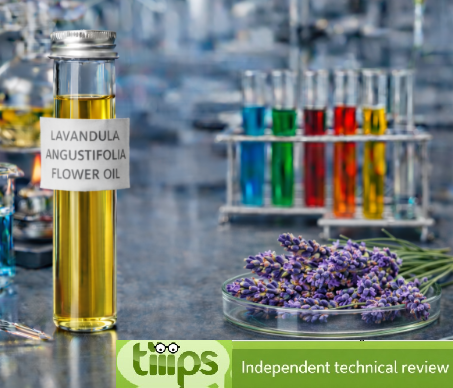
Lavandula angustifolia flower oil is the essential oil obtained from lavender flowers. In cosmetics, it is used primarily as a fragrance ingredient, with a direct impact on the sensorial profile and olfactory identity of both leave-on and rinse-off products.
Definition
Lavandula angustifolia flower oil is a UVCB substance (a mixture with variable composition): there is no single representative chemical structure, because composition depends on cultivar/chemotype, cultivation area, season, and the supplier’s quality specification. Practically, the ingredient is managed as an “odorant raw material,” with technical requirements based on analytical controls (GC profile), olfactory consistency, and limits for impurities/contaminants.
For more information: LAVENDER
Main uses
Cosmetics.
Frequently used in functional perfumery, cleansing products, bodycare, and haircare for fragrance purposes and to modulate sensorial “feel” (clean/fresh perception). In formula, performance depends on: matrix (anhydrous vs emulsion), use level, compatibility with other odorants, and oxidative stability.
INCI functions
Fragrance. It plays a very important role in the formulation of cosmetic products as it allows perfume to be enhanced, masked or added to the final product, improving its commercial viability. The consumer always expects to find a pleasant scent in a cosmetic product.
Medicine.
Not a therapeutic active; any general references do not replace clinical guidance. In traditional medicine it is used as a medical plant in the treatment of inflammation, depression and stress, due to its sedative and anxiolytic action, thrombotic and antimicrobial properties.
Key constituents
Typical composition includes terpenes and oxygenated volatile compounds; among the most frequently reported major constituents are linalyl acetate and linalool, with variable contributions from other fractions (e.g., (E)-caryophyllene, terpinen-4-ol, lavandulyl acetate, borneol, 1,8-cineole). The ratio among these components drives both the olfactory signature and part of the stability and tolerability considerations.
Nutritional use note and bioactive compounds
Not relevant within the cosmetic scope. In technical evaluation, the “relevant compounds” coincide with the main volatile constituents that determine aromatic profile, stability, and labeling obligations (for example, management of fragrance allergens where applicable).
Identification data and specifications
| Characteristic | Value |
|---|---|
| INCI name | Lavandula angustifolia flower oil |
| INCI functions | fragrance |
| CAS number | 90063-37-9 (frequently used for “Lavender, Lavandula angustifolia, ext.” and in supply chains); in some supply chains 8000-28-0 may also appear for “lavender oil” (related entry/grade-dependent) |
| EC/EINECS number | 289-995-2 |
| Molecular formula | not applicable (UVCB/variable-composition mixture) |
| Molecular weight | not applicable as a single value (UVCB/mixture) |
| Typical commercial form | essential oil for cosmetic use (quality defined by analytical profile and supplier specification) |
Physico-chemical properties (indicative)
| Characteristic | Value | Note |
|---|---|---|
| Chemical nature | UVCB / mixture of lipophilic volatiles | variable composition, controlled by specification |
| Water solubility | very low | may require solubilizers in aqueous systems |
| Solubility in oil phase | high | compatible with anhydrous bases and oil phases |
| Stability to oxygen and light | sensitive | barrier packaging and controlled storage conditions are useful |
| Thermal sensitivity | moderate | avoid prolonged thermal stress to preserve the olfactory profile |
| Critical parameters | GC profile, olfactory consistency, impurities | drive repeatability and compliance |
Functional role and practical mechanism of action
In cosmetics, the action is primarily sensorial: the oil contributes to the olfactory signature and use perception (freshness, cleanliness, floral note). Real-world performance depends on the system (emulsion, cleanser, anhydrous), dose, and stability over time (oxygen, light, interactions with other odorants and packaging).
Formulation compatibility
Compatibility is generally good in anhydrous systems and oil phases. In emulsions and aqueous formulas, an appropriate solubilizer/surfactant system is often required to prevent haze and separation. It is good practice to verify:
olfactory stability over shelf-life (oxidation and note “drift”)
interactions with complex fragrance accords and preservatives
packaging compatibility (absorption, permeation, sensorial changes)
Use guidelines (indicative)
Use should be guided by supplier documentation, finished product safety assessment, and sensorial objective. Operationally: define the olfactory target, select a grade with a consistent profile, validate under accelerated stability, and correctly manage labeling obligations for fragrance allergenic components where applicable.
Quality, grades, and specifications
Quality is strongly linked to standardization: analytical profile (GC), olfactory repeatability, limits for impurities/contaminants, and batch-to-batch consistency. In an industrial approach, supplier qualification and a clear specification reduce the risk of sensorial variability and long-term instability.
Safety, regulatory, and environment
As a class, essential oils may present irritation and sensitization risks (dose- and matrix-dependent), often driven by individual constituents (e.g., terpene alcohols and esters naturally present). Correct management is through finished product assessment (concentration, use area, target population), grade quality control, and an oxidative-stability strategy to limit degradation and compositional shifts over time. A GMP framework (good manufacturing practice; benefit: reduces variability and contamination) supports repeatability and traceability across the supply chain.
Formulation troubleshooting (reduced)
Haze or separation in aqueous formulas.
Action: optimize the solubilizer/surfactant system and validate with hot/cold cycling and centrifugation.
Olfactory drift over shelf-life.
Action: reduce exposure to light/oxygen (packaging and process), evaluate compatible formula antioxidants, and verify stability on the finished product.
Conclusion
Lavandula angustifolia flower oil is a UVCB essential oil used predominantly as a fragrance ingredient. For robust cosmetic use, the determining factors are: grade consistency (analytical and olfactory profile), solubilization management in aqueous systems, oxidative stability, and correct safety assessment on the finished product.
Mini-glossary
UVCB: substances of unknown or variable composition, complex reaction products, or biological materials.
Chemotype: a characteristic compositional profile that varies with genetics and cultivation conditions.
Solubilizer: a system that allows dispersing/solubilizing lipophilic ingredients in aqueous matrices.
GMP: good manufacturing practice; benefit: improves quality control and reduces contamination/variability.

