



Prunus amygdalus dulcis fruit extract – INCI functions, identifiers (CAS/EC), composition, cosmetic uses, and formulation notes
Prunus amygdalus dulcis fruit extract
Fruit extract of Prunus amygdalus dulcis – family Rosaceae
Synonyms: sweet almond fruit extract, almond fruit extract
INCI / functions: skin conditioning, hair 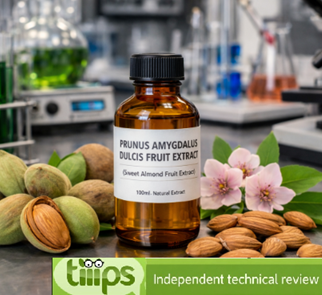
Definition
Prunus amygdalus dulcis fruit extract is an extract obtained from the fruit of sweet almond, Prunus amygdalus dulcis (family Rosaceae), typically via solvent extraction (often aqueous or hydro-glycolic systems, depending on the commercial grade). From a compositional standpoint, it is a complex mixture: depending on the extracted fraction and standardization, it may contain carbohydrate components (e.g., soluble sugars), phenolic fractions (polyphenols, variable level), organic acids, and other minor botanical fractions compatible with the extraction system. In cosmetics it is mainly used as a conditioning ingredient, supporting skin feel and improving combability and sensory performance on hair.
Prunus Amygdalus Dulcis (Sweet Almond) is one of the most popular crops worldwide and belongs to the Rosaceae family. Photochemical analysis revealed a number of compounds beneficial to health: Phenolic acids (hydrobenzoic acids), polyphenolic acids (ellagic acid, gallic acid, caffeic acid), isoflavones, anthocyanins (cyanidin and delphinidin), bioflavonoids, flavanols (epicatechin and procyanidins), flavonol glycosides (kaempferol, quercetin, isorhamnetin-3-O-glucoside), triterpenes, tannins, all with antioxidant and anti-inflammatory activity.
Main uses:
Medical
Clinical studies have shown properties in counteracting some major diseases, reducing oxidative stress, glucose homeostasis, protection against cardiovascular risk, neuroprotection. It also reduces the symptoms of irritable bowel syndrome.
Cosmetics
Hair conditioning agent. A large number of ingredients with specific purposes can co-exist in a hair shampoo: cleansers, conditioners, thickeners, mattifying agents, sequestering agents, fragrances, preservatives, special additives. However, the indispensable ingredients are the cleansers and conditioners as they are necessary and sufficient for hair cleansing and manageability. The others act as commercial and non-essential auxiliaries such as: appearance, fragrance, colouring, etc. Hair conditioning agents have the task of increasing shine, manageability and volume, and reducing static electricity, especially after treatments such as colouring, ironing, waving, drying and brushing. They are, in practice, dispersing agents that may contain cationic surfactants, thickeners, emollients, polymers. The typology of hair conditioners includes: intensive conditioners, instant conditioners, thickening conditioners, drying conditioners.
Skin conditioning agent. It is the mainstay of topical skin treatment by restoring, increasing or improving skin tolerance to external factors, including melanocyte tolerance. The most important function of the conditioning agent is to prevent skin dehydration, but the subject is rather complex and involves emollients and humectants.
Identification data and specifications
| Identifier | Value |
|---|---|
| INCI name | Prunus amygdalus dulcis fruit extract |
| Preparation type | extract (solvent extract) |
| Origin | botanical |
| CAS number | 90320-37-9 |
| EC/EINECS number | 291-063-5 |
Key constituents
| Class | Typical components | Technical note |
|---|---|---|
| Carbohydrate fraction | sugars and water-soluble components | may influence sensory profile and potential tack at higher use levels |
| Phenolic fraction | polyphenols (variable level) | depends on matrix and solvent; can affect color/stability |
| Minor botanical fractions | organic acids and minor compounds | batch variability: manage via supplier specifications |
Functional role and technical clarifications
| Function | What it does in the formula | Operational note |
|---|---|---|
| Skin conditioning | supports maintaining skin in good condition | effect depends on vehicle and concentration |
| Hair conditioning | improves combability and sensory feel on hair | useful in synergy with compatible conditioning polymers |
Formulation compatibility
In practice, compatibility depends primarily on the extract carrier (water, glycols, mixtures) and the solids content. In O/W emulsions and aqueous gels, the extract can be added into the water phase or post-addition (per supplier guidance), checking: color stability, potential increase in tack at higher use levels, and compatibility with the preservative system.
In “clear” systems (transparent gels, clear cleansers) it may increase the risk of haze if the grade contains higher solids or if the system ionic strength/pH is not optimized. It is recommended to verify stability over 24–48 hours, thermal cycles, and compatibility with fragrances and pH-sensitive actives.
Use guidelines (indicative)
| Application | Typical range | Technical note |
|---|---|---|
| Leave-on (creams/serums/lotions) | 0.2–3.0% | evaluate color and sensoriality |
| Rinse-off (cleansers/shampoo) | 0.5–5.0% | verify clarity and preservation robustness |
| Conditioning hair care | 0.2–3.0% | synergistic with compatible conditioning polymers |
Typical applications
Skin care products aimed at conditioning support and cosmetic comfort.
Hair care formulas (shampoos, conditioners, masks) to support combability and a softer feel.
Cleansers and gels where a botanical conditioning extract is desired (after verifying clarity/stability).
Quality, grades and specifications
| QC topic | What to verify |
|---|---|
| Identity | INCI consistency and batch traceability |
| Solids/actives | solids %, carrier (water/glycols), batch-to-batch repeatability |
| Sensory profile | color/odor and changes under heat/light |
| Microbiology | limits and compatibility with the finished-product preservative system |
| Impurities | insolubles, metals (if required), process residues per CoA |
Safety, regulatory and environment
As a botanical cosmetic extract, the appropriate safety approach is the finished product assessment (use scenario, population, exposure). Operationally, the most relevant considerations are: (i) potential irritation in sensitive individuals or on compromised skin (formula- and dose-dependent), (ii) microbiological control (aqueous/high-solids extracts require preservative attention), and (iii) odor/color stability over time. Environmentally, impact is primarily linked to organic load and process effluent management; apply good manufacturing practice and local regulatory requirements for wastewater handling.
Formulation troubleshooting
| Issue | Likely cause | Recommended action |
|---|---|---|
| Haze in clear systems | solids/carrier, pH/electrolytes, polymer incompatibility | reduce dose, switch grade, optimize pH and rheology |
| Darkening/color shift | oxidation of phenolic fractions, light/heat | barrier packaging, compatible antioxidants, reduce dose |
| Tackiness | high carbohydrate fraction or high dosage | reduce dose, rebalance humectants and oil phase |
| Microbiological instability | insufficient preservation or high initial bioburden | strengthen preservative system, tighten raw material specs, run challenge testing |
Conclusion
Prunus amygdalus dulcis fruit extract is a Prunus amygdalus dulcis fruit extract used mainly for skin conditioning and hair conditioning. Selecting the right grade (carrier/solids), validating preservation, and controlling color and clarity (where required) are the key factors for stable, repeatable formulation performance.
Mini-glossary
| Term | Meaning | Note |
|---|---|---|
| INCI | International cosmetic ingredient nomenclature | used for labeling |
| Solvent extract | extract obtained using a solvent system | water/glycols/alcohols depending on grade |
| Skin conditioning | maintaining skin in good condition | cosmetic function |
| Hair conditioning | improving combability/sensory feel on hair | cosmetic function |
| GMP | Good Manufacturing Practice | process quality-control standard |

