



Polyester-7: : properties, uses, INCI functions, safety
Polyester-7 – aliphatic polyester copolymer (synthetic polymer) used as a film former, rheology modifier, and “performance polymer” in multiple cosmetic categories
Synonyms: Trimethylolpropane/Adipic Acid/Neopentyl Glycol/Hexanediol copolymer (compositional description), polyester copolymer (technical use)
INCI / Functions: film forming, skin conditioning, viscosity controlling
Definition
Polyester-7 is a synthetic polymer belonging to the aliphatic polyester family, designed to create a continuous film on the surface (skin/hair) and to contribute to the physical stability and rheology of predominantly lipophilic or hybrid systems. In formulation terms, it can be viewed as a hydrophobic film former: its practical role is to improve adhesion and cohesion of the cosmetic deposit, support wear (water/abrasion resistance, depending on the formulation architecture), and modulate sensoriality (slip, and in some systems a reduction of greasy feel).
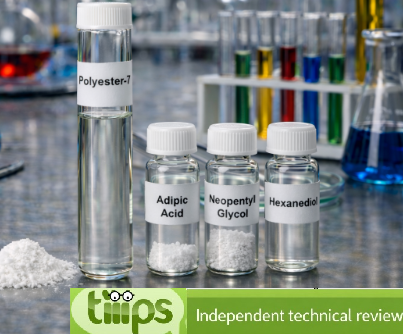
In the production method, Polyester-7 is commonly described as a copolymer obtained from Adipic Acid, Neopentyl Glycol, Hexanediol, and Trimethylolpropane: in practice, a condensation polyesterification between a diacid and diols, with the use of a triol as a branching/structuring agent. This approach yields a polymer with film-forming and hydrophobic characteristics that are valuable in formulas where a more uniform and more “robust” deposit is required after application.
From an application standpoint, the ingredient is often selected for products where film performance is functionally relevant (hold, water resistance, uniformity) and where system viscosity benefits from a structuring contribution that is non-aqueous or predominantly lipophilic.
Main uses
Cosmetics.
The main use is as a film former and viscosity controlling agent in multiple categories, with particular relevance where film performance is critical. In suncare, for example, it may be used to support water resistance and the formation of a more uniform deposit; some commercial systems also position it in combination with emollients/solubilizers to help manage UV filters in the oil phase and reduce issues such as recrystallization or film inhomogeneity.
In make-up and color cosmetics, it can contribute to wear, adhesion, and film cohesion (affecting long-wear, transfer, and sensoriality), while in skincare it may be chosen to provide a more uniform finish and a light film-forming/protective feel. In hair care (selected categories), a film former is typically linked to frizz control, discipline, and surface protection, always dependent on overall formula design.
INCI Functions
Film-forming agent. It produces a continuous ultra-thin film with an optimal balance of cohesion, adhesion and stickiness on the skin or hair to counteract or limit damage from external phenomena such as chemicals, UV rays and pollution.
Skin conditioning agent. It is the mainstay of topical skin treatment by restoring, increasing or improving skin tolerance to external factors, including melanocyte tolerance. The most important function of the conditioning agent is to prevent skin dehydration, but the subject is rather complex and involves emollients and humectants.
Surfactant - Suspending agent. Cosmetic or pharmaceutical suspensions are known to be thermodynamically unstable and it is therefore essential to include in the formulation a suspending agent capable of dispersing any sedimented particulates and reducing the rate of sedimentation. The presence of this agent increases the consistency of the suspension medium and exerts a protective colloidal action with a surfactant action.
Identification data and specifications
| Identifier | Value |
|---|---|
| INCI name | Polyester-7 |
| Compositional description (technical) | copolymer of Trimethylolpropane, Adipic Acid, Neopentyl Glycol, Hexanediol |
| CAS number | 68492-80-8 (reported in databases/SDS; some regulatory ingredient listings may omit it) |
| EC/EINECS number | Not available / not assigned (often not reported for this INCI as a polymer) |
| Origin | synthetic |
| Typical commercial appearance | solid/resin or solution/dispersion in a carrier, grade-dependent |
Chemical-physical properties (indicative)
| Property | Value | Note |
|---|---|---|
| Water affinity | low | typically hydrophobic |
| Behavior in formula | film-forming and structuring | impact on sensoriality/wear is system-dependent |
| Processing incorporation | often in the oil phase | depends on grade (neat vs in carrier) |
| Compatibility with UV filter system | potentially helpful | in some market systems it also supports UV filter deposition |
Functional role and practical mechanism
| Function | What it does in formula | Technical note |
|---|---|---|
| Film forming | forms a continuous film on skin/hair | can increase adhesion and cohesion of the cosmetic deposit |
| Skin conditioning | improves sensoriality and finish | effect often linked to film microstructure |
| Viscosity controlling | adjusts consistency and stability | useful in lipophilic/hybrid systems, also with powders |
Formulation compatibility
Polyester-7 is typically easier to manage in lipophilic architectures (oils/esters/silicones or hybrid systems), where it can contribute to film, stability, and sensoriality. Real compatibility depends strongly on the commercial grade (neat polymer vs pre-dispersed/pre-solubilized) and on the solvent/emollient package: in many cases it is preferable to incorporate it into the oil phase and ensure sufficient mixing energy to avoid micro-agglomerates or inhomogeneity that can translate into film defects.
In powder-rich systems (make-up, mineral suncare, sticks), it can help deposit cohesion, but requires careful balancing between film former, emollients, and structuring agents to avoid excessive tack, drag, or a “plastic” feel. For water-resistant positioning, efficacy must be verified through finished-product testing (water resistance, rub/abrasion tests, transfer).
When claims or performance link to UV filters, it is good practice to evaluate: compatibility with organic/inorganic filters, hot/cold stability, potential recrystallization, and film uniformity after application and volatile evaporation.
Use guidelines (indicative)
| Application | Typical range | Technical note |
|---|---|---|
| Sunscreens (emulsions, sprays, sticks) | 1–10% | often introduced in the oil phase; verify water resistance and sensoriality |
| Color cosmetics (long-wear, foundations, lip products) | 0.5–8% | balance with emollients and powders to avoid tack and drag |
| Skincare with film-forming effect | 0.2–3% | oriented to finish and film uniformity more than “activity” |
| Selected hair care (film/discipline) | 0.2–5% | check build-up, sensoriality, and rinseability |
Quality, grades, and specifications
| QC parameter | What to check |
|---|---|
| Identity | INCI consistency and compositional description of the copolymer |
| Physical profile | supply form (resin vs solution), viscosity/consistency |
| Volatiles/carrier (if present) | carrier nature and active content, lot repeatability |
| Impurities and residues | control residual monomers/solvents per supplier specs |
| Stability | hot/cold behavior, haze, separations, rheology drift |
Safety, regulatory, and environment
In cosmetics, Polyester-7 is handled as a functional ingredient (film former/viscosity modifier) and safety is assessed on the finished product based on use scenario, use level, and target population, within the applicable regulatory framework. For polymers, practical attention points often relate more to grade quality (impurity/residual profile) and formula compatibility (eyes, mucosa, reactive skin) than to intrinsic reactivity.
From an environmental standpoint, the assessment depends on the polymer profile and on the data available for the specific commercial grade: some suppliers associate biodegradability-related claims and data with certain grades or combinations, which must be read and verified in the technical dossier of the ingredient actually used.
In manufacturing, applying GMP (Good manufacturing practice; first occurrence) is relevant to minimize variability, contamination, and specification drift. Benefit: improved repeatability and process control. In supply-chain and quality-control contexts, HACCP (Hazard analysis and critical control points; first occurrence) can be relevant as a preventive risk-management method. Benefit: a more robust control system across critical stages.
Formulation troubleshooting
| Problem | Possible cause | Recommended intervention |
|---|---|---|
| Non-uniform film / streaking | incomplete dispersion, carrier incompatibility, unbalanced evaporation | optimize oil phase and mixing, consider pre-solubilization/alternative grade, rebalance volatiles |
| Excess tack | too much film former or suboptimal emollient balance | reduce level, increase “dry” emollients, rebalance powders/structurants |
| Unstable viscosity | interaction with structurants or powder load, thermal sensitivity | retune rheology network, test thermal cycles, consider alternative grade |
| Haze/turbidity | micro phase separation, incomplete polymer solvation | review compatible solvents/esters, addition order, process temperature |
| Water resistance below target | insufficient film or discontinuous deposit | increase/rebalance film former, optimize volatile phase, validate with dedicated tests |
Conclusion
Polyester-7 is a film-forming polymer and rheology modifier used to improve wear, deposit uniformity, and consistency across multiple cosmetic categories, with particular interest where film performance is a key driver (e.g., suncare and long-wear). Performance is strongly dependent on grade, oil-phase architecture, and process: with proper compatibility and dispersion management, it can deliver a meaningful technical contribution to sensoriality and finished-product robustness.
Mini-glossary
INCI: standard nomenclature for cosmetic ingredient labeling.
Film former: ingredient that forms a continuous film on skin/hair after drying to improve wear and surface protection.
Condensation polyesterification: reaction forming ester bonds between diacids and diols/polyols, producing a polymer.
GMP: Good manufacturing practice; benefit: reduces variability and operational risks.
HACCP: Hazard analysis and critical control points; benefit: strengthens prevention and control in quality systems.

