



Polyester-33: properties, uses, pros, cons, safety
Polyester-33 is a synthetic polymer of the polyester type used in cosmetics mainly as a film former and as a performance polymer. In practical terms, it is designed to create a continuous film on skin/hair/nails, improving uniformity, sensoriality (slip, smooth glide), and—in some applications—wear/hold and resistance to humidity or transfer, depending on the formulation base.
Definition
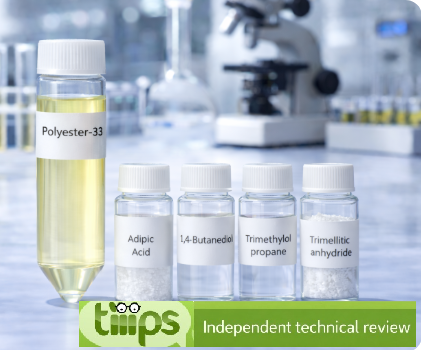
Polyester-33 is produced by polycondensation using the following substances in the production method: Adipic Acid, 1,4-Butanediol, Trimethylolpropane, Trimellitic anhydride.
From a chemical–functional standpoint:
Adipic Acid and 1,4-Butanediol build the polyester “backbone” through ester bonds.
Trimethylolpropane (a triol) introduces branching points that can increase film cohesion and robustness.
Trimellitic anhydride (an aromatic anhydride) can contribute to higher film rigidity, adhesion, and stability, affecting gloss, durability, and tactile feel.
The expected outcome is a film-forming resin/polymer whose properties can be tuned via dosage, carrier, and system plasticization.
Main uses
Cosmetics
Typical use in products where a controlled surface film is beneficial:
hair styling (sprays, gels, creams) to improve hold, definition, and humidity control;
make-up (some bases, primers, long-wear products) to increase adhesion and uniformity;
selected skincare to optimize feel and finish (when compatible).
INCI functions
Film forming. Produces a continuous film on skin, hair, and/or nails.
Industrial use
Primarily cosmetic (personal care), as a functional polymer to modulate surface properties (film, cohesion, mechanical robustness of the deposit) in compatible matrices.
Identification data and specifications
| Characteristic | Value | Note |
|---|---|---|
| INCI name | Polyester-33 | Cosmetic denomination |
| Origin | synthetic | Synthetic polymer |
| Class | polyester (polymer) | Ester-bond structure |
| Main function | film forming | Cosmetic use function |
| Synthesis method (description) | polycondensation | With the substances listed below |
| Substances used in the production method | Adipic Acid; 1,4-Butanediol; Trimethylolpropane; Trimellitic anhydride | Useful for QC and traceability |
| CAS number | to be verified in SDS/supplier documentation | Often not unique across grades |
| EC number (EINECS) | to be verified in SDS/supplier documentation | Depends on classification |
Chemical-physical properties (indicative)
| Characteristic | Indicative value | Note |
|---|---|---|
| Physical state | resin/solid or solution/dispersion form | Depends on commercial grade |
| Color | light to slightly amber | Batch/carrier-dependent |
| Odor | mild / neutral | Usually not dominant in the finished product |
| Water solubility | low / variable | Often more dispersible than soluble |
| Solubility in cosmetic solvents | variable | Often favored in hydroalcoholic systems or dedicated carriers |
| Film properties | from flexible to more rigid | Depends on composition, dose, and plasticization |
| Chemical stability | generally good | Criticalities more often tied to compatibility and flaking |
Functional role and mechanism of action
The action is mainly physical. After application, evaporation of the carrier leads to formation of a continuous film that can:
increase product cohesion and adhesion to the surface;
improve uniformity and finish;
on hair, contribute to hold and shape control, with response influenced by humidity, humectants, and plasticizer balance.
Formulation compatibility
Performance depends mainly on:
solvent system (water, alcohols, glycols, blends) and carrier type;
presence of surfactants and electrolytes (possible effects on stability and haze);
combination with other film formers (acrylates, polyurethanes, resins) and plasticizers (synergies or excessive stiffening).
It is advisable to validate with thermal cycling, accelerated stability, and targeted application tests (hold, flexibility, humidity resistance, sensoriality).
Production process
A scheme consistent with polycondensation synthesis:
reaction between Adipic Acid and 1,4-Butanediol forming ester bonds and growing the chain;
use of Trimethylolpropane to introduce branching and tune resin cohesion/viscosity;
introduction of Trimellitic anhydride to achieve the final architecture and adjust film properties;
finishing and grade standardization (solids, viscosity, color, residuals), depending on the cosmetic application.
Pros and cons
Pros
Strong film-forming contribution for uniformity and performance (hold/adhesion) in compatible systems.
Possible improvement in humidity resistance and perceived durability when properly balanced.
Versatile use in hair styling and some make-up bases.
Cons
Risk of an overly rigid film with a dry feel, tightness, or flaking if not plasticized.
Non-universal compatibility: may require an appropriate carrier and process to avoid instability or non-uniform performance.
Possible build-up on hair with repeated use, especially if combined with other high-deposition film formers.
Safety, regulatory, and environmental aspects
High-molecular-weight polymers generally show low dermal bioavailability, but safety assessment must always refer to the finished product (use level, use pattern, application area, and format).
Allergen.
It is not typically a classic “fragrance allergen”; any reactions are more often linked to the overall formula and individual sensitivity.
Contraindications (brief).
For spray/aerosol formats, consider incidental inhalation exposure depending on aerosol profile and the formulation strategy.
Formulation troubleshooting
Film flaking or poor flexibility.
Action: introduce or re-tune a compatible plasticizer; reduce dose; balance with a more flexible film former.
Haze or long-term instability.
Action: optimize solvent system and order of addition; verify compatibility with surfactants/electrolytes; consider an alternative carrier.
Insufficient hold under humidity.
Action: review polymer/plasticizer ratio; evaluate synergies with other film formers; standardize tests and environmental conditions.
Conclusion
Polyester-33 is a film-forming polyester produced by polycondensation from Adipic Acid, 1,4-Butanediol, Trimethylolpropane, and Trimellitic anhydride. Its technical value is the ability to form a continuous film that supports uniformity and performance (especially in styling and some make-up bases). Results depend mainly on carrier, plasticization, system compatibility, and process control.

