



Polyester-12: properties, uses, pros, cons, safety
Polyester-12 is a synthetic polymer used in cosmetics mainly as a bulking agent and as a texture modifier. In practical terms, it is used to reduce density and give the formula a lighter feel thanks to a swelling behavior that can increase apparent volume and influence texture (a drier/more slip finish, depending on the matrix).
Definition
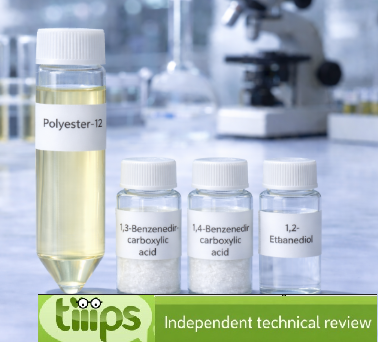
Polyester-12 is a copolyester obtained by polycondensation from:
1,3-benzenedicarboxylic acid (isophthalic)
1,4-benzenedicarboxylic acid (terephthalic)
1,2-ethanediol (ethylene glycol)
From a functional standpoint, this combination results in a polyester-type polymer that, in some commercial forms, is used as a swelling bulking agent: it absorbs/imbibes within the formulation medium and helps “fill” the matrix, reducing perceived density and modulating rheology.
Main uses
Cosmetics
Typical use in products where a light body and improved sensoriality are desired without excessively increasing the oil phase:
make-up (some bases, primers, face products) to lighten texture and improve slip/soft feel
selected skincare to modulate consistency and finish
products where a technical “filler” effect is useful (apparent volume and density reduction)
INCI functions
Bulking agent. It regulates the water content, dilutes other solids, can increase the volume of a product for better flow, acts as a buffer against organic acids, helps to keep the pH of the mixture within a certain level.
CAS: 847147-74-4
Industrial use
Primarily cosmetic (personal care) as a functional additive to control apparent density, texture, and consistency.
Identification data and specifications
| Characteristic | Value | Note |
|---|---|---|
| INCI name | Polyester-12 | Cosmetic denomination |
| Origin | synthetic | As reported in EU databases |
| Class | polyester (copolymer) | Ester bonds |
| Main function | bulking (swelling) | Reduces density through swelling |
| Substances used in the production method | 1,3-benzenedicarboxylic acid; 1,4-benzenedicarboxylic acid; 1,2-ethanediol | Useful for QC and traceability |
| CAS number | 847147-74-4 | May vary depending on commercial grade |
| EC number (EINECS) | to be verified in SDS/supplier documentation | Not always reported as unique |
| Molecular formula | not applicable (polymer) | Polymeric structure |
| Molecular weight | not applicable (polymer) | Distribution, not a single value |
Chemical-physical properties (indicative)
| Characteristic | Indicative value | Note |
|---|---|---|
| Physical state | polymeric solid (often in particulate form) | Depends on commercial grade |
| Color | white to off-white | Batch-dependent |
| Odor | mild / neutral | Usually not dominant in the finished product |
| Water solubility | very low | Dispersion/swelling behavior is more typical |
| Solubility in oils/cosmetic solvents | variable | Depends on carrier and polymer architecture |
| Effect on density | reduced apparent density | Linked to swelling/volume |
| Chemical stability | generally good | Criticalities more often related to compatibility and dispersion |
Functional role and mechanism of action
The effect is mainly physical–structural: depending on form and particle size/structure, the polymer can swell in the system and contribute to:
lowering the product’s apparent density
modulating consistency and the perception of lightness
improving slip and finish (effect depends on base, continuous phase, and other polymers/powders present)
Formulation compatibility
Performance depends significantly on:
system type (emulsion, anhydrous, gel, hybrid)
viscosity of the continuous phase and presence of other rheology modifiers
dispersion process (order of addition, shear, wetting time)
During development it is useful to check hot/cold stability, thermal cycling, centrifugation, and application tests (uniformity, absence of lumps, slip).
Production process
A scheme consistent with polycondensation of aromatic dicarboxylic acids with a diol:
reactive charge with 1,3-benzenedicarboxylic acid and 1,4-benzenedicarboxylic acid together with 1,2-ethanediol
initiation of polycondensation forming ester bonds and progressively building chain length while controlling conversion and viscosity
polymer finishing and grade standardization (physical form, particle size/dispersion, solids content), tailored to cosmetic use as a swelling bulking agent
Pros and cons
Pros
Reduces apparent density and helps achieve lighter textures.
Can improve sensoriality (drier/more slip feel) in compatible systems.
Useful as a technical tool to modulate consistency without significantly increasing oils or waxes.
Cons
Non-universal compatibility: poor dispersion can lead to inhomogeneity or “speckling.”
Performance is highly dependent on process (dispersion) and matrix; in some bases the effect can be limited.
Environmental aspects: as a synthetic polymer, biodegradability may be limited; assessment depends on structure, use scenario, and market/claim requirements.
Safety, regulatory, and environmental aspects
High-molecular-weight polymers generally show low dermal bioavailability; safety assessment remains linked to the finished product (use level, area of use, frequency, and format).
Allergen.
It is not typically a classic “fragrance allergen”; any reactions are more often related to the overall formula and individual sensitivity.
Contraindications (brief).
For spray/aerosol products, consider incidental inhalation exposure depending on aerosol profile and the presence of powders/particles in the final format.
Formulation troubleshooting
Lumps or non-uniform dispersion.
Action: optimize wetting and order of addition; increase controlled shear; consider pre-dispersion in a compatible vehicle.
Insufficient “lightening” effect.
Action: re-tune dosage; check synergies with other consistency modifiers; control base microstructure (viscosity and continuous phase).
Texture too dry or excessive slip.
Action: balance with emollients/humectants or reduce level; review combinations with powders and other polymers.
Conclusion
Polyester-12 is a synthetic polyester used mainly as a swelling bulking agent to reduce density and modulate texture and sensoriality. Its practical value lies in designing consistency and feel, with results strongly dependent on dispersion, formulation base, and balancing with other structuring agents.

