



Punica granatum seed oil hydroxyphenethyl esters: properties, uses, pros, cons, safety
(Punica granatum; Lythraceae)
Punica granatum seed oil hydroxyphenethyl esters is a plant-derived/synthetic-origin ingredient obtained from pomegranate (Punica granatum) seed oil and a phenolic “hydroxyphenethyl” moiety. In cosmetics it is mainly positioned for an antioxidant contribution and to support protective and body-care concepts (grade-dependent).
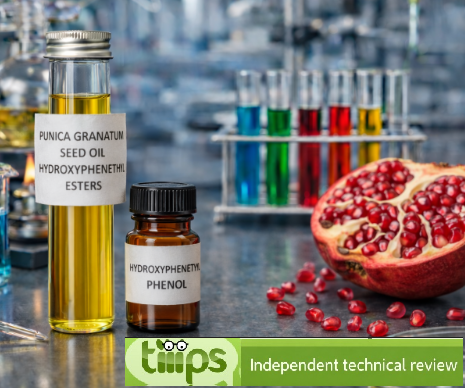
Synonyms: pomegranate seed oil hydroxyphenethyl esters (descriptive); “Delipidol®” (trade name for a specific grade).
Definition
The ingredient is defined as a complex mixture of esters obtained via transesterification between hydroxyethyl phenol (structurally consistent with a hydroxyphenethyl motif) and Punica granatum seed oil. In practice it is not a single molecule, but a set of esters in which the lipid portion reflects the seed-oil profile (thus containing pomegranate-typical fatty acids, including a characteristic share of conjugated fatty acids) and the phenolic portion provides a rationale for protection against oxidative processes.
From a formulator’s standpoint, performance is driven by three elements: the quality of the starting oil (fatty-acid profile and oxidative stability), the degree of conversion/definition of the product (assay and impurities), and any functional specifications declared by the manufacturer (for example, claims focused on free radical scavenging and body-care positioning).
Punica granatum is a tree belonging to the Lythraceae family with a long and established history as a source of medicinal components. In Ayurvedic and traditional medical medicine, it is used in the treatment of diabetes, as an anti-parasitic agent, to combat dysentery and atherosclerosis.
Phytochemical analysis has shown interesting health components such as ellagic acid, ursolic acid, gallic acid, polyphenols, flavonoids, anthocyanins and tannins. All these components have demonstrated antioxidant, antimicrobial and antiviral activity and have proved useful in the treatment of Alzheimer's and diabetes.
For more information: Pomegranate
Main uses
Cosmetics
Used in leave-on products (oils, serums, body creams) where it can support an oxidative-protection positioning and the maintenance of skin appearance. Some commercial grades are specifically proposed for body products with “orange peel” appearance and tonicity claims, with a rationale linked to antiradical activity and cosmetic support mechanisms.
INCI functions
Antioxidant (function reported in ingredient databases for this INCI and in sector registries).
Cultivation
Punica granatum is a tree/shrub species cultivated in temperate and Mediterranean areas; the oil is obtained from the seeds. For the finished ingredient, the supply-chain variability that matters to the formulator is mainly driven by starting-oil quality (lipid profile and oxidative stability) and by standardization of the conversion process into hydroxyphenethyl esters.
Nutritional use note and bioactive compounds
Within the cosmetic scope, a nutritional framing is not relevant. In terms of formulation-relevant “bioactive” composition, the ingredient is characterized by: a lipid fraction derived from pomegranate seed oil and a hydroxyphenethyl phenolic component (grade-dependent). Realistic evaluation must rely on supplier CoA and specifications because the composition is that of a mixture and may vary across commercial grades.
Calories (energy value)
For topical use, energy value is neither an operational parameter nor a cosmetic labeling requirement. In addition, even though the matrix is lipidic, the cosmetic use levels typically make the topic practically irrelevant for formulation.
Identification data and specifications
| Characteristic | Value |
|---|---|
| INCI name | punica granatum seed oil hydroxyphenethyl esters |
| common name | hydroxyphenethyl esters of pomegranate seed oil |
| common name | pomegranate |
| botanical family | Lythraceae |
| CAS number | 84961-57-9 (generic) |
| EC/EINECS number | 284-646-0 |
| molecular formula | not applicable (mixture) |
| molecular weight | not applicable as a single value (mixture) |
| typical commercial form | oily liquid / lipidic material (grade-dependent) |
| origin (typical) | plant-derived/synthetic (derived from vegetable oil via transesterification) |
Physico-chemical properties (indicative)
| Characteristic | Value | Note |
|---|---|---|
| chemical nature | mixture of lipidic esters with a hydroxyphenethyl moiety | not a single substance |
| water solubility | negligible | typical behaviour of lipidic/ester materials |
| oil solubility | high | compatible with oil phases and anhydrous systems |
| oxidative stability | can be improved with an antioxidant strategy | depends on lipid profile and packaging |
| pH stability | generally good in anhydrous systems | in emulsions, overall system stability dominates |
| critical parameters | assay, impurities, odor/color, lipid profile | drive repeatability and shelf-life |
Functional role and practical mechanism of action
In formulas, the ingredient acts mainly as an antioxidant functional component within a lipidic matrix: it helps reduce the impact of oxidative processes on the finished product and, in use, supports a cosmetic positioning linked to protection and comfort. In body-care grades, the supplier positioning often combines antiradical activity with tonicity and skin-appearance concepts, within cosmetic (non-therapeutic) claim boundaries.
Formulation compatibility
It is generally compatible with oil phases, oils, esters, and (depending on the system) silicones, and can be incorporated into O/W or W/O emulsions as part of the oil phase. The most frequent watchpoints are: odor management over time (lipidic materials), oxidative stability (especially with oxygen-permeable packaging), and interactions with fragrances or lipophilic actives that may accelerate organoleptic drift. In practice, accelerated stability testing and verification in final packaging are recommended.
Use guidelines (indicative)
Use should follow the technical sheet of the specific grade. In development, it is advisable to: define the sensorial target (oil, body cream, serum), select an antioxidant system consistent with the formula, and verify stability (odor/color) and compatibility with fragrance and actives. In leave-on body products, claim consistency should be aligned with evidence and the supplier documentation for the selected grade.
Quality, grades, and specifications
Quality drivers include: assay/specifications, impurities, organoleptic profile, and contaminant controls per cosmetic standards. Because it is derived from a vegetable oil, batch consistency is strongly linked both to starting-oil quality and to control of the transesterification process.
Implementation of GMP (good manufacturing practice; benefit: reduces variability and contamination) is a key requirement to ensure repeatability for complex raw materials of this type.
Safety, regulatory, and environment
Within the cosmetic scope, the ingredient falls into the category of complex, botanically derived and derivatized substances. Practical safety depends on the grade and the finished-product safety assessment (concentration, area of use, population). Key practical points include: quality and impurities, oxidation management (to avoid degradation by-products associated with odor drift or potential irritation in sensitive individuals), and appropriate skin-compatibility assessment in the formulation context.
Formulation troubleshooting
Odor/color drift over shelf-life.
Typical cause: oxidation of the lipid fraction and interactions with fragrance. Action: strengthen the formula’s antioxidant strategy, reduce exposure to oxygen/light, validate more barrier-type packaging.
Emulsion instability or overly “heavy” sensorial profile.
Typical cause: unbalanced oil phase or incompatibility with the emulsifier/structuring system. Action: retune the oil phase, viscosity, and emulsifier system; evaluate addition point and processing temperature.
Conclusion
Punica granatum seed oil hydroxyphenethyl esters is a mixture of esters produced by transesterification from pomegranate seed oil and a hydroxyphenethyl component, with cosmetic use centered on an antioxidant function and leave-on applications, especially in body care. For repeatable performance, the key factors are: grade quality, oxidation control (formula and packaging), and organoleptic validation over shelf-life.
Mini-glossary
Transesterification: a reaction that exchanges the alcohol group of an ester with another alcohol, generating new esters.
Antioxidant: a substance that reduces or slows oxidative processes in a formula and/or on biological substrates, within the cosmetic scope.
Complex mixture: a material not consisting of a single molecule but of many related chemical species.
GMP: good manufacturing practice; benefit: improves quality control and reduces contamination/variability.

