



Brassica campestris seed oil: properties, uses, pros, cons, safety
Brassica campestris seed oil is a “fixed” vegetable oil obtained from rapeseed, used mainly in cosmetics as an emollient and oil-phase component to improve slip, skin comfort, and sensorial profile. The raw material is a mixture of triglycerides, so in-formula behavior depends more on the fatty-acid profile and grade (refined, deodorized, high-oleic) than on a single “molecule.”
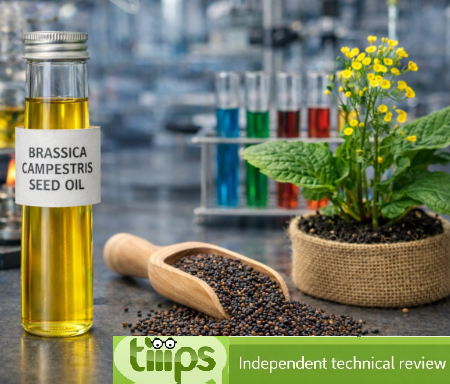
Synonyms: rapeseed oil; canola oil (food use, typically low-erucic); Brassica rapa seed oil (related botanical entry in some supply chains).
For more information: Rapeseed
Definition
Brassica campestris seed oil is a lipophilic mixture consisting predominantly of triglycerides. In practice, the profile may include oleic, linoleic, and linolenic acids, with variability depending on cultivar and intended use; in some traditional varieties, erucic acid can be high, whereas food/canola grades and many modern cosmetic supply chains tend to select low-erucic profiles with improved oxidative stability.
The oil is used mainly as an emollient base and as a carrier for lipophilic actives, with specific attention to oxidation, residual odor, and batch-to-batch quality.
Main uses
Food.
It is widely used as an edible oil when obtained from low-erucic varieties and produced under food-grade specifications. This report focuses primarily on the cosmetic context.
Cosmetics.
Used in emulsions, body oils, ointment/balm systems, lip balms, and hair products as an oil-phase component with emollient function and sensorial enhancement. It is often selected for formulations requiring a vegetable oil with good spreadability and favorable cost/performance, provided oxidative stability and sensorial quality are properly managed.
INCI functions
Skin conditioning agent. It is the mainstay of topical skin treatment by restoring, increasing or improving skin tolerance to external factors, including melanocyte tolerance. The most important function of the conditioning agent is to prevent skin dehydration, but the subject is rather complex and involves emollients and humectants.
Medicine.
Not a therapeutic active ingredient. Where present, use is linked to carrier function in non-pharmacological topical products or devices, depending on the specific regulatory positioning.
Pharmaceutical.
Not a “default” excipient. It may be used as a lipid component/carrier in specific formulations, with quality and impurity requirements defined by the dossier.
Industrial use.
Used as a technical vegetable oil in blends, bio-based lubricants, and non-food applications, with specifications different from cosmetic grades.
Nutritional use note and bioactive compounds
In cosmetics, relevance is not nutritional. Compositionally, the oil contains fatty-acid fractions that determine functional performance; minor fractions (unsaponifiables) are also present at variable levels depending on grade, influencing stability and sensorial profile.
Energy value (practical note)
In food contexts, vegetable oils typically have an energy value of about 9 kcal/g (≈ 37 kJ/g). In cosmetics this data is not normally stated on labeling, but remains a general technical reference for oils and fats.
Identification data and specifications
| Characteristic | Value |
|---|---|
| INCI name | Brassica campestris seed oil |
| common name | rapeseed oil; canola oil (for low-erucic food grades) |
| reference plant | Brassica campestris |
| botanical family | Brassicaceae |
| CAS number | 8002-13-9; 90989-79-0 (variants reported depending on registries/grades) |
| EC/EINECS number | 232-299-0; 292-737-1 (variants reported depending on registries/grades) |
| molecular formula | not applicable (triglyceride mixture) |
| molecular weight | not applicable as a single value (mixture; range depends on lipid profile) |
| typical commercial form | cosmetic-grade vegetable oil, grade depending on refining and specifications |
Physico-chemical properties (indicative)
| Characteristic | Value | Note |
|---|---|---|
| nature | lipophilic triglyceride mixture | not a “pure” substance |
| density (20 °C) | ~0.910–0.925 g/ml | typical range from cosmetic rapeseed/canola specifications |
| peroxide value (typical spec) | <20 meq O₂/kg | acceptance limit varies by grade and supplier |
| water solubility | practically insoluble | consistent with oil phase |
| oxidative stability | dependent on unsaturation profile | requires antioxidant and packaging strategy when needed |
Functional role and practical mechanism of action
In formulations, Brassica campestris seed oil acts as an emollient and oil-phase component. The practical benefit is reduced dry feel via a lipid film, increased slip, and support for dispersing/solubilizing lipophilic actives. A higher unsaturated fraction can improve spreadability, but increases sensitivity to oxidation and olfactory drift over time.
Formulation compatibility
It is generally compatible with most emulsions and anhydrous systems. Recurring issues are: oxidative instability in highly unsaturated formulas, sensorial interaction with delicate fragrances (residual note), and batch variability if specifications are not well defined. In clear oil products, clarity depends on purity and temperature; in emulsions compatibility is typically high, but sensorial stability should be confirmed with accelerated testing.
Practical management includes: peroxide-value control at incoming inspection, use of compatible antioxidants when needed, and packaging that limits oxygen and light for long shelf-life products.
Use guidelines (indicative)
Use is typically in the oil phase, at percentages driven by product type and target sensory profile. For “sensitive” lines or very light fragrance profiles, a deodorized/refined grade with tight odor and oxidation specifications is preferable. For leave-on products, oxidative stability of the complete system should be verified through stability studies and olfactory monitoring.
Quality, grades, and specifications
The most relevant parameters include: fatty-acid profile (batch consistency), peroxide value, acid value, water and impurity content, and color/odor within supplier specification. The distinction between “traditional” and “low-erucic” grades is most critical for food supply chains, but it is also useful in cosmetics when a more predictable and stable profile is required.
Safety, regulatory, and environment
In cosmetics, practical safety is linked to raw-material quality and finished-formula stability. The most frequent issues are individual reactivity to oxidized material (sensitivity to rancid notes and possible irritation in predisposed users) and out-of-spec quality (oxidation, off-odor). The safety assessment of the finished product, under the applicable framework, should consider purity, process-related impurities, and stability over time.
Adoption of GMP (good manufacturing practice; benefit: reduces variability and contamination) supports repeatability and quality control across sourcing and production.
Formulation troubleshooting
Rancid odor or “aged note” over time.
Typical cause: oxidation of unsaturates and peroxide increase. Action: tighter incoming specs, compatible antioxidants, barrier packaging, and reduced headspace.
Sensory variability between batches.
Typical cause: differences in origin/refining or lipid profile. Action: supplier qualification, definition of minimum parameters (peroxides, odor, GC profile if available), and comparative sampling.
Instability in anhydrous “clear” products.
Typical cause: impurities or crystallization at low temperature. Action: select a more refined/dewaxed grade and verify cold stability with thermal cycling.
Conclusion
Brassica campestris seed oil is a widely used cosmetic vegetable oil as an emollient and oil-phase component. Formulation performance is generally favorable, but depends decisively on grade quality (refining, odor) and oxidative stability management. For leave-on products and sensorially “clean” lines, grade selection and antioxidant/packaging strategy are often the key determinants of performance and batch consistency.
Mini-glossary
Triglycerides: glycerol esters with three fatty acids, the main constituents of vegetable oils.
Peroxide value: an indicator of primary oxidation in oils; higher values often correlate with instability and rancid notes.
Unsaponifiables: minor fraction not convertible to soap; may include sterols and other trace components.
GMP: good manufacturing practice; benefit: improves quality control and reduces contamination/variability.

