



Polyester-32: properties, uses, pros, cons, safety
Polyester-32 is a synthetic polymer used in cosmetics mainly as a film former. In practical terms, it is used to create a thin, continuous film on skin and/or hair, with the aim of improving uniformity, sensoriality (slip, smooth glide), and deposit robustness (depending on the formulation base and use level).
Definition
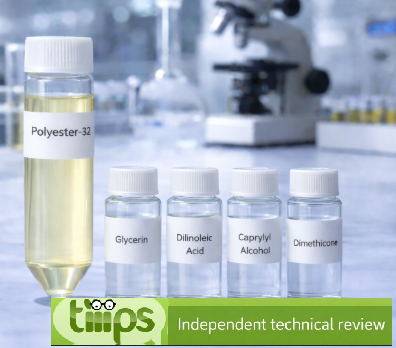
Polyester-32 is obtained from the reaction of Glycerin, Dilinoleic Acid, a series of fatty alcohols (Caprylyl Alcohol, Decyl Alcohol, Lauryl Alcohol, Oleyl Alcohol, Octyldodecanol, Behenyl Alcohol), a functionalized silicone segment (Hydroxypropyldimethicone), and additional fatty acids (Capric Acid, Isostearic Acid, Behenic Acid).
From a formulation standpoint, this “architecture” tends to generate a polymer with:
lipophilic portions (C8–C22 chains and fatty acids) that favor compatibility with oil phases and an emollient/film-like sensory profile;
a glycerin and dilinoleate component that contributes to the “polyester” structure;
a silicone fragment that can improve slip and reduce perceived friction, depending on the matrix.
The expected result is an ingredient oriented toward film formation and finish modulation.
Main uses
Cosmetics
Typical use in products where a controlled film and a more “ordered” sensorial profile are desired:
make-up (some bases/primers) to improve uniformity and slip;
selected skincare to optimize feel and surface finish;
haircare and leave-on products where a light film can contribute to smoothing and friction reduction (effect dependent on the overall system).
INCI functions
Film-forming agent. It produces a continuous ultra-thin film with an optimal balance of cohesion, adhesion and stickiness on the skin or hair to counteract or limit damage from external phenomena such as chemicals, UV rays and pollution.
Industrial use
Primarily cosmetic (personal care), as a functional polymer to modulate surface and sensory properties of the deposit.
Identification data and specifications
| Characteristic | Value | Note |
|---|---|---|
| INCI name | Polyester-32 | Cosmetic denomination |
| Origin | synthetic | Classification in ingredient databases |
| Class | polyester (polymer) with lipophilic and siloxane components | Structure depends on the commercial grade |
| Main function | film forming | Cosmetic use function |
| Reaction raw materials (provided) | Glycerin; Dilinoleic Acid; Caprylyl Alcohol; Decyl Alcohol; Lauryl Alcohol; Oleyl Alcohol; Octyldodecanol; Behenyl Alcohol; Hydroxypropyldimethicone; Capric Acid; Isostearic Acid; Behenic Acid | Useful for technical review and supplier verification |
| CAS number | to be verified in SDS/supplier documentation | May not be handled as unique across grades |
| EC number (EINECS) | to be verified in SDS/supplier documentation | Depends on material classification |
| Molecular formula | not applicable (polymer) | Polymeric structure |
| Molecular weight | not applicable (polymer) | Distribution, not a single value |
Chemical-physical properties (indicative)
| Characteristic | Indicative value | Note |
|---|---|---|
| Physical state | viscous liquid, paste, or carrier-based resin | Depends on commercial grade and carrier |
| Color | colorless to pale yellow/light amber | Batch-dependent; influenced by oxidation of lipid fractions |
| Odor | mild / characteristic | Usually not dominant in the finished product |
| Water solubility | very low | Expected due to lipophilic/silicone component |
| Compatibility with oils/emollients | generally good | Verify for the specific system and polarity |
| Emulsion behavior | possible role in texture/film | Depends on continuous phase, emulsifiers, and process |
| Chemical stability | generally good | Criticalities more often tied to compatibility and oxidative stability of lipid fractions |
Functional role and mechanism of action
The action is mainly physical. After application, Polyester-32 can organize into a surface film that:
improves continuity and deposit uniformity;
reduces perceived friction, giving a smoother glide;
contributes to a more controlled finish (less unevenness, greater perceived smoothness), depending on dose and matrix.
Formulation compatibility
Performance depends mainly on:
polarity and composition of the oil phase (esters, oils, hydrocarbons, silicones);
presence of surfactants/emulsifiers and electrolyte level (if in an emulsion);
processing (order of addition, temperature, shear, homogenization time).
During development, it is useful to verify accelerated stability, thermal cycling, and application tests on real substrates (skin and/or hair), because feel and film cohesion are often highly formula-dependent.
Pros and cons
Pros
Supports a film-forming function, improving uniformity and finish.
Can increase slip and reduce perceived friction, especially in emollient/silicone-rich systems.
May contribute to a more “ordered” and consistent feel over time (base-dependent).
Cons
Non-universal compatibility: in some emulsions it may require careful balancing to avoid instability or texture drift.
If the film becomes too cohesive or use level is high, it may increase “film feel” or heaviness (more critical on fine hair or very thin make-up finishes).
Environmental aspects: as a synthetic polymer, biodegradability can be limited; assessment depends on structure, use scenario, and market/claim requirements.
Safety, regulatory, and environmental aspects
In cosmetics, high-molecular-weight polymers generally show low dermal bioavailability, but evaluation must always refer to the finished product (concentration, use pattern, application area, and format).
Dimethicone ((polydimethylsiloxane) is a chemical compound, a high molecular weight polymer derived from silicone, a chemically inert mixture of linear methylated siloxane polymers. The term 'dimeth' denotes two methyl groups bonded to the silicone molecule that provide the formation of dimethicone. It possesses a pronounced viscoelasticity characteristic and is hydrophobic, thus adding shine and slipperiness when applied to hair or skin. It forms a kind of barrier that prevents exogenous substances from entering the stratum corneum and at the same time prevents water loss. It is also UV-resistant, non-greasy and cost-effective. At low concentrations it is considered by the US FDA (Food and Drug Administration) to be a skin protector with a good degree of safety.
It is therefore considered safe when formulated to be non-irritating in cosmetic products as, given its high molecular weight, it is poorly absorbed by the skin or scalp.
Allergen.
It is not typically a classic “fragrance allergen.” Any reactions are more often related to the overall formula and individual sensitivity.
Contraindications (brief).
For spray/aerosol formats, consider incidental inhalation exposure depending on aerosol profile and the presence of film-forming/lipophilic components.
Formulation troubleshooting
Instability or texture drift over time.
Action: review emulsifier/oil-phase balance; optimize order of addition and temperature; evaluate a different emollient/silicone profile.
Film feel too strong.
Action: reduce dosage; balance with lighter emollients; introduce components that increase film flexibility (depending on the concept).
Insufficient slip.
Action: evaluate synergy with low-friction silicones/esters; optimize oil-phase microstructure and polymer distribution.
Conclusion
Polyester-32 is a film-forming synthetic polymer obtained from a combination of lipid components (fatty acids and fatty alcohols), glycerin, and a silicone segment. Its practical value is linked to forming a film that improves uniformity and sensoriality. Performance is strongly dependent on base compatibility, process, and control of film level to avoid unwanted sensory effects.

