



Aluminum stearate is an inorganic chemical compound, the aluminum salt of stearic acid, commonly used in various cosmetic and industrial applications. It is valued for its multifunctional properties, including its role as an anticaking agent, colorant, emulsion stabilizer, and viscosity controller.
Chemical Composition and Structure
Aluminum stearate is an organic compound that consists of aluminum ions combined with stearic acid, a long-chain fatty acid. This combination gives the compound its unique properties and wide range of applications.
Physical Properties
Aluminum stearate typically appears as a white, fine powder. It is insoluble in water but soluble in oils and organic solvents. The compound is known for its stability, resistance to heat, and ability to form gels with oils, making it highly useful in various formulations.
Chemical Industrial Synthesis Process
- Preparation of reagents. The main raw materials include stearic acid and an aluminum compound such as aluminum chloride (AlCl₃) or aluminum sulfate (Al₂(SO₄)₃).
- Saponification. The stearic acid is heated and treated with a sodium hydroxide (NaOH) solution to form sodium stearate (sodium stearate soap).
- Precipitation of aluminum stearate. The aluminum chloride or aluminum sulfate is slowly added to the sodium stearate solution with constant stirring. This reaction forms a precipitate of aluminum stearate.
- Filtration. The resulting suspension is filtered to separate the solid aluminum stearate precipitate from the aqueous solution.
- Washing. The aluminum stearate precipitate is washed with deionized water to remove any soluble impurities and residual reagents.
- Drying. The washed aluminum stearate is dried at controlled temperatures to remove residual moisture and obtain a dry powder.
- Grinding. The dried aluminum stearate is ground to obtain a fine and uniform powder. This step may involve the use of ball mills or other grinding machinery.
- Classification. The dried powder is classified to ensure a uniform particle size. This step may involve sieving or the use of air classifiers.
- Stabilization. The aluminum stearate powder is stabilized to ensure its stability during transportation and storage, preventing aggregation and degradation.
- Quality control. The aluminum stearate undergoes rigorous quality testing to ensure it meets standards for purity, safety, and functionality. These tests include chemical analysis, spectroscopy, and physical tests to determine particle size and rheological properties.
What it is used for and where
It is used as an agent to gel or thicken aliphatic and aromatic hydrocarbons.
Cosmetics
Restricted cosmetic ingredient as IV/150 a Relevant Item in the Annexes of the European Cosmetics Regulation 1223/2009. Substance or ingredient reported:
- Aluminium, zinc, magnesium and calcium stearates.
Cosmetics - INCI Functions
- Absorbent: It absorbs substances dispersed or dissolved in aqueous solutions, water/oil, oil/water.
- Anticaking Agent: Aluminum stearate is used as an anticaking agent in powders and other dry products to prevent clumping and improve flowability. It helps maintain the free-flowing nature of products, enhancing their usability and shelf life.
- Colorant: While aluminum stearate itself is not a colorant, it is often used in conjunction with pigments to enhance their dispersion and stability in cosmetic formulations. It helps achieve uniform color distribution in products like foundations and eyeshadows.
- Emulsion Stabilizer: In emulsions, aluminum stearate acts as a stabilizing agent, preventing the separation of oil and water phases. This property is particularly valuable in creams, lotions, and other emulsion-based products, ensuring a consistent and stable formulation.
- Viscosity Controller: Aluminum stearate is used to control the viscosity of various cosmetic and industrial formulations. It helps thicken products, providing the desired consistency and texture in items such as creams, ointments, and paints.
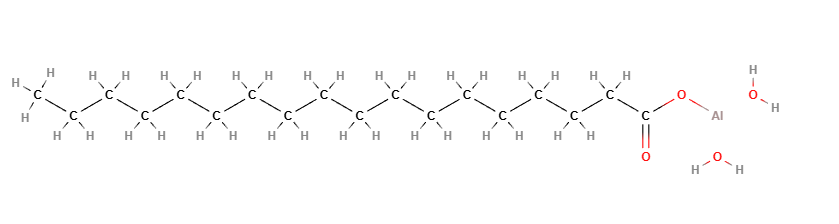 | 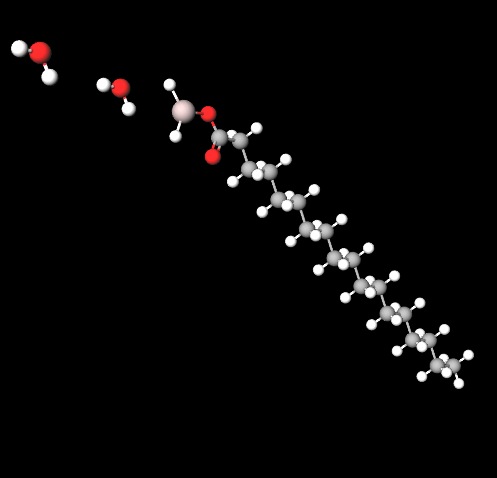 |
Molecular Formula C18H39AlO4
Molecular Weight 346.5 g/mol
CAS 7047-84-9
UNII P9BC99461E
EC number 230-325-5
Synonyms:
Aluminum monostearate
Safety
Careful consideration should be given to the risk of cumulative aluminum intake, which cannot be ruled out because this ingredient can be found in both cosmetic products and widely consumed food products such as bread, various baked goods (1).

