



Citrus Tankan Fruit Water (Citrus × tankan, Rutaceae): properties, uses, pros, cons, safety
Citrus Tankan Fruit Water is a plant-derived cosmetic ingredient defined as the aqueous solution of the steam distillate obtained from the tankan fruit (Citrus × tankan, family Rutaceae). In practice, it is an aromatic water “hydrosol-like” material (fruit water) in which the aqueous phase contains a very low amount of volatile and water-soluble fruit components. In formulation it is used mainly as a humectant and as a mild sensorial component in aqueous phases.
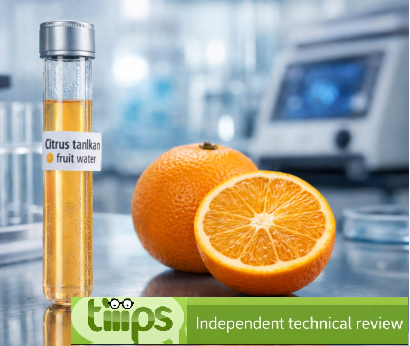
The fruit is a hybrid between the 'Ponkan' and the sweet orange and native to southern China, has few seeds, an excellent taste, but needs high temperatures to provide the best citrus fruit.
Like all trees of the Rutaceae family, the fruit is used industrially by food, cosmetic and pharmaceutical companies. It contains numerous components of interest to human health such as flavonoids, terpenes, linalool, vitamin C, folic acid, with antioxidant properties.
“Tankan” is a citrus fruit commonly classified as a tangor (hybrid between mandarin and sweet orange in many botanical/agronomic sources), and the term “Fruit Water” indicates the fruit distillation water. This material should not be confused with the essential oil (much richer in terpenes and therefore more strongly odor-active and potentially more sensitizing).
Production process and key constituents
How it is produced (in brief)
The typical supply chain involves washing and preparing the fruit, then steam distillation. The oily phase (if present) is separated and the aqueous phase (distillate) is collected. Filtration follows, with possible standardization (odor, pH, conductivity, microbial load) and preservation with a system suitable for the intended application.
Key constituents
Citrus-typical volatile components
D-Limonene
Linalool
β-Myrcene
Phenolic components at low concentration
Ferulic acid
p-Coumaric acid
Organic acids and water-soluble fraction
Citric acid
Malic acid
Technical note. A “Fruit Water” typically contains much lower levels of volatiles than an essential oil; actual composition depends on the raw material, distillation conditions, and the manufacturer’s standard.
Main uses
Cosmetics
Primarily used as a component of the aqueous phase in skincare and haircare products (toners, mists, gels, emulsions, gentle cleansers) when a humectant contribution and a light sensory profile are desired.
INCI functions
Skin conditioning agent - Humectant. Humectants are hygroscopic substances used to minimise water loss in the skin and to prevent it from drying out by facilitating faster and greater absorption of water into the stratum corneum of the epidermis. The epidermis is the most superficial of the three layers that make up the human skin (epidermis, dermis and hypodermis) and is the layer that maintains hydration in all three layers. In turn, the epidermis is composed of five layers: corneum, the most superficial, lucidum, granulosum, spinosum and basale. Humectants have the ability to retain in the stratum corneum the water they attract from the air and have the function of moisturising the skin. It is better to use them before emollients that are oil-based.
Industrial use
A raw material for cosmetics (bulk) and for aqueous perfumed/“botanical water” bases in naturally positioned formulas, typically dosed according to perceived hydration performance and microbiological compatibility.
Identification data and specifications
| Characteristic | Value | Note |
|---|---|---|
| INCI name | Citrus Tankan Fruit Water | INCI denomination |
| Botanical origin | Citrus × tankan | Tangor (citrus hybrid) |
| Botanical family | Rutaceae | Citrus family |
| Preparation type | Fruit distillation water | Aqueous solution of the distillate |
| Main function | Humectant | In the aqueous phase |
| CosIng | ID 89310 | “Humectant” function registration |
| CAS / EC number | not always reported for this fruit water | Depends on database and supplier |
Chemical-physical properties (indicative)
| Characteristic | Indicative value | Note |
|---|---|---|
| Physical state | Aqueous liquid | Water-based |
| Color | Colorless to very pale yellow | Batch-dependent |
| Odor | Light citrus | Variable intensity |
| Water solubility | Complete | Already in aqueous phase |
| pH | Slightly acidic (variable) | Depends on fruit and standardization |
| Volatility | Low | Different from an essential oil |
| Stability | Sensitive to microbial load | Requires preservative management and suitable packaging |
Functional role and mechanism of action
The action is mainly physical and formulation-related: it contributes to superficial hydration (humectancy) and to the “watery feel” of the formula. The trace content of volatile components and organic acids can marginally influence sensoriality and perceived freshness, but it should not be interpreted as a “strong active” comparable to concentrated extracts or essential oils.
Formulation compatibility
Generally compatible with emulsions and aqueous gels. Key points are: compatibility with the preservative system, microbiological stability (especially at high use levels), possible batch-to-batch odor variation, and compatibility with pH-sensitive polymers. In leave-on formulas it is advisable to evaluate odor impact and the presence of potential fragrance allergens in traces, if relevant for product positioning.
Pros and cons
Pros
Humectant contribution in the aqueous phase with botanical positioning.
Soft citrus sensory profile, useful for light and refreshing products.
Good versatility as a “functionalized water” component.
Cons
Batch variability (odor, trace volatiles, pH).
Microbiological risk is more relevant than for anhydrous raw materials if not properly managed.
Limited “active” effect versus more concentrated extracts; often a supporting ingredient.
Safety, regulatory, and environment
Allergen.
It is not a “single allergen” in itself; however, it may contain trace citrus volatiles (e.g., limonene, linalool) that, under certain conditions and concentrations, can contribute to sensitization in predisposed individuals. Assessment should be performed on the finished product and supplier specification.
Contraindications (brief).
Use caution on highly reactive skin, especially in leave-on products with high percentages of perfumed botanical waters. Verify preservative compatibility and stability to reduce contamination risks.
Formulation troubleshooting
Odor not consistent between batches.
Action: request sensory standards from the supplier, set up blending practices, consider compatible light masking.
Microbiological instability or increasing microbial load over time.
Action: recalibrate preservative system, reduce use level, improve packaging and QC (water, tanks, lines).
Viscosity shifts in pH-sensitive gels.
Action: check fruit water pH, buffer the formula, verify polymer performance (carbomer/HEC/other) under real conditions.
Conclusion
Citrus Tankan Fruit Water is a distillation-derived fruit water mainly used as a humectant and botanical aqueous-phase component. Its technical value lies in sensoriality and positioning, while managing variability and microbiology is central to ensuring stability and finished-product consistency.

