



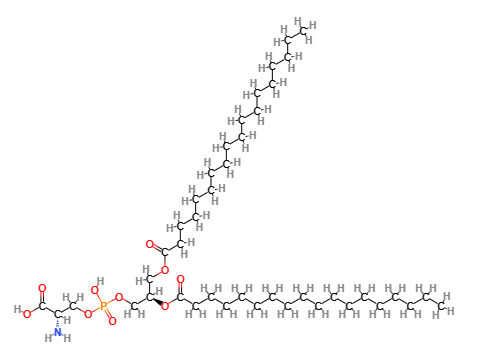
Fosfatidilserina o Phosphatidylserine è un fosfogliceride degli acidi grassi, legato ad un estere fosforico o all'acido fosforico. I fosfolipidi costituiscono il principale costituente e possono essere estratti sia da grassi vegetali che da uova. La funzione dei fosfolipidi, che si trovano nelle membrane cellulari animali e vegetali è il corretto mantenimento degli organi vitali del corpo umano: fegato, cervello ecc.
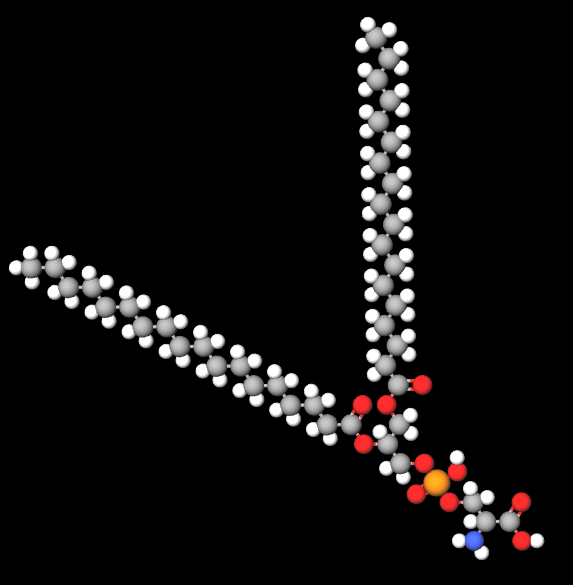
Il nome definisce la struttura della molecola:
- "Phosphatidyl-" si riferisce alla porzione di acido fosfatidico della molecola.
- "-serine" si riferisce all'aminoacido serina, che è attaccato all'acido fosfatidico.
Sintesi di fosfatidilserina nel corpo
La sintesi coinvolge una serie di reazioni enzimatiche. Versione semplificata del processo:
- Il processo inizia con fosfatidilcolina o fosfatidiletanolamina, altri tipi di fosfolipidi.
- Un enzima chiamato fosfatidilserina sintasi catalizza una reazione che scambia la parte di colina o etanolamina della molecola con la serina, un aminoacido, per formare fosfatidilserina.
- La fosfatidilserina appena formata viene poi incorporata nelle membrane cellulari, in particolare nel foglietto interno del doppio strato lipidico.
A cosa serve e dove si usa
Medicina
- Neurologia. La Fosfatidilserina (PS) è altamente concentrata nel cervello ed è coinvolta nel mantenimento dell'integrità delle membrane neuronali, nella funzione sinaptica e nella neuroplasticità. Gioca un ruolo cruciale nel supporto delle funzioni cognitive come la memoria, l'apprendimento e l'attenzione. La supplementazione con PS è stata studiata per i suoi potenziali benefici nella declinazione cognitiva correlata all'età, nella malattia di Alzheimer e in altre patologie neurologiche.
- Riduzione dello Stress. La PS ha dimostrato di avere effetti riducenti dello stress attraverso la modulazione della risposta del corpo agli ormoni dello stress, come il cortisolo. Può contribuire a mitigare gli effetti negativi dello stress cronico e migliorare l'umore e il benessere psicofisico.
- Disturbo da Deficit di Attenzione e Iperattività (ADHD). La supplementazione con PS è stata investigata come possibile terapia aggiuntiva per l'ADHD. Studi suggeriscono che possa contribuire a migliorare l'attenzione, l'impulsività e le prestazioni cognitive nelle persone con ADHD.
- Prestazioni Sportive. La supplementazione con PS è stata studiata per i suoi potenziali benefici nel miglioramento delle prestazioni sportive e nella riduzione dello stress e del danno muscolare indotto dall'esercizio fisico. Può favorire il recupero e sostenere un'ottimale funzione muscolare.
- Salute Oculare legata all'età. La PS ha un suo possibile ruolo nel mantenimento di una visione sana e nel supporto alla salute degli occhi, in particolare nella degenerazione maculare legata all'età (AMD) e in altre condizioni retiniche.
È importante notare che sebbene la PS abbia mostrato promettenti risultati in questi ambiti, ulteriori ricerche sono necessarie per comprendere appieno i suoi meccanismi d'azione e le sue applicazioni cliniche
Cosmetica
Agente condizionante per capelli. In uno shampoo per capelli possono coesistere una quantità rilevante di ingredienti con scopi specifici e mirati: detergenti, condizionanti, addensanti, opacizzanti, sequestranti, fragranze, conservanti, additivi particolari. Tuttavia gli ingredienti indispensabili sono i detergenti ed i condizionanti in quanto necessari e sufficienti per la pulizia e la gestibilità dei capelli. Gli altri hanno funzioni accessorie commerciali e non indispensabili come: aspetto estetico, profumo, colorazione ecc. Gli agenti condizionanti per i capelli hanno il compito di aumentarne la lucentezza, la maneggevolezza ed il volume, ridurne l'elettricità statica soprattutto dopo trattamenti quali colorazione, stiratura, ondulazione, asciugatura e spazzolatura. Sono, in pratica, dispersori che possono contenere tensioattivi cationici, addensanti, emollienti, polimeri. La tipologia degli agenti condizionatori per capelli comprende: condizionatori intensivi, condizionatori istantanei, condizionatori addensanti, condizionatori per l'asciugatura.
Protettivo della pelle. Crea una barriera protettiva sulla pelle per difenderla da sostanze nocive, irritanti, allergeni, agenti patogeni che possono provocare varie condizioni infiammatorie. Questi prodotti possono anche migliorare la barriera cutanea naturale e nella maggior parte dei casi ne occorrono più di uno per raggiungere un risultato efficace.
Agente condizionante della pelle - Misto. Questo ingrediente ha il compito di modificare le condizioni della pelle quando è danneggiata o secca ridimensionandone la sfogliatura e restituendone elasticità.
 |  |
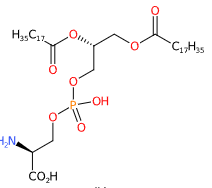 | 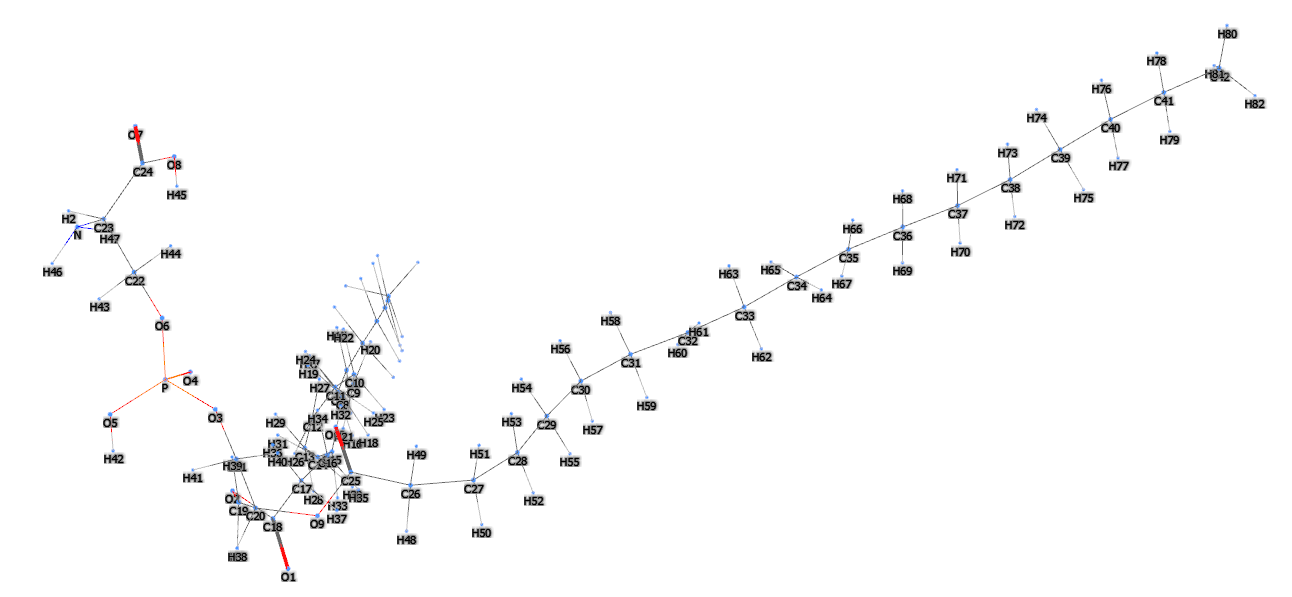 |
- Molecular Formula C42H82NO10P
- Molecular Weight 792.1 g/mol
- CAS 51446-62-9 1446756-47-3
- UNII 394XK0IH40
- EC Number
- Nikkaji J1.757.189C
Compendio degli studi più significativi con riferimento a proprietà, assunzione, effetti.
Leventis PA, Grinstein S. The distribution and function of phosphatidylserine in cellular membranes. Annu Rev Biophys. 2010;39:407-27. doi: 10.1146/annurev.biophys.093008.131234.
Abstract. Phosphatidylserine (PS) is the most abundant negatively charged phospholipid in eukaryotic membranes. PS directs the binding of proteins that bear C2 or gamma-carboxyglutamic domains and contributes to the electrostatic association of polycationic ligands with cellular membranes. Rather than being evenly distributed, PS is found preferentially in the inner leaflet of the plasma membrane and in endocytic membranes. The loss of PS asymmetry is an early indicator of apoptosis and serves as a signal to initiate blood clotting. This review discusses the determinants and functional implications of the subcellular distribution and membrane topology of PS.
Wanderley JLM, DaMatta RA, Barcinski MA. Apoptotic mimicry as a strategy for the establishment of parasitic infections: parasite- and host-derived phosphatidylserine as key molecule. Cell Commun Signal. 2020 Jan 15;18(1):10. doi: 10.1186/s12964-019-0482-8.
Abstract. The establishment of parasitic infection is dependent on the development of efficient strategies to evade the host defense mechanisms. Phosphatidylserine (PS) molecules are pivotal for apoptotic cell recognition and clearance by professional phagocytes. Moreover, PS receptors are able to trigger anti-inflammatory and immunosuppressive responses by phagocytes, either by coupled enzymes or through the induction of regulatory cytokine secretion. These PS-dependent events are exploited by parasites in a mechanism called apoptotic mimicry. Generally, apoptotic mimicry refers to the effects of PS recognition for the initiation and maintenance of pathogenic infections. However, in this context, PS molecules can be recognized on the surface of the infectious agent or in the surface of apoptotic host debris, leading to the respective denomination of classical and non-classical apoptotic mimicry. In this review, we discuss the role of PS in the pathogenesis of several human infections caused by protozoan parasites.
Bruton A, Nauman J, Hanes D, Gard M, Senders A. Phosphatidylserine for the Treatment of Pediatric Attention-Deficit/Hyperactivity Disorder: A Systematic Review and Meta-Analysis. J Altern Complement Med. 2021 Apr;27(4):312-322. doi: 10.1089/acm.2020.0432.
Abstract. Objective: To examine the evidence for efficacy of phosphatidylserine for symptoms of attention-deficit/hyperactivity disorder (ADHD) in children. Methods: Medline, Cochrane Library, and ClinicalTrials.gov were searched from inception through August 2020. Studies of any design that assessed phosphatidylserine supplementation for children aged ≤18 years with a diagnosis of ADHD were included in the systematic review; only randomized clinical trials were included in the meta-analysis. Standardized mean differences and 95% confidence intervals (CIs) were calculated, and the heterogeneity of the studies was estimated using I2. The overall quality of the evidence was assessed using the Grading of Recommendations Assessment, Development and Evaluation tool. Results: Four studies met the inclusion criteria for the narrative review (n = 344) and three for the meta-analysis (n = 216). Results of the meta-analysis showed a statistically significant effect of 200-300 mg/day of phosphatidylserine on symptoms of inattention relative to placebo (effect size [ES] 0.36; 95% CI: 0.07 to 0.64; p = 0.01). The effects of phosphatidylserine on overall symptoms of ADHD (ES 0.76; 95% CI: -0.07 to 1.60; p = 0.07) and hyperactivity-impulsivity (ES 0.24; 95% CI: -0.04 to 0.53; p = 0.09) were not statistically significant. Conclusions: Preliminary evidence suggests that phosphatidylserine may be effective for reducing symptoms of inattention in children with ADHD, although the quality of the evidence is low and additional research in this area is warranted.
Chang W, Fa H, Xiao D, Wang J. Targeting phosphatidylserine for Cancer therapy: prospects and challenges. Theranostics. 2020 Jul 23;10(20):9214-9229. doi: 10.7150/thno.45125.
Abstract. Cancer is a leading cause of mortality and morbidity worldwide. Despite major improvements in current therapeutic methods, ideal therapeutic strategies for improved tumor elimination are still lacking. Recently, immunotherapy has attracted much attention, and many immune-active agents have been approved for clinical use alone or in combination with other cancer drugs. However, some patients have a poor response to these agents. New agents and strategies are needed to overcome such deficiencies. Phosphatidylserine (PS) is an essential component of bilayer cell membranes and is normally present in the inner leaflet. In the physiological state, PS exposure on the external leaflet not only acts as an engulfment signal for phagocytosis in apoptotic cells but also participates in blood coagulation, myoblast fusion and immune regulation in nonapoptotic cells. In the tumor microenvironment, PS exposure is significantly increased on the surface of tumor cells or tumor cell-derived microvesicles, which have innate immunosuppressive properties and facilitate tumor growth and metastasis. To date, agents targeting PS have been developed, some of which are under investigation in clinical trials as combination drugs for various cancers. However, controversial results are emerging in laboratory research as well as in clinical trials, and the efficiency of PS-targeting agents remains uncertain. In this review, we summarize recent progress in our understanding of the physiological and pathological roles of PS, with a focus on immune suppressive features. In addition, we discuss current drug developments that are based on PS-targeting strategies in both experimental and clinical studies. We hope to provide a future research direction for the development of new agents for cancer therapy. © The author(s).
Kay JG, Fairn GD. Distribution, dynamics and functional roles of phosphatidylserine within the cell. Cell Commun Signal. 2019 Oct 15;17(1):126. doi: 10.1186/s12964-019-0438-z.
Abstract. Phosphatidylserine (PtdSer), an essential constituent of eukaryotic membranes, is the most abundant anionic phospholipid in the eukaryotic cell accounting for up to 10% of the total cellular lipid. Much of what is known about PtdSer is the role exofacial PtdSer plays in apoptosis and blood clotting. However, PtdSer is generally not externally exposed in healthy cells and plays a vital role in several intracellular signaling pathways, though relatively little is known about the precise subcellular localization, transmembrane topology and intracellular dynamics of PtdSer within the cell. The recent development of new, genetically-encoded probes able to detect phosphatidylserine is leading to a more in-depth understanding of the biology of this phospholipid. This review aims to give an overview of recent developments in our understanding of the role of PtdSer in intracellular signaling events derived from the use of these recently developed methods of phosphatidylserine detection.
Stace CL, Ktistakis NT. Phosphatidic acid- and phosphatidylserine-binding proteins. Biochim Biophys Acta. 2006 Aug;1761(8):913-26. doi: 10.1016/j.bbalip.2006.03.006.
Abstract. Phosphatidic acid and phosphatidylserine are negatively charged abundant phospholipids with well-recognized structural roles in cellular membranes. They are also signaling lipids since their regulated formation (or appearance) can constitute an important signal for downstream responses. The list of potential effectors for these lipids is expanding rapidly and includes proteins involved in virtually all aspects of cellular regulation. Because it is not always clear whether these effectors recognize the specific phospholipids or a general negatively-charged membrane environment, questions about specificity must be addressed on a case by case basis. In this review we present an up to date list of potential phosphatidic acid- and phosphatidylserine-binding proteins.

