



C12-15 Alkyl Benzoate: properties, uses, advantages, disadvantages, safety
C12-15 Alkyl Benzoate is a mixture of esters of benzoic acid with aliphatic alcohols containing predominantly 12 to 15 carbon atoms. In cosmetics it is used mainly as an emollient, providing a smooth and silky skin feel without the heaviness associated with some oils, and as a solvent/dispersing agent for lipophilic substances, particularly useful in sunscreens and make-up.
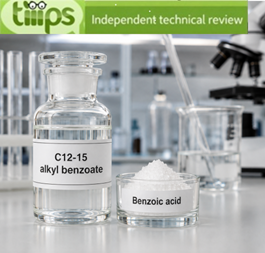
It is therefore not a single molecule, but a mixture of C12, C13, C14 and C15 homologues, which may include linear and branched components. ECHA identifies the substance as Benzoic acid, C12-15-alkyl esters, CAS 68411-27-8 and EC 270-112-4.
The name C12-15 ALKYL BENZOATE is also included in the official European glossary of common cosmetic ingredient names, under entry 4503 of Commission Implementing Decision (EU) 2025/1175.
Description
From a chemical standpoint, C12-15 Alkyl Benzoate belongs to the family of long-chain aromatic esters.
Its general structure derives from:
benzoic acid + C12-C15 alcohol → benzoate ester + water
The benzoate portion provides the aromatic group, while the long alkyl chain gives the molecule a strongly lipophilic character.
This combination normally produces a liquid that is:
clear;
relatively low in viscosity;
oily but light on the skin;
low in volatility;
practically insoluble in water;
compatible with many oils, esters, silicones and oil-soluble UV filters.
The Cosmetic Ingredient Review defines C12-15 Alkyl Benzoate specifically as the mixture of esters of benzoic acid with C12-15 alcohols and classifies it as a skin-conditioning agent–emollient.
Its relatively light, “dry” sensory profile has made it a common alternative or complement to mineral oils, triglycerides and heavier emollients.
Production process
C12-15 Alkyl Benzoate is industrially produced by esterification of benzoic acid with a mixture of C12-C15 alcohols.
The process generally includes:
preparation of benzoic acid;
preparation of the C12-C15 alcohol fraction;
mixing of the reactants;
controlled esterification;
removal of the water formed during the reaction;
completion of the conversion;
removal of excess unreacted benzoic acid and alcohols;
purification;
optional distillation or stripping;
filtration;
control of acidity, colour, moisture and purity;
standardisation of the commercial product.
ECHA also describes the material as an “esterification product of alcohols, C12-15 (linear and branched) and benzoic acid.”
The origin of the raw materials cannot be determined from the INCI name alone. C12-C15 alcohols may come from different industrial supply chains, and both conventional synthetic grades and grades based partly on renewable feedstocks are available.
For example, COSMACOL EBL from Sasol, marketed under the INCI C12-15 Alkyl Benzoate, is classified by the manufacturer as synthetic.
The INCI name should therefore not automatically be interpreted as either “natural” or “petrochemical”: origin must be verified for the specific commercial grade actually used.
Main substances contained
Commercial C12-15 Alkyl Benzoate consists mainly of benzoate esters of C12-C15 alcohols.
The mixture may include:
dodecyl benzoate – C12 component;
tridecyl benzoate – C13 component;
tetradecyl benzoate – C14 component;
pentadecyl benzoate – C15 component;
corresponding linear and/or branched isomers, depending on the alcohol feedstock.
A 2025 analysis of the commercial product Finsolv TN, for example, identified approximately 14.3% n-C12 alkyl benzoate, with predominantly linear C13-C15 alkyl benzoates and a smaller fraction of branched C12-C15 alkyl benzoates. This composition applies to that specific commercial grade and must not be treated as a universal INCI composition.
Controlled amounts of the following may also remain:
unreacted C12-C15 alcohols;
trace free benzoic acid;
water;
manufacturing-related impurities.
For example, the commercial grade COSMACOL EBL specifies at least 90% ester, up to 10% free alcohols, water ≤0.5% and an acid number ≤3 mg KOH/g. These figures are grade-specific and should not automatically be assigned to every C12-15 Alkyl Benzoate material.
Identification data and functions
| Characteristic | Data |
|---|---|
| INCI name | C12-15 Alkyl Benzoate |
| Chemical name | Benzoic acid, C12-15-alkyl esters |
| Chemical category | Mixture of long-chain aromatic esters |
| CAS | 68411-27-8 |
| EC | 270-112-4 |
| Composition | Esters of benzoic acid with C12-C15 alcohols |
| Molecular formula | Not unique; the main homologues range approximately from C₁₉H₃₀O₂ to C₂₂H₃₆O₂ |
| Molecular weight | Not unique; approximately 290–333 g/mol for C12-C15 homologues |
| Main cosmetic function | Skin conditioning – emollient |
| Other functions reported in CosIng | Skin conditioning; antimicrobial |
| EU cosmetic glossary | Entry 4503 – C12-15 ALKYL BENZOATE |
| Origin | Industrial; depends on raw materials and production process |
Its nature as a mixture is confirmed by both CIR and ECHA, and the substance as a whole therefore does not have one discrete molecular structure.
Indicative physicochemical properties
The exact properties depend on the homolog distribution and commercial grade. COSMACOL EBL can be used as an example of a well-characterised commercial material.
| Characteristic | Indicative value |
|---|---|
| Appearance at 20 °C | clear liquid |
| Minimum ester content | ≥90% |
| Free alcohols | ≤10% |
| Water | ≤0.5% |
| Acid number | ≤3.0 mg KOH/g |
| Viscosity at 20 °C | approximately 16 mPa·s |
| Density at 20 °C | approximately 0.933 g/ml |
| Flash point | approximately 190 °C |
| Pour point | approximately −27 °C |
Cosmetics
C12-15 Alkyl Benzoate is used in a wide range of cosmetic products, including:
facial creams;
body creams;
lotions;
sunscreens;
foundations;
make-up;
lipsticks and lip glosses;
cleansing oils;
cleansing balms;
hair products;
deodorants;
anhydrous formulations;
sticks.
Its principal role is that of an emollient, improving softness and the surface feel of the skin.
It also has useful ability to solubilise or disperse lipophilic substances, which is particularly important in sunscreen formulations.
Some commercial grades are specifically marketed as lightweight emollients and solvents for organic UV filters.
Sunscreens
C12-15 Alkyl Benzoate is particularly common in sunscreen formulations.
Many organic UV filters are lipophilic or poorly soluble and must remain properly dissolved in the oil phase.
C12-15 Alkyl Benzoate can help:
solubilise certain UV filters;
reduce or prevent crystallisation;
promote uniform dispersion;
improve spreadability;
reduce greasy skin feel;
improve overall sunscreen sensoriality.
This does not mean that C12-15 Alkyl Benzoate is itself a UV filter.
It does not provide regulated photoprotection comparable to UV filters specifically authorised under Annex VI of the EU Cosmetics Regulation.
Its role is primarily that of a vehicle, emollient and lipophilic solvent.
Make-up
In make-up, it can also function as a pigment wetting and dispersing agent.
This can be useful in:
foundations;
concealers;
lipsticks;
lip glosses;
blushes;
bronzers;
stick products.
Good pigment wetting can contribute to:
more uniform colour;
improved dispersion;
better slip;
reduced pigment agglomeration;
improved sensory properties.
Skin conditioning
As a skin-conditioning emollient, C12-15 Alkyl Benzoate mainly modifies the surface properties of the skin.
It can:
improve softness;
increase slip;
reduce rough feel;
improve spreadability;
leave a light film;
reduce the greasy feel of formulations containing heavier oils.
It should not be interpreted as a dermatological active ingredient.
It is not technically correct to automatically attribute:
therapeutic;
anti-inflammatory;
repairing;
anti-ageing;
deep-moisturising
effects to this ingredient.
Its principal role is emollient and sensory.
Skin feel
One of the main reasons for its widespread use is its sensory profile.
Compared with some plant oils or heavier esters, it can provide a feel that is:
light;
silky;
relatively dry;
non-sticky;
easily spreadable.
This makes it useful for reducing the greasy feel of sunscreens, make-up and leave-on products containing substantial oil phases.
Advantages
It is a lightweight emollient.
Improves slip and spreadability.
Reduces the greasy feel of some formulations.
Is compatible with many lipophilic ingredients.
Is particularly useful as a solvent for organic UV filters.
Can help reduce crystallisation of certain lipophilic substances when properly formulated.
Improves pigment wetting and dispersion.
Is useful in sunscreens, skincare, make-up and anhydrous products.
Has relatively low viscosity.
Is less volatile than many light organic solvents.
Can modify sensory properties without necessarily relying on volatile silicones.
CIR's published safety assessment concluded that the ingredient was safe in the present practices of use and concentration covered by that review.
Disadvantages
It is a highly processed industrial ingredient.
The origin of the raw materials cannot be determined from the INCI name.
It is not a dermatological active ingredient.
It does not itself provide regulated UV protection.
Its presence in a sunscreen should not be confused with the presence of an authorised UV filter.
Because it is a C12-C15 mixture, it does not have one single molecular formula or molecular weight.
Homologue composition may vary between commercial grades.
Properties such as viscosity, free alcohol content and acidity depend on the specific raw material.
High concentrations can significantly modify viscosity, solubility and sensory behaviour of the formulation.
Quality control should consider residual benzoic acid, unreacted alcohols and other manufacturing impurities.
Safety
The Cosmetic Ingredient Review (CIR) published a safety assessment of C12-15 Alkyl Benzoate and related alkyl benzoates.
The Panel concluded that the ingredients evaluated were safe in the present practices of use and concentration covered by the assessment.
For C12-15 Alkyl Benzoate, reported cosmetic uses covered concentrations ranging from approximately 0.0008% up to 59%.
Clinical testing cited in the assessment included products containing:
19.5% C12-15 Alkyl Benzoate in a body oil;
35% in a hair serum;
without evidence of irritation or sensitisation in the reported protocols.
The available dataset also did not indicate a significant genotoxicity concern for the evaluated alkyl benzoates.
CIR reassessment
An important current point is that C12-15 Alkyl Benzoate and related alkyl benzoates are undergoing renewed CIR review in 2026.
Therefore, the “safe as used” conclusion described above is the previously published CIR conclusion. The ongoing reassessment should be treated separately until the updated final safety conclusion is published.
Dermal absorption and metabolism
A 2025 in vitro human-skin study investigated absorption and metabolism of C12 alkyl benzoate as a representative worst-case component of commercial C12-15 Alkyl Benzoate.
The study reported dermal absorption of approximately 2.97% according to the methodology used.
An especially relevant finding was substantial skin metabolism: absorbed C12 alkyl benzoate was extensively hydrolysed by cutaneous esterases.
In metabolically active skin, the parent ester was not detected in the receptor fluid; the principal identified metabolite was benzoic acid, together with the expected corresponding alcohol component.
This indicates that potential systemic exposure should not be assessed only in terms of the intact ester molecule but should also consider its cutaneous metabolites.
These newer data are relevant because they provide more modern information than the penetration data available during earlier safety assessments.
Irritation and sensitisation
Historical data considered by CIR indicate a low irritation and sensitisation potential under normal cosmetic conditions of use.
This does not mean that individual reactions are impossible.
Tolerance of the finished product depends on:
concentration;
application area;
duration of contact;
other ingredients;
condition of the skin barrier;
complete formulation.
An irritant reaction to a complex cosmetic should not automatically be attributed to C12-15 Alkyl Benzoate without ingredient-specific evidence.
Comedogenicity
C12-15 Alkyl Benzoate is frequently marketed as a lightweight emollient suitable for formulations intended to avoid an excessively heavy or occlusive feel.
However, the generic claim “non-comedogenic” should not automatically be assigned to the isolated ingredient as a universal guarantee.
Comedone formation depends on:
concentration;
combination of oils and esters;
total occlusivity;
emulsion type;
use pattern;
individual skin characteristics.
The appropriate assessment should therefore concern the finished formulation, not simply the presence of this INCI ingredient.
European Union cosmetic regulation
The name C12-15 ALKYL BENZOATE is officially included in the European glossary of common cosmetic ingredient names adopted through Commission Implementing Decision (EU) 2025/1175, under entry 4503.
Its inclusion in the glossary primarily establishes the name to be used in the ingredient list.
It does not, by itself, mean that every concentration is automatically safe.
Under Regulation (EC) No 1223/2009, a cosmetic product placed on the market must be safe for human health under normal or reasonably foreseeable conditions of use.
For C12-15 Alkyl Benzoate, no specific individual entry comparable to substances prohibited or restricted under Annexes II–VI is generally associated with the ingredient itself.
This does not remove the requirement for the Cosmetic Product Safety Report to consider:
concentration;
exposure;
purity;
impurities;
use conditions;
characteristics of the finished product.
United Kingdom
In Great Britain, C12-15 Alkyl Benzoate is used as an INCI cosmetic ingredient under the UK cosmetics framework.
As with EU cosmetics, the absence of a specific concentration restriction does not mean that safety assessment is unnecessary.
The responsible person must ensure that the finished cosmetic is safe under its intended and reasonably foreseeable conditions of use and that the ingredient quality and impurity profile are appropriately documented.
United States
In the United States, FDA's Global Substance Registration System recognises ALKYL (C12-15) BENZOATE / C12-15 ALKYL BENZOATE, CAS 68411-27-8.
Cosmetic safety has also been specifically reviewed by the Cosmetic Ingredient Review, which concluded in its published assessment that C12-15 Alkyl Benzoate and the related alkyl benzoates evaluated were safe under the practices and concentrations of use considered.
As noted above, the ingredient group is undergoing renewed CIR review in 2026.
Impurities and raw-material control
Because the ingredient is produced by esterification, a professional raw material should be characterised at least for:
ester content;
acid value;
free benzoic acid;
free C12-C15 alcohols;
water;
colour;
odour;
identity;
homologue distribution;
relevant process residues.
Commercial grades may differ substantially.
For example, COSMACOL EBL permits up to 10% free alcohols, whereas other commercial grades may have different specifications.
Therefore, two raw materials carrying the same INCI name may have different physical properties and purity specifications.
Environment
Environmental behaviour should be assessed for the actual material rather than inferred solely from the presence of a benzoate group.
Safety documentation for some commercial C12-15 Alkyl Benzoate grades describes the material as readily biodegradable according to OECD 301B and as not meeting PBT/vPvB criteria under the relevant REACH assessment.
This is favourable information, but it should be interpreted carefully: it refers to the material documented in the specific dossier and should not be used to generalise every environmental property to all commercial grades.
ECHA also identifies Benzoic acid, C12-15-alkyl esters as a REACH-registered substance.
For a professional environmental assessment, relevant information should include:
updated SDS;
REACH dossier data;
biodegradability;
aquatic ecotoxicity;
bioaccumulation potential;
actual environmental release.
Conclusion
C12-15 Alkyl Benzoate is a mixture of esters of benzoic acid with C12-C15 alcohols, identified by CAS 68411-27-8 and EC 270-112-4.
It does not have one universal molecular formula or molecular weight because it contains several homologues and isomers.
It is industrially manufactured by esterification of benzoic acid with C12-C15 alcohols, which may include both linear and branched components. The origin of the raw materials cannot be determined from the INCI designation alone and must be verified for the actual commercial grade.
In cosmetics it is primarily a lightweight emollient, valued for good spreadability, a silky and relatively dry skin feel, and its ability to solubilise lipophilic substances, particularly organic UV filters. It can also improve pigment dispersion in make-up.
It should not, however, be confused with a sunscreen active ingredient: C12-15 Alkyl Benzoate does not itself provide regulated UV protection, although it can act as a solvent and vehicle for UV filters.
The published CIR safety assessment concluded that C12-15 Alkyl Benzoate was safe in the practices and concentrations of use evaluated, which included reported concentrations up to 59%. Clinical testing of products containing 19.5% and 35% did not show irritation or sensitisation under the reported conditions.
The scientific assessment is currently being updated, as CIR is re-reviewing C12-15 Alkyl Benzoate and related alkyl benzoates in 2026.
More recent human-skin research also indicates that a small fraction can penetrate the skin and that absorbed alkyl benzoate is extensively hydrolysed by skin esterases to benzoic acid and the corresponding aliphatic alcohol, which is relevant to modern systemic-exposure assessment.
Overall, C12-15 Alkyl Benzoate can be regarded as a functional, versatile and generally well-tolerated cosmetic emollient, particularly useful in sunscreens, make-up and formulations requiring a lightweight lipophilic solvent. Proper evaluation should nevertheless consider concentration, commercial grade, purity, residual alcohols, acidity, impurities, exposure and the complete finished formulation.

