



Sodium lauryl phosphate: anionic phosphate surfactant (sodium salt), INCI functions, identifiers, and formulation guidance
Sodium lauryl phosphate
Sodium salt of lauryl phosphate – alkyl phosphate (C12) in neutralized form (sodium)
Synonyms: sodium dodecyl phosphate, sodium monolauryl phosphate, sodium monododecyl phosphate, dodecyl phosphate, sodium salt
INCI / functions: surfactant – cleansing, surfactant – foaming, surfactant – emulsifying (anionic surfactant)
Definition
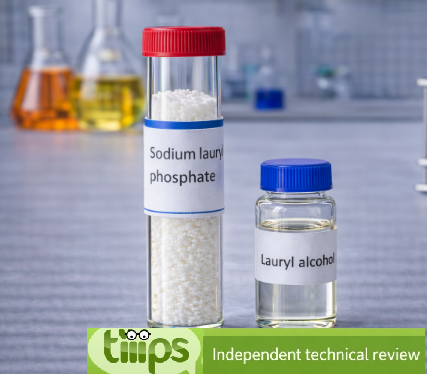
Sodium lauryl phosphate is the sodium salt of a C12 phosphate ester (the alkyl phosphates family), obtained by phosphorylation of lauryl alcohol (1-dodecanol) followed by neutralization with a sodium base. From a compositional standpoint, commercial grades may be described as the salt of the “monoester” species (dodecyl phosphate) or as a controlled mixture of related species (mono/di phosphate esters and their salts), depending on the process and producer specification. The sodium form is typically selected to improve water solubility, facilitate use in cleansing products, and make pH control more predictable than the acid form.
Main uses
Cosmetics: cleansers (face/body), shampoos, foaming systems, and some O/W systems as an anionic surfactant/co-emulsifier.
Medicine: not typical as a standard ingredient; any use is specialized.
Pharmaceutical: not common as a mainstream excipient; use depends on dossier/specification.
Industrial use: surfactant/emulsifier and wetting agent in technical formulations.
Identification data and specifications
| Identifier | Value |
|---|---|
| INCI name | Sodium Lauryl Phosphate |
| Chemical framing | alkyl phosphate, sodium salt (C12) |
| Reference chemical species (common) | sodium dodecyl phosphate (salt of dodecyl phosphate) |
| CAS number | 50957-96-5 (frequently reported for sodium dodecyl phosphate) |
| EC/EINECS number | 256-865-1 (linked in various SDS to the CAS above) |
| Note on CAS/EC | some commercial grades may show alternative identifiers (mixture/registration); always rely on the manufacturer’s SDS/CoA |
| Molecular Formula | C12H26NaO4P |
| Molecular Weight | 288.30 g/mol |
Key constituents
| Class | Typical components | Technical note |
|---|---|---|
| Surfactant phosphate fraction | sodium salt of the monoester and, in some grades, a fraction of related species | affects foam, cleansing, clarity, and viscosity |
| Counterions | Na⁺ (predominant) | defines the “sodium salt” form |
| Controlled traces/impurities | process residues and related species | managed through specifications and QC |
Functional role and practical mechanism of action
| Function | What it does in the formula | Technical note |
|---|---|---|
| Anionic cleansing surfactant | reduces surface tension; improves wetting and soil removal | performance depends on pH and the surfactant package |
| Foaming agent | contributes to foam volume and quality | synergistic with amphoterics/nonionics |
| Emulsifier/co-emulsifier | supports O/W systems and solubilization of lipophilic fractions | useful in targeted blends |
Formulation compatibility
As an anionic surfactant, Sodium lauryl phosphate is generally compatible with anionic and amphoteric cleansing packages (e.g., betaines), where it can contribute to foam and wetting. Compatibility with cationic components (quaternaries, polyquaterniums, cationic conditioners) must be handled carefully due to the risk of complexation (haze, precipitates, performance loss): in “2-in-1” or strongly cationic conditioner systems it is not usually a primary choice unless the formulation architecture is specifically designed for it.
In “clear” systems, clarity depends on active level, electrolyte profile, co-surfactants, and temperature. Because the sodium form is already neutralized, pH management is typically simpler than with the acid form; however, it remains important to verify pH/viscosity stability over time and across thermal cycles. In O/W emulsions it can act as a co-emulsifier, but performance depends strongly on the overall emulsifier system and ionic strength: stability testing (thermal stress, centrifugation) is recommended.
Use guidelines (indicative)
| Application | Typical range | Technical note |
|---|---|---|
| Face/body cleansers (gels, foams, liquid syndets) | 0.5–5.0% | adjust based on mildness and foam target |
| Shampoo | 0.5–5.0% | synergistic with amphoterics; optimize viscosity and electrolytes |
| Co-emulsifier / O/W solubilizer | 0.2–2.0% | verify stability and electrolyte compatibility |
(Percentages depend on the commercial grade and the active concentration of the raw material.)
Typical applications
Foaming face/body cleansers with an anionic profile, often blended with amphoterics to optimize mildness.
Shampoos and hair cleansing products where added foam and wetting are desired.
Specific O/W systems where the phosphate headgroup supports emulsification/solubilization in combination with other emulsifiers.
Quality, grades and specifications
| QC parameter | What to control |
|---|---|
| Identity | INCI alignment and CAS/EC per SDS/CoA |
| Assay/actives | active level and profile (mono/di esters, if declared) |
| pH (solution) | range and batch-to-batch repeatability |
| Electrolytes/impurities | residual salts, free sulfates/phosphates (if applicable) |
| Color/odor | stability and impact on clear formulas |
| Microbiology (if in solution) | limits and preservation status, where relevant |
Safety, regulatory and environment (discursive section)
As an anionic surfactant, Sodium lauryl phosphate should be evaluated primarily with respect to potential eye irritation upon direct contact (a common theme for foaming cleansers). Proper management is based on dosage, final pH, selection of co-surfactants (amphoterics/nonionics) and mildness additives, plus the safety assessment of the finished product under EU Regulation (EC) 1223/2009 and the CPSR process. Environmentally, the recommended approach is typical for surfactants: minimize uncontrolled industrial releases and manage effluents according to local regulation and good process practices.
Formulation troubleshooting
| Issue | Likely cause | Recommended action |
|---|---|---|
| Haze/precipitates with cationic conditioners | anionic–cationic complexation | reduce/avoid cationics, separate functional phases, reformulate surfactant system |
| Loss of clarity in cleansing gel | electrolytes, temperature, co-surfactant profile | retune salts, adjust amphoterics/nonionics, optimize thickener |
| Perceived irritation | dosage/pH/surfactant system not optimized | reduce actives, use milder co-surfactants, adjust pH and soothing additives |
| Low or unstable foam | surfactant balance not correct | increase amphoterics, optimize anionic/amphoteric ratio, check electrolytes |
Conclusion
Sodium lauryl phosphate is an anionic alkyl phosphate in sodium salt form, useful in cleansing products for its contribution to wetting, foam, and potential co-emulsifying behavior. Key success factors are correct surfactant-package balancing, management of compatibility with cationic components, and control of clarity and stability against pH/electrolytes to ensure repeatable performance and sensorial quality.
Mini-glossary
Alkyl phosphates: phosphate esters with alkyl chains; often used as surfactants/emulsifiers.
Anionic: surfactant carrying a negative charge in solution.
Neutralization: conversion of the acid form into a salt (here Na⁺) to tune pH and solubility.
GMP: Good Manufacturing Practice.
HACCP: Hazard Analysis and Critical Control Points (relevant as a process-control concept in regulated settings).

