



Lauryl phosphate: anionic phosphate surfactant, INCI functions, identifiers, uses, and formulation notes
Lauryl phosphate
Lauryl phosphate – phosphoric ester of lauryl alcohol (1-dodecanol) (the “alkyl phosphates” family)
Synonyms: dodecyl dihydrogen phosphate, monolauryl phosphate, phosphoric acid, monododecyl ester (technical designations, often used in registrations/specifications)
INCI / functions: surfactant – emulsifying; in some commercial grades and/or related salts (e.g., sodium/potassium salts) it may also contribute to cleansing and foaming
Definition
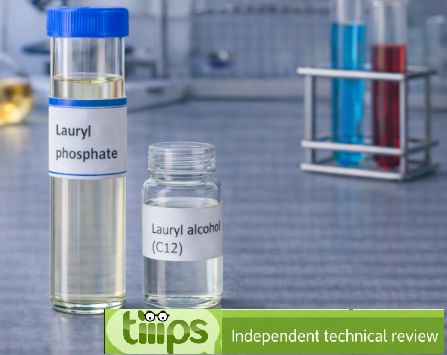
Lauryl phosphate belongs to the alkyl phosphates family, i.e., organic esters of orthophosphoric acid obtained by phosphorylation of a fatty alcohol, here lauryl alcohol (C12). From a compositional standpoint, commercial grades may correspond to a well-defined species (often described as the monoester: dodecyl dihydrogen phosphate) or to a distribution/mixture of related species (mono/diesters and/or their salts, depending on neutralization), with direct impact on solubility, surfactant performance, and rheology.
Main uses (brief, by sector):
Food: not intended as a standard food additive (typically a personal care/industrial ingredient).
Cosmetics: anionic surfactant and/or co-emulsifier in cleansing and O/W systems; it may be supplied non-neutralized and neutralized “in formula” to match the target (pH, mildness, performance).
Medicine: not typical as a standard ingredient; any use is specialized and specification-dependent.
Pharmaceutical: not common as a mainstream excipient; where present, it is tied to supplier dossier and requirements.
Industrial use: used as a surfactant/emulsifier and wetting agent in technical formulations.
Identification data and specifications
| Identifier | Value |
|---|---|
| INCI name | Lauryl Phosphate |
| Chemical framing | alkyl phosphate (C12 phosphate ester) |
| Formula (the “monoester” species frequently declared) | C12H27O4P |
| Molar mass (monoester species) | 266.32 g/mol |
| CAS number (often reported for the monoester species) | 2627-35-2 |
| EC/EINECS number (linked to the monoester species in many SDS) | 220-095-4 |
| Note on CAS/EC | in some supplier documents Lauryl Phosphate may be declared with alternative CAS/EC (depending on substance definition/registration and the commercial grade); always confirm against the manufacturer’s SDS/CoA |
Key constituents
| Class | Typical components | Technical note |
|---|---|---|
| “Phosphate esters” fraction | monoester (dodecyl dihydrogen phosphate) and, in some grades, a fraction of related species | distribution affects mildness, foam, and solubility |
| Counterions (if supplied as salts) | Na⁺/K⁺ or other neutralizing species depending on grade | neutralization changes pH and water behavior |
| Controlled traces/impurities | minor residues linked to synthesis and lot profile | managed via specifications and QC |
Functional role and practical mechanism of action
| Function | What it does in the formula | Technical note |
|---|---|---|
| Anionic surfactant | reduces surface tension; improves wetting and cleansing | performance depends on pH and ionic strength |
| Emulsifier/co-emulsifier | helps stabilize O/W systems | often synergistic with other emulsifiers |
| Foam support (grade-dependent) | can contribute to foam quality and stability | more evident in tailored cleansing systems |
Formulation compatibility
Lauryl phosphate is typically handled as an anionic component: in cleansing systems with anionic/amphoteric surfactants it generally integrates well, affecting perceived mildness, wetting, and foam profile depending on the surfactant package. In O/W emulsions it can act as an emulsifier or co-emulsifier, but performance depends strongly on neutralization (acid form vs salt), electrolyte profile, and co-surfactants.
Key practical attention points:
With cationic polymers (e.g., polyquaterniums), complexation and haze/instability may occur; manage via addition order, charge balancing, or functional separation.
In “clear” systems, transparency may be impacted by pH/electrolytes and grade form (acid vs salt): verify quickly at different temperatures and over 24–48 h.
If supplied non-neutralized, in-process neutralization (with suitable bases) is critical to achieve the target pH and performance without compromising stability or sensory profile.
Use guidelines (indicative)
| Application | Typical range | Technical note |
|---|---|---|
| Facial/body cleansers (syndet, cleansing gels, foams) | 0.5–5.0% | indicative range; depends on grade and surfactant system |
| Shampoo / hair cleansing | 0.5–5.0% | adjust based on foam and mildness target |
| Co-emulsifier in O/W | 0.2–2.0% | often synergistic with other emulsifiers; optimize neutralization |
(Percentages depend on the commercial grade and the active content of the raw material.)
Typical applications
Mild cleansing and foaming products where a mild profile and good post-rinse sensoriality are desired (grade-dependent).
O/W systems requiring an anionic emulsifier/co-emulsifier contribution, with performance tunable via neutralization.
Technical formulas where a phosphate headgroup surfactant is useful (wetting/emulsification), provided overall system compatibility.
Quality, grades and specifications
| QC parameter | What to control |
|---|---|
| Identity | INCI match and CAS/EC as per supplier SDS/CoA |
| Assay/actives | active content and profile (mono/diesters, if declared) |
| Acidity/neutralization | acid value, solution pH, and neutralization guidance |
| Color/odor | lot-to-lot stability and impact on clear/light formulas |
| Impurities/metals | limits aligned with target application and customer requirements |
| Microbiology (if aqueous solution) | limits and preservation status, where applicable |
Safety, regulatory and environment
Lauryl phosphate, as part of the alkyl phosphates used in cosmetics, is mainly applied as a surfactant/emulsifier; the appropriate safety approach is the assessment of the finished product (use scenario, population, exposure). Practically, like many anionic surfactants, the most relevant point is potential eye irritation upon direct contact (especially in cleansers and foaming products), which is managed through grade selection, concentration, pH, and the overall surfactant system. From an environmental standpoint, as with surfactants and organic load ingredients, recommended practice focuses on responsible industrial effluent management and process optimization to minimize uncontrolled releases.
Formulation troubleshooting
| Issue | Likely cause | Recommended action |
|---|---|---|
| Haze or loss of “clear” | pH/electrolytes, acid vs salt form, complexes with cationics | optimize neutralization, reduce electrolytes, rebalance with nonionics/amphoterics |
| O/W emulsion instability | neutralization off-target or insufficient co-emulsifier support | retune base/neutralizer, increase co-emulsifier, optimize oil phase and rheology |
| Perceived irritation (cleansing) | dose/pH/surfactant system not optimized | reduce active level, use milder co-surfactants, adjust pH and soothing additives |
| Foam too low or too “dry” | surfactant balance not correct | adjust amphoterics/nonionics, tune electrolytes, test an alternative grade |
Conclusion
Lauryl phosphate is a C12 alkyl phosphate used in cosmetics mainly as an anionic surfactant and emulsifier/co-emulsifier, with performance strongly influenced by neutralization and the overall formulation system. Careful management of pH, electrolytes, and compatibility with cationic components is essential to achieve stability, clarity (where required), and a sensorial profile aligned with a “mild” positioning.
Mini-glossary
INCI: International Nomenclature of Cosmetic Ingredients; standardized naming for cosmetic labeling.
Alkyl phosphates: organic esters of orthophosphoric acid with alkyl chains; commonly used as surfactants/emulsifiers.
Neutralization: conversion of the acid form into a salt (e.g., sodium/potassium) to tune pH and properties.
GMP: Good Manufacturing Practice; quality systems to ensure consistent manufacturing and control.
HACCP: Hazard Analysis and Critical Control Points; a systematic approach to hazard analysis and control (most common in food chains, but relevant as a process-control concept in regulated settings).

