



Potassium Cetyl Phosphate: properties, uses, pros, cons, safety
Potassium Cetyl Phosphate is an anionic surfactant and emulsifying agent consisting of potassium salts of phosphoric esters of cetyl alcohol. Its documented cosmetic functions are SURFACTANT – CLEANSING and SURFACTANT – EMULSIFYING.
The long C₁₆ cetyl chain forms the lipophilic portion of the molecule, while the potassium-neutralized phosphate group forms the polar and ionic portion. This amphiphilic structure allows the ingredient to position itself at the interface between water and oil and contribute to the formation and stabilization of oil-in-water (O/W) emulsions.
Description
Potassium Cetyl Phosphate belongs to the family of alkyl phosphates, organic esters of orthophosphoric acid with fatty alcohols.
The material can be described as the potassium salt of a complex mixture of phosphoric acid esters with cetyl alcohol. The INCI ingredient should therefore not necessarily be regarded as one perfectly pure molecular species: depending on the manufacturing process and commercial grade, different esterified and neutralized phosphate species may be present.
The combination of:
a long lipophilic alkyl chain;
a polar phosphate group;
potassium as the counterion;
provides marked surfactant properties.
In cosmetic systems, it can:
reduce interfacial tension between water and oil;
promote emulsion formation;
improve dispersion of the oil phase;
contribute to long-term physical stability;
participate in cleansing;
facilitate dispersion of pigments and other lipophilic components.
It is particularly well known as an anionic O/W emulsifier and can also be used in complex formulations containing high levels of oils, pigments, sunscreen filters, electrolytes, or alcohol.
Manufacturing process
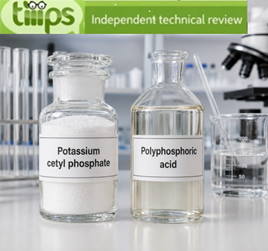
Alkyl phosphates can be produced by reacting a fatty alcohol with phosphoric or polyphosphoric acid, forming the corresponding phosphate esters. For Potassium Cetyl Phosphate, the principal fatty alcohol is cetyl alcohol (1-hexadecanol).
The process may include:
preparation and purification of cetyl alcohol;
reaction with phosphoric or polyphosphoric acid;
formation of phosphoric esters;
controlled neutralization with a potassium base, typically potassium hydroxide;
adjustment of the proportion of monoesterified and related phosphate species;
removal of volatile or unreacted components;
purification;
drying;
conversion into powder or another commercial form;
pH and acidity control.
Neutralization converts acidic cetyl phosphate species into their corresponding potassium salts, which are responsible for the ingredient's anionic behavior.
Commercial quality depends particularly on controlling:
degree of esterification;
neutralization;
residual cetyl alcohol;
inorganic phosphates or residual phosphoric acid;
moisture;
color;
pH;
purity of the commercial grade.
Main compounds present
The characteristic components are potassium salts of phosphoric esters of cetyl alcohol.
Depending on the commercial grade, the material may contain:
potassium monocetyl phosphate;
cetyl phosphate species with different degrees of neutralization;
related phosphoric esters;
small amounts of unreacted cetyl alcohol;
residual phosphates or phosphoric acid;
water;
residues originating from the neutralization process.
Potassium Cetyl Phosphate should therefore be considered a mixture of related alkyl phosphate species, predominantly based on C₁₆ chains.
Identification data and specifications
| Characteristic | Value | Note |
|---|---|---|
| INCI name | Potassium Cetyl Phosphate | cosmetic ingredient name |
| Chemical name | 1-Hexadecanol, phosphate, potassium salt | European chemical denomination |
| Other name | Potassium hexadecyl hydrogen phosphate | representative monoester form |
| Chemical category | alkyl phosphate / anionic surfactant | phosphoric ester of a fatty alcohol |
| Molecular formula | not completely unique for the INCI material; C₁₆H₃₄KO₄P for potassium hexadecyl hydrogen phosphate | representative monoester form |
| Molecular weight | not completely unique; 360.51 g/mol for the representative monoester form | depends on the chemical species present |
| CAS | 84861-79-0; 19035-79-1 | identifiers associated with registered forms |
| EC | 284-374-2; 242-768-1 | related European identifiers |
| PubChem CID | 23672321 | representative Potassium Cetyl Phosphate entry |
| CosIng reference | 79512 | European cosmetic ingredient reference |
| Cosmetic functions | Surfactant – Cleansing; Surfactant – Emulsifying | documented functions |
| Cosmetics Regulation provisions | no specific provision indicated | no specific Annex II–VI provision identified |
Indicative physicochemical properties
| Characteristic | Indicative value | Note |
|---|---|---|
| Appearance | white to off-white powder | typical commercial grade |
| Odor | absent or slightly fatty | grade-dependent |
| Solubility in warm water | readily soluble | depends on the commercial form |
| Compatibility with oil phase | dispersible/soluble in heated oil phase | useful during emulsification |
| pH | approximately 6.5–8 in a 1% aqueous preparation | indicative value |
| Acid value | approximately 270–295 | representative commercial specification |
| Ionic nature | anionic | potassium-neutralized phosphate group |
| Formulation behavior | O/W emulsifier and surfactant | effective at the water/oil interface |
| Formulation stability | good in suitable systems | depends on pH, electrolytes, and co-emulsifiers |
| Operating pH range | relatively broad for specific grades | commercial systems may be suitable around pH 5–9 |
Cosmetics
Potassium Cetyl Phosphate is mainly used as an anionic oil-in-water emulsifier.
It may be present in:
facial creams;
body creams;
light emulsions;
sunscreen products;
foundations;
BB and CC creams;
mascaras;
make-up products;
lotions;
emulsified sprays;
mousses;
cleansing products;
products containing pigments or mineral powders.
It can be particularly useful in sunscreen formulations because it can help stabilize systems containing substantial amounts of:
organic UV filters;
mineral UV filters;
oils;
pigments;
electrolytes.
Specific commercial grades can also be used as co-emulsifiers at relatively low concentrations to improve the robustness of technically demanding emulsions.
Supplier guidelines for certain commercial grades indicate approximately 1–3% as a primary emulsifier and 0.5–1% as a co-emulsifier. These are formulation recommendations, not regulatory maximum limits.
Its surfactant activity can also contribute to cleansing, which is one of its documented cosmetic functions.
Pros
It is an effective anionic O/W emulsifier.
It promotes formation of stable emulsions.
It can be used as either a primary emulsifier or a co-emulsifier.
It performs well in technically complex formulations.
It can support relatively high oil-phase contents in appropriately designed systems.
It can help disperse pigments and sunscreen filters.
It is suitable for skin care, sun care, and make-up.
It also has a documented cleansing function.
Specific commercial grades are PEG-free.
Available cosmetic safety assessments support its use under the evaluated conditions when formulations are designed to be non-irritating.
Cons
As an anionic surfactant, it may cause irritation if used under unsuitable conditions or at inappropriate concentrations.
The main safety concern is skin and especially eye irritation.
Products applied close to the eyes require particular attention during finished-product testing.
Performance may change in the presence of high electrolyte levels or ionically incompatible ingredients.
Emulsion behavior depends on pH and on the overall surfactant/emulsifier system.
The INCI name may represent a mixture of phosphate species rather than one perfectly uniform molecule.
Hazard characteristics of the concentrated raw material should not automatically be transferred to the diluted finished cosmetic product.
Safety, regulation and environment
The Expert Panel for Cosmetic Ingredient Safety evaluated Potassium Cetyl Phosphate together with other alkyl phosphates.
The assessment concluded that these ingredients are safe under the evaluated cosmetic practices and concentrations when formulated to be non-irritating.
Skin and eye irritation
This is the principal point of caution.
Some alkyl phosphates show skin and ocular irritation potential, which is why the safety conclusion specifically includes the condition “when formulated to be non-irritating.”
Potassium Cetyl Phosphate has historically been reported at relatively high concentrations in some eye-area products such as mascara, making finished-product ocular tolerability particularly important.
These reported use concentrations are historical formulation data and not regulatory maximum limits.
Experimental testing of appropriately diluted Potassium Cetyl Phosphate preparations has also shown low ocular irritation potential under specific test conditions, demonstrating that irritation depends strongly on concentration and formulation.
EU Cosmetics Regulation provisions
No specific “Cosmetics Regulation provisions / Cosmetic restrictions” are identified for Potassium Cetyl Phosphate under Annexes II–VI of the EU Cosmetics Regulation.
Its documented functions are SURFACTANT – CLEANSING and SURFACTANT – EMULSIFYING, without a specific Annex provision associated with the ingredient.
The absence of a specific restriction does not remove the requirement for the finished cosmetic product to be safe and non-irritating, particularly in applications near the eyes.
Raw-material control
For professional evaluation, it is advisable to obtain:
an updated SDS;
a Certificate of Analysis (COA);
technical data sheet;
composition and purity of the commercial grade;
distribution of phosphate species;
acid value;
pH;
moisture content;
residual cetyl alcohol;
residual phosphates or phosphoric acid;
color and odor specifications;
stability data;
skin- and eye-irritation data;
supplier-recommended use concentrations;
compatibility information for electrolytes and other surfactants.
The hazard classification of the concentrated raw material should be checked on the supplier-specific SDS, since different commercial forms and concentrations may show different irritation or serious-eye-damage classifications.
Environment
Environmental behavior should be evaluated for the actual substance and commercial grade used.
Potassium Cetyl Phosphate contains a long alkyl chain and an ionic phosphate group, so relevant parameters include:
biodegradability;
adsorption to sludge and solids;
degradation of the alkyl component;
phosphate release;
concentration in rinse-off products;
behavior in wastewater-treatment systems.
Certain commercial grades have been reported as biodegradable under standardized test conditions, but such results should not automatically be generalized to every raw material sold under the same INCI name.
Conclusion
Potassium Cetyl Phosphate is an anionic surfactant particularly useful as an oil-in-water emulsifier, while also providing a cleansing function. Its amphiphilic structure allows it to stabilize the interface between aqueous and lipid phases, including in technically demanding formulations such as sunscreens and make-up.
The available cosmetic safety assessment is generally favorable: the ingredient is considered safe under the evaluated practices and concentrations when the finished formulation is non-irritating.
No specific Cosmetics Regulation provisions are identified for this ingredient.
The principal point of caution is its irritation potential, particularly for formulations used near the eyes. Other important quality parameters include commercial-grade composition, purity, pH, acidity, process residues, and compatibility with the other ingredients in the formulation.
Potassium Cetyl Phosphate can be considered a technically valuable and generally favorable cosmetic emulsifier and surfactant, provided that the finished product is properly designed and verified to be non-irritating, with particular attention to periocular applications.

