



Glyceryl palmitate/stearate: properties, uses, pros, cons, safety
Glyceryl palmitate/stearate is a mixture of glycerol monoesters of palmitic acid (C16:0) and stearic acid (C18:0), used in cosmetics primarily as an emollient to improve slip, softness, and the sensory profile of the oil phase. It is a variable-composition ingredient: practical performance depends on the mono/di/triester distribution, the free-fatty-acid fraction, and the commercial grade (purity, residual odour, rheological behaviour).
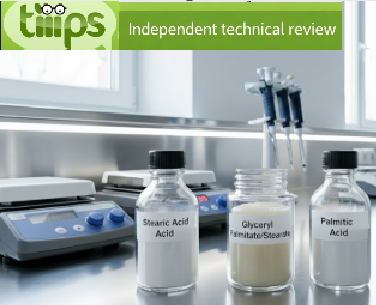
Glyceryl Palmitate/Stearate is a monoglyceric monoester obtained by the esterification of glycerine and carboxylic acids (an equivalent of a carboxylic acid and an equivalent of glycerine), in this ingredient a blend of palmitic and stearic acid.
Definition
It is a UVCB substance (variable-composition mixture): it does not correspond to a single molecule, but to a set of C16–C18 glycerides with a distribution controlled by the manufacturer.
In formulation, key parameters are: melting point/consistency, impact on body and pay-off, compatibility with other lipids and surfactants, and emulsion physical stability (crystallization, grittiness, viscosity drift).
Main uses
Cosmetics.
Used in face/body creams, balms, sticks, anhydrous products, and emulsions where increased emolliency and improved skin feel are desired. It is also commonly used as an oil-phase “structuring” component to modulate consistency and stability.
INCI Functions
Skin conditioning agent - Emollient. Emollients have the characteristic of enhancing the skin barrier through a source of exogenous lipids that adhere to the skin, improving barrier properties by filling gaps in intercorneocyte clusters to improve hydration while protecting against inflammation. In practice, they have the ability to create a barrier that prevents transepidermal water loss. Emollients are described as degreasing or refreshing additives that improve the lipid content of the upper layers of the skin by preventing degreasing and drying of the skin. The problem with emollients is that many have a strong lipophilic character and are identified as occlusive ingredients; they are oily and fatty materials that remain on the skin surface and reduce transepidermal water loss. In cosmetics, emollients and moisturisers are often considered synonymous with humectants and occlusives.
Surfactant - Emulsifying agent. Emulsions are thermodynamically unstable. Emulsifiers have the property to reduce the oil/water or water/oil interfacial tension, improve emulsion stability and also directly influence the stability, sensory properties and surface tension of sunscreens by modulating their filmometric performance.
Key constituents
The mixture predominantly contains glycerol monoesters of C16–C18 fatty acids, with possible minor fractions of di/triesters and traces of free fatty acids depending on the supplier specification. Operationally, these fractions drive: consistency, crystallization behaviour, sensoriality, and compatibility with other lipids.
Nutritional use note and bioactive compounds
It is not a “nutritional” ingredient and it is not used to deliver bioactive compounds: its role is technological (emolliency and oil-phase structuring).
Identification data and specifications
| Characteristic | Value |
|---|---|
| INCI name | Glyceryl palmitate/stearate |
| INCI functions | skin conditioning – emollient |
| CAS number | 68002-71-1 |
| EC/EINECS number | 268-084-3 |
| Substance type | Mixture of glycerol esters of C16–C18 fatty acids (UVCB) |
| Molecular formula | Not applicable (mixture) |
| Molecular weight | Not applicable as a single value (mixture) |
Indicative physico-chemical properties
| Characteristic | Indicative value | Note |
|---|---|---|
| Chemical nature | Lipid ester (C16–C18 glyceride) | Variable-composition mixture |
| Solubility | Insoluble in water; compatible with lipid phases | Compatibility depends on oil phase and temperature |
| Physical state | Typically solid or semi-solid | Depends on “cut” and ester distribution |
| pH stability | High (lipid component) | Overall stability depends on the emulsion and preservative system |
| Light/oxygen stability | Generally good | Depends on unsaturation level and on impurities/antioxidants in formula |
| Critical parameters | Melting point, crystallization, residual odour, purity | Key drivers for sensoriality and physical stability |
Functional role and practical mechanism of action
It acts as an emollient by reducing surface friction and improving the perception of softness and slip. In many formulas it also contributes to oil-phase structure, influencing viscosity, consistency, and long-term stability (especially crystallization behaviour).
Formulation compatibility
Common points of attention include: compatibility with butters/waxes and oils with different melting profiles, risk of grittiness or texture changes due to crystallization in high-lipid systems, and the need to validate behaviour in emulsions (cool-down curve, shear, packaging). In anhydrous and stick formats, grade selection is often decisive to avoid “sweating” or hardness drift.
Use guidelines
Use levels depend on the goal (emolliency, body, structure) and the lipid system. Good practice is to set targets for: consistency, slip, absence of grittiness, thermal stability (hot/cold cycles), and behaviour in final packaging.
Quality, grades, and specifications
Supplier variability can be significant. Robust control includes: melting/solidification specifications, crystallization profile, odour, colour, and purity (including limits on free fatty acids and undesired fractions). Adoption of GMP (good manufacturing practice; benefit: reduces variability and contamination) supports traceability and repeatability.
Safety, regulatory, and environment
The purity level of commercial monoglyceric monoester is about 90 per cent, and impurities include fatty acids, monoglyceric diesters, mono-, di- and tri-glycerides.
Safety must be assessed on the finished product considering concentration, use area, and target population. In general, glycerol esters of fatty acids are used as emollients with a favourable tolerability profile, but grade quality (impurities, residual odour) and overall formulation design can influence tolerability in predisposed individuals.
Allergen.
It is not typically classified as an allergen (and it is not among fragrance allergens). However, in predisposed skin, individual intolerance phenomena may occur depending on the overall formula.
Contraindications (brief).
Use caution on very sensitive or reactive skin; in highly occlusive leave-on products, assess compatibility with skin type and the intended user experience. Avoid application on compromised skin if risk assessment and tolerability tests indicate concerns.
Formulation troubleshooting
Grittiness in emulsions or anhydrous systems.
Action: review lipid melting profile, optimize cool-down curve and shear, select a grade with more controlled crystallization.
Viscosity drift over time.
Action: evaluate thermal stability (cycling), optimize the ratio between lipid structurants, verify compatibility with other emollients and waxes.
Perceptible residual odour.
Action: select a more “deodorized” grade, tighten organoleptic specifications, and verify interactions with fragrance/actives.
Conclusion
Glyceryl palmitate/stearate is a lipid emollient used mainly for skin conditioning – emollient, with a relevant impact on sensoriality and oil-phase structure. Reliable use requires grade selection, control of crystallization behaviour, stability validation, and a finished-product safety assessment including a concise note on allergenicity and practical contraindications.
Mini-glossary
UVCB. Substances of unknown or variable composition, complex reaction products, or biological materials.
Crystallization. Phenomenon that can affect texture, grittiness, hardness, and stability of emulsions and lipid anhydrous systems.
GMP. Good manufacturing practice; benefit: improves traceability and reduces contamination/variability.

