



Glyceryl hydrogenated rosinate: properties, uses, pros, cons, safety
Glyceryl hydrogenated rosinate is a rosin derivative: in practice, a set of glycerol esters obtained from resin acids (rosin acids) that have been hydrogenated to improve stability and color. It is a typical raw material for anhydrous or low-water-activity systems, used mainly in cosmetics (make-up and film-forming systems) and, as a chemically related family, it is also relevant in food as “ester gum” (if and only if the grade is compliant with the specific regulatory framing).
In practice, what truly matters is the grade: color (Gardner), odor, softening point, compatibility profile with oils/waxes/polymers, and lot-to-lot repeatability (impurities, metals, process residues). It is a functional/technological ingredient: its value is measured in adhesion, wear, film, and rheological behavior, not in “bioactivity”.
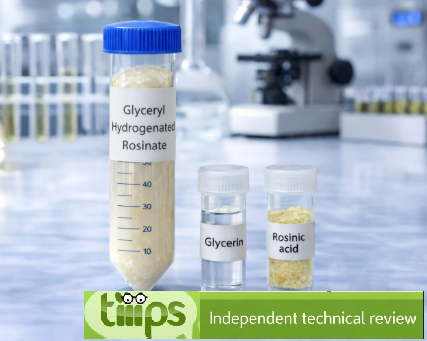
Definition
It is a resinous substance consisting of glycerol esters of hydrogenated resin acids (typical description: “resin acids and rosin acids, hydrogenated, esters with glycerol”). Although it is a specific INCI name, from a chemical-industrial standpoint it should be treated as a mixture: the exact profile depends on the starting rosin (gum/tall oil/wood rosin), the hydrogenation degree, and esterification conditions.
Operationally, quality control focuses on: identity, softening point, insolubles, color, odor, moisture (if relevant for the commercial form), and contaminants (especially for grades intended for oral/food-contact use).
Main uses
Food
Within the “ester gum / glycerol esters of rosin” perimeter, the typical use is as a weighting agent to stabilize citrus flavor oils in beverages and as a component of chewing-gum bases, when the material meets the specifications of an authorized additive (e.g., E 445). Glyceryl hydrogenated rosinate may appear as a hydrogenated technological variant in “ester gum” grades, but operationally you must always verify the regulatory entry, specifications, purity, and intended use.
Cosmetics
Used mainly as a film former and tackifier (increases adhesion and “grip”) in lipsticks, long-wear products, sticks, mascaras, and water-resistant formulas. In practice it helps to: improve wear, reduce migration, increase film cohesion, and optimize sensorial performance (controlled slip and film “grip”).
INCI functions
Film-forming agent. It produces, upon application, a very thin continuous film with an optimal balance of cohesion, adhesion and stickiness on skin, hair or nails to counteract or limit damage from external phenomena such as chemicals, UV rays and pollution.
Industrial use.
Used as a tackifying resin for adhesives (PSA/HMA), coatings, and technical films where low color, good thermal stability, and aging resistance are required. In this area, selecting the right softening point and polymer compatibility is often the main lever.
Key constituents (principali sostanze contenute)
It is not a plant extract, but a mixture of glycerol esters of hydrogenated resin acids (rosin-derived). Operational variability is mainly driven by: resin-species distribution, hydrogenation degree, and minor fractions that influence odor, color, and potential sensitization in predisposed subjects.
Identification data and specifications
| Characteristic | Value |
|---|---|
| INCI / common name | Glyceryl hydrogenated rosinate |
| Chemical description (operational) | Hydrogenated resin acid esters with glycerol (mixture) |
| CAS number | 65997-13-9 |
| EC number | 266-042-9 |
| Molecular formula | Not applicable as a single value (mixture) |
| Molecular weight | Not applicable as a single value (mixture) |
| Nature of substance | Resin/thermoplastic solid (tackifier) |
| Typical commercial grades | Cosmetic grade / industrial grade; possible “food/ester gum” grades only if compliant with dedicated specifications |
| Regulatory note (operational) | In cosmetics it is handled as a film-forming ingredient; in food, the “ester gum” family is regulated as a specific additive and requires entry-by-entry compliance verification |
Indicative chemical-physical properties
| Characteristic | Indicative value | Note |
|---|---|---|
| Appearance | Resinous solid / pellets / flakes | Color and form depend on producer and grade |
| Water solubility | Insoluble | Tends to sediment; not a “water phase” ingredient |
| Solubility in oils/non-polar solvents | Typically good | Compatibility must be verified with the formula’s oils, waxes, esters, and polymers |
| Softening point | Variable (grade-dependent) | Key parameter for wear, film structure, and processability |
| Oxidative/color stability | Variable | Possible darkening over time: storage and lot rotation help |
| Critical parameters | Softening point, color, odor, insolubles, impurities | Main drivers for performance and repeatability |
Functional role and practical mechanism of action
In cosmetics it behaves as a film-forming resin: it increases film cohesion and adhesion (tack), improving wear resistance and reducing migration/smudging, especially in anhydrous systems with waxes and oils. Formulation-wise, it is a lever to tune the trade-off between: application slip, film grip, and comfort.
In industrial adhesives, the logic is similar: it is a tackifier that increases tack and substrate wetting, with performance driven by compatibility with the base polymer and the softening point.
Formulation compatibility
In anhydrous formulas (sticks, balms, waxes): compatibility is often good, but synergy with waxes (crystallization), oils/esters, and pigments (wetting and pay-off) must be controlled. In O/W emulsions: water insolubility requires handling in the oil phase and controlling physical stability (creaming/viscosity). In peel-off or polymeric film systems: verify compatibility and film clarity, plus odor and final color.
Use guidelines
Good practice includes: selecting a grade with softening point and color aligned with the target (long-wear vs sensoriality), setting limits for odor/color and insolubles, validating accelerated stability (oxidation/darkening, syneresis, hardness shifts), and checking compatibility with packaging and transport thermal conditions (thermoplastic material).
Quality, grades, and specifications
Supplier variability can be significant in softening point, color, odor, and compatibility with specific oils/polymers. A robust control plan includes: COA with declared methods, specifications for softening point and color, insolubles control, and contaminant checks. For uses that touch the food perimeter, quality management must be consistent with GMP and HACCP, and with the relevant additive specifications (where applicable).
Safety, regulatory, and environment
In cosmetics, safety must be assessed on the finished product (concentration, use area, target population). A practical point is potential sensitization linked to rosin derivatives: hydrogenation tends to improve stability and may reduce some issues, but caution remains sensible in predisposed individuals.
Allergen.
Not a “label allergen” in the food sense, but may be relevant for people with specific sensitivity to rosin derivatives.
Contraindications (brief).
Caution in case of history of reactivity to rosin/colophony, or very sensitive skin, especially for leave-on or lip products. In industrial settings, properly manage process dust/fumes and disposal according to SDS and local regulations.
Formulation troubleshooting
Film too “tacky” or heavy sensorial feel.
Action: reduce use level, choose a grade with a different softening point, balance with low-tack esters or waxes with different crystallinity.
Heat-related wear loss or color migration.
Action: increase structure robustness (waxes/structurants), use a higher-softening-point grade, check compatibility with “migrating” oils.
Darkening/odor over time.
Action: tighten color/odor specs, optimize system antioxidants (where applicable), reduce process thermal stress, improve storage and lot rotation.
Conclusion
Glyceryl hydrogenated rosinate is a tackifying, film-forming resin used mainly to improve adhesion and long wear in cosmetics (and for industrial adhesive applications). It is a specification-driven ingredient: softening point, color, odor, and matrix compatibility. In practice, the difference between “okay” use and robust use lies in the specification sheet and in stability/sensorial validation on the finished product, with attention to potential sensitivities related to rosin derivatives.
Mini-glossary
Softening point. Indicative temperature at which a thermoplastic resin begins to soften; key parameter for wear and processability.
Tackifier. Resin that increases tack/adhesion and film “grip” in a cosmetic film or an adhesive.
GMP. Good manufacturing practice; benefit: reduces variability and contamination through controlled production practices.
HACCP. Hazard analysis and critical control points; benefit: systematic prevention and control of food-safety hazards via critical points.

