



Babassuamide DEA: properties, uses, pros, cons, safety
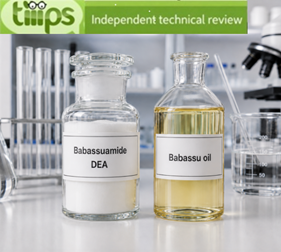
Babassuamide DEA is a mixture of diethanolamides of fatty acids derived from babassu oil. The lipid raw material comes from babassu seed oil, traditionally associated with Orbignya oleifera, and is particularly rich in medium- and long-chain fatty acids, especially lauric acid and myristic acid.
The abbreviation DEA refers to diethanolamine, which is used to form the corresponding fatty acid amides. The finished ingredient is therefore not free diethanolamine, but a mixture of tertiary amides; however, residual free DEA and the possible formation of N-nitrosamines are key safety and regulatory considerations.
Its documented cosmetic functions include Hair Conditioning, Surfactant – Cleansing, Surfactant – Foam Boosting, and Viscosity Controlling.
An essential regulatory point is the presence of Cosmetics Regulation provisions: III/60, relating to the category “Fatty acid dialkylamides and dialkanolamides.”
Description
Babassuamide DEA belongs to the family of fatty acid diethanolamides, substances obtained by reacting fatty acids or their derivatives with diethanolamine.
Its general structure contains:
a lipophilic portion derived from babassu fatty acids;
an amide group;
two hydroxyethyl groups derived from diethanolamine.
This structure gives the ingredient predominantly non-ionic behavior, with the ability to interact both with the aqueous phase and with lipid components and other surfactants.
Babassu oil generally contains a high proportion of saturated fatty acids. Exact values vary according to origin and analytical method, but lauric acid is normally the predominant component, followed mainly by myristic acid, with additional caprylic, capric, palmitic, stearic, and oleic acids.
Babassuamide DEA is therefore a mixture of different diethanolamides, with the distribution of acyl chains reflecting the fatty acid composition of the original babassu oil.
Manufacturing process
There is no single publicly standardized manufacturing process applicable to every commercial grade of Babassuamide DEA.
Fatty acid diethanolamides are generally produced by amidation or transamidation between the fatty component and diethanolamine.
The process may use:
fatty acids obtained from babassu oil;
fatty acid esters;
suitably processed fractions of babassu oil;
diethanolamine;
possible catalysts.
In general, manufacturing may include:
preparation of the babassu fatty acid fraction;
reaction with diethanolamine;
controlled heating;
formation of the diethanolamides;
removal of water or other by-products;
catalyst neutralization or removal;
purification;
control of free DEA;
control of secondary amines;
nitrosamine analysis;
standardization of the finished raw material.
For related diethanolamides, manufacturing conditions and stoichiometric ratios can significantly influence the final concentration of free DEA and other residual substances.
The process should therefore be designed not only to provide good surfactant performance but also to minimize residual amines and prevent nitrosamine contamination.
Main compounds present
Babassuamide DEA consists mainly of diethanolamides of the fatty acids naturally present in babassu oil.
The mixture may include derivatives of:
lauric acid;
myristic acid;
capric acid;
caprylic acid;
palmitic acid;
stearic acid;
oleic acid;
smaller amounts of other fatty acids.
Depending on the manufacturing process, the raw material may also contain:
free diethanolamine;
unreacted fatty acids;
residual esters or glycerides;
monoethanolamine or other amines as process impurities;
water;
catalyst residues;
traces of N-nitrosamines if production and storage are not adequately controlled.
The quality of the commercial grade is therefore particularly important for this ingredient.
Identification data and specifications
| Characteristic | Value | Note |
|---|---|---|
| INCI name | Babassuamide DEA | cosmetic ingredient name |
| Chemical name/description | Babassu amides, N,N-bis(2-hydroxyethyl)- | European chemical description |
| Definition | mixture of diethanolamides of fatty acids derived from babassu oil | multicomponent material |
| Chemical category | fatty acid dialkanolamide / diethanolamide | fatty acid amide |
| Lipid raw material | babassu oil fatty acids | predominantly lauric and myristic |
| Molecular formula | not applicable | mixture of amides with different acyl chains |
| Molecular weight | not unique | varies according to fatty acid distribution |
| CAS | 124046-24-8 | substance identifier |
| EC | not assigned/indicated | — |
| CosIng reference | 32048 | European cosmetic ingredient reference |
| Cosmetic functions | Hair Conditioning; Surfactant – Cleansing; Surfactant – Foam Boosting; Viscosity Controlling | documented cosmetic functions |
| Cosmetics Regulation provisions | III/60 | Fatty acid dialkylamides and dialkanolamides |
Indicative physicochemical properties
| Characteristic | Indicative value | Note |
|---|---|---|
| Commercial form | viscous liquid, paste, or semi-solid material | depends on composition and temperature |
| Color | nearly colorless to yellowish/amber | commercial-grade dependent |
| Odor | mild, characteristic | influenced by raw material and purity |
| Ionic nature | predominantly non-ionic | typical of fatty acid diethanolamides |
| Water affinity | moderate | due to hydroxyethyl groups |
| Oil-phase affinity | significant | due to fatty acid chains |
| Formulation behavior | thickening and foam-stabilizing | particularly useful in cleansers |
| Viscosity | strongly temperature- and composition-dependent | verify supplier TDS |
| Stability | dependent on pH, temperature, and formulation system | particular attention to nitrosating conditions |
| Volatility | low | relatively high-molecular-weight amide mixture |
Cosmetics
Babassuamide DEA is used mainly in cleansing and hair-care products.
It may be present in:
shampoos;
body washes;
shower gels;
liquid cleansers;
hair-care products;
foaming formulations;
certain conditioners;
surfactant systems requiring greater viscosity and foam stability.
As a Surfactant – Foam Boosting ingredient, it can increase:
foam volume;
persistence;
density;
creaminess;
bubble stability.
As a Viscosity Controlling ingredient, it can help thicken aqueous surfactant formulations.
In some systems, this effect can reduce the amount of additional thickener required.
As a Hair Conditioning ingredient, it can improve certain sensory properties of the hair, while its Surfactant – Cleansing function contributes to the removal of oils and dirt together with the other surfactants in the formulation.
Its main value is therefore predominantly technical and formulation-related.
Pros
It improves foam quantity and stability.
It can produce a creamier and more persistent foam.
It contributes to increasing viscosity in cleansing systems.
In some formulations, it can reduce the amount of additional thickener required.
It is compatible with many surfactant systems.
It can contribute to hair conditioning.
Its lipid portion is derived from babassu fatty acids.
Cosmetic safety assessments support the use of the diethanolamide group under the evaluated conditions when formulated to be non-irritating and with appropriate control of free DEA.
Cons
It is subject to a specific EU Cosmetics Regulation provision: III/60.
Residual free DEA is an important impurity that must be controlled.
Secondary amines can participate in the formation of N-nitrosamines.
It must not be used with nitrosating systems.
Nitrites in the raw material, other ingredients, or packaging should be avoided.
Certain nitrosamines, particularly N-nitrosodiethanolamine (NDELA), are of significant toxicological concern.
The concentrated raw material may irritate skin and eyes.
Safety depends substantially on purity and manufacturing quality.
The INCI name alone does not reveal the actual levels of free DEA, secondary amines, or nitrosamines.
Safety, regulation and environment
The Cosmetic Ingredient Review Expert Panel evaluated Babassuamide DEA together with other diethanolamides.
The conclusion was that these ingredients are safe under the cosmetic practices and concentrations evaluated when formulated to be non-irritating and when free DEA levels do not exceed those considered safe in the separate DEA assessment.
The Panel also specifically recommends that these substances not be used in cosmetic products under conditions in which N-nitroso compounds may form.
EU Cosmetics Regulation provisions
Babassuamide DEA is subject to:
Cosmetics Regulation provisions: III/60
and falls under the entry:
Fatty acid dialkylamides and dialkanolamides.
Annex III, entry 60 of Regulation (EC) No 1223/2009 establishes:
maximum secondary amine content in the finished cosmetic product: 0.5%;
do not use with nitrosating systems;
maximum secondary amine content in the raw material: 5%;
maximum nitrosamine content: 50 μg/kg;
keep in nitrite-free containers.
These conditions represent an important Cosmetics Regulation provision.
Entry III/60 does not establish a general maximum concentration of Babassuamide DEA itself in the finished cosmetic product. The 0.5% limit applies to secondary amines, not to Babassuamide DEA as such.
Free DEA
Free diethanolamine requires particular attention.
Babassuamide DEA is a tertiary amide and is not chemically equivalent to free DEA. However, diethanolamine may remain in the raw material as:
unreacted starting material;
impurity;
a component resulting from certain degradation conditions.
Residual DEA levels in fatty acid diethanolamides depend strongly on the manufacturing process.
A modern high-quality grade should therefore have residual DEA well characterized and minimized, even when it complies formally with applicable regulatory limits.
Nitrosamines
The most important safety issue is the possible formation of N-nitrosamines.
The simultaneous presence of:
secondary amines;
nitrites;
nitrosating agents;
favorable chemical conditions;
can lead to the formation of compounds such as N-nitrosodiethanolamine (NDELA).
This is why EU legislation requires:
avoidance of nitrosating systems;
limits on secondary amines;
a very low nitrosamine limit;
nitrite-free containers.
Safety assessment must therefore consider the entire formulation, not only Babassuamide DEA in isolation.
Raw-material control
For professional evaluation of Babassuamide DEA, it is advisable to obtain:
an updated SDS;
a Certificate of Analysis (COA);
technical data sheet;
identification of the lipid raw material;
assay;
composition of the diethanolamide mixture;
free DEA;
total secondary amine content;
NDELA and other nitrosamines;
presence/absence of nitrites;
free fatty acids;
water content;
pH;
viscosity;
color;
odor;
catalyst residues;
stability data;
declaration of compliance with Annex III, entry 60.
For this ingredient, a generic “cosmetic grade” statement is not sufficient: documentation should allow direct verification of secondary amines, nitrosamines, and relevant production and storage conditions.
Environment
The lipophilic portion of Babassuamide DEA is derived from plant fatty acids, but the finished ingredient is a chemically modified diethanolamide and should not be considered equivalent to natural babassu oil.
Environmental assessment should consider:
biodegradability of the finished ingredient;
degradation of diethanolamides;
aquatic toxicity;
concentration in rinse-off products;
fate in wastewater-treatment systems;
process-related impurities and by-products;
origin and sustainability of the babassu raw material.
The plant origin of the fatty component is therefore not sufficient to automatically assign a favorable environmental profile to the finished ingredient.
Conclusion
Babassuamide DEA is a mixture of diethanolamides of babassu fatty acids used mainly to increase and stabilize foam, control viscosity, contribute to cleansing, and improve hair conditioning.
From a formulation standpoint, it is an effective ingredient, especially in cleansing systems and shampoos.
Its safety assessment nevertheless requires specific caution. Babassuamide DEA is subject to Cosmetics Regulation provisions III/60, which impose limits on secondary amines and nitrosamines, prohibit use with nitrosating systems, and require nitrite-free containers.
The available cosmetic safety assessment supports the use of this group of diethanolamides when formulations are non-irritating, free DEA is adequately controlled, and conditions that could allow formation of N-nitroso compounds are avoided.
Babassuamide DEA can be considered a technically effective cosmetic ingredient, but with a higher level of caution than ingredients without the specific issues associated with diethanolamides. The main points to verify are free DEA, secondary amines, NDELA/nitrosamines, nitrites, nitrosating systems, raw-material purity, and compliance with Cosmetics Regulation provision III/60.

