



Isostearyl Hydroxystearate: properties, uses, INCI functions, safety, alternatives
Isostearyl Hydroxystearate
Ester of isostearyl alcohol and 12-hydroxystearic acid – C₃₆H₇₂O₃
Synonyms: isostearyl 12-hydroxystearate, 16-methylheptadecyl 12-hydroxyoctadecanoate
INCI / functions: skin conditioning – emollient (emollient)
Definition
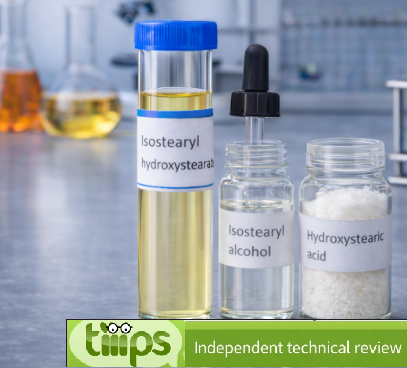
Isostearyl Hydroxystearate is a lipid ester obtained by esterification of isostearyl alcohol (a branched C18 fatty alcohol) with 12-hydroxystearic acid (a hydroxylated C18 fatty acid). From a compositional standpoint, the ingredient consists primarily of the single molecule Isostearyl Hydroxystearate, with possible controlled trace levels (grade-dependent) of related components such as residual free acid/alcohol or closely related esters within specification. In formulation it behaves as a high-slip emollient, useful to improve spreadability, comfort, and payoff on skin and lips, and it can also contribute as a viscosity modifier and anti-tack component in anhydrous systems and color cosmetics.
Food: not a typical food ingredient; mainly a technical/cosmetic material.
Cosmetics: emollient, supports texture and oil-phase stability; widely used in make-up and lip products.
Medicine: possible technical use in lipophilic topical bases (grade-dependent).
Pharmaceutical: potential lipophilic excipient for topical dosage forms, subject to grade and applicable dossier.
Industrial use: lipophilic ester for technical applications where lubricity and “feel” are required (sector-dependent).
Calories (energy value)
| Metric | Value |
|---|---|
| Energy value (100 g) | ~900 kcal (typical order of magnitude for lipid esters) |
| Technical note | Used at functional levels: energy impact on the finished product is negligible |
Identification data and specifications
| Identifier | Value |
|---|---|
| INCI name | Isostearyl Hydroxystearate |
| Chemical name (IUPAC, reference) | Octadecanoic acid, 12-hydroxy-, 16-methyl-heptadecyl ester |
| Molecular formula | C₃₆H₇₂O₃ |
| Molar mass | 552.96 g/mol |
| CAS number | 162888-05-3 |
| EC number | Not consistently listed as a single public entry (refer to supplier SDS/CoA) |
| CosIng reference | 57680 |
Key constituents
| Fraction | Components | Technical note |
|---|---|---|
| Main ester | Isostearyl Hydroxystearate | driver of emollient performance and rheology |
| Controlled traces (grade-dependent) | residual acid/alcohol, related esters | may influence odor, drag, and stability; managed via QC |
Physicochemical properties (practically relevant)
| Property | Typical indication | Formulation impact |
|---|---|---|
| Physical state | typically a viscous liquid or semi-liquid (grade-dependent) | suitable for anhydrous systems and the oil phase of emulsions |
| Polarity | moderate (hydroxyl group present) | useful for pigment wetting and sensorial tuning |
| Solubility | miscible with many oils/esters; not water-miscible | incorporation in the oil phase |
| Stability | generally stable under standard cosmetic conditions | monitor odor/oxidation in very sensitive formulas |
Functional role in formulation
| Function | What it does in the formula | Operational notes |
|---|---|---|
| Emollient | softens and improves skin feel | supports slip and comfort without excessive greasiness (system-dependent) |
| Viscosity modifier | can increase body/structure in anhydrous systems | useful in sticks, balms, creamy make-up |
| Anti-tack / anti-greasy feel | reduces perceived stickiness in oil-rich systems | particularly valuable in lip and cream make-up |
| Pigment dispersion support | improves wetting and color payoff | important in foundations, lipsticks, glosses, and pigmented anhydrous products |
Formulation compatibility
| System | Compatibility | Recommended checks |
|---|---|---|
| Anhydrous systems (oils/esters/waxes) | generally excellent | verify crystallization and hot/cold stability |
| O/W emulsions | good (in oil phase) | monitor droplet size and thermal-cycle stability |
| W/O emulsions | good | beneficial for sensorial/barrier feel; validate emulsifier compatibility |
| Silicone / hybrid systems | often compatible | evaluate feel and synergies with elastomers/powders |
| Powders/pigments | very useful | optimize ratio vs dispersants and pigment treatments |
Use guidelines (indicative)
| Application | Typical range | Technical note |
|---|---|---|
| Creams/lotions (oil phase) | 0.5–5.0% | improves emolliency and slip |
| Cream make-up / foundation | 1.0–10.0% | supports payoff and reduces drag |
| Lipsticks / lip balm / sticks | 2.0–15.0% | contributes to structure, anti-tack, and comfort |
| Gloss / lip oils | 1.0–10.0% | improves feel and can reduce stickiness (balance required) |
| Hair styling / pomades | 0.5–5.0% | supports shine and sensorial control |
Typical applications
Lip products (lipsticks, balms, gloss): improved comfort, reduced tack, structural support.
Cream make-up and foundations: slip, pigment wetting, application uniformity.
Body/hand creams: emolliency with a silkier after-feel.
Pomades and hair products: shine support and sensorial “hold” (in synergy with waxes/polymers).
Quality, grades and specifications
| QC parameter | What to control |
|---|---|
| Identity | CAS match and supplier analytical fingerprint |
| Purity/assay | assay and impurity profile (residual acid/alcohol) |
| Chemical indices | acid value, saponification value, OH content (if part of the spec) |
| Oxidative stability | oxidation markers and odor/color stability (as required) |
| Documentation | lot CoA and SDS |
Safety, regulation and environment
| Topic | Operational guidance |
|---|---|
| Safety profile | generally suitable for cosmetic use at typical levels; formulate to be non-irritating in the finished product |
| EU cosmetics | usable under general requirements and GMP; safety assessment on the finished product |
| Sensitization/irritation | typically low; handle as a lipophilic material (avoid concentrated eye contact) |
| Environment | avoid uncontrolled release; manage oily residues per local rules and good practice |
Formulation troubleshooting
| Issue | Likely cause | Corrective actions |
|---|---|---|
| Graininess/crystallization in sticks/balms | wax/ester balance not optimized | rebalance structuring waxes, add compatible esters, optimize cooling profile |
| Sweating in sticks | liquid phase migration | increase structure (waxes/oil gellants), reduce overly mobile fraction, run heat-stress tests |
| Residual tackiness | excess polar oils or film-formers | increase Isostearyl Hydroxystearate share or pair with “dry feel” esters; retune powders |
| Emulsion instability | unbalanced oil phase or suboptimal process | optimize emulsifier system and oil-phase viscosity profile |
Alternatives
| Option (INCI) | Product type | Key advantages |
|---|---|---|
| Hydrogenated Castor Oil | Plant wax/structurant | Builds viscosity and structure, suitable for sticks and balms, improves oil-phase stability |
| Ricinus Communis (Castor) Seed Oil | Viscous plant oil | Good adhesion and slip, enhances payoff and shine, useful in lip products |
| Euphorbia Cerifera (Candelilla) Cera | Plant wax | Increases hardness and wear, helps reduce “sweating,” supports stick stability |
| Copernicia Cerifera (Carnauba) Wax | High-melting plant wax | Improves heat resistance, increases hardness and wear, supports mechanical stability |
| Butyrospermum Parkii (Shea) Butter | Plant butter | Adds emolliency and body, improves comfort and barrier feel, useful for rich balms/creams |
Conclusion
Isostearyl Hydroxystearate is a high-performance INCI emollient, particularly effective at improving slip, comfort, and tack reduction in color cosmetics and lip products, often also contributing positively to structure in anhydrous systems. Best results come from correct oil-phase design, sensorial and thermal stability control, and consistent QC specifications (acid value, impurities, odor stability).
Mini-glossary
| Term | Meaning | Note |
|---|---|---|
| Emollient | ingredient that softens and improves skin feel | typically lipophilic or amphiphilic |
| Acid value | acidity index (residual free acids) | useful for quality and stability control |
| Saponification value | index related to ester saponification | correlates with composition and purity |
| Tack | sticky feel | managed through balancing oils/esters/powders |

